
How to Match Jewellery with Your Outfit: A Complete UK Styling Guide
Most of us own jewellery that never quite earns its place. A necklace bought on holiday. Earrings that looked perfect in the shop and strange with everything since. The problem is rarely the jewellery itself. It is usually that nobody has explained how to read an outfit and choose pieces that actually work with it.
This guide is about matching jewellery to what you are wearing: the neckline, the colour, the fabric and the occasion. If you are trying to work out whether gold or silver suits your complexion, that is a slightly different question, and we cover it in full in our guide to choosing jewellery for your skin tone. This article picks up where that one leaves off.
The Quick Answer: Three Rules for Matching Jewellery to Any Outfit
To match jewellery with your outfit, check three things in order: your neckline (to choose necklace length and shape), your outfit’s colour and fabric (to choose metal tone and how bold to go), and the occasion (to set the overall scale). Pick one focal point, whether that is a statement necklace or bold earrings, and keep everything else simple so the look stays cohesive rather than cluttered.
Why Matching Jewellery Isn’t About Perfect Colour Matching
Coordinating Versus Matching
There is a useful distinction between matching jewellery and coordinating it. Matching means picking pieces that mirror your outfit exactly, gold buttons with a gold necklace, for instance. Coordinating means picking pieces that work with the overall mood, colour temperature and formality of what you are wearing, without needing to copy it precisely. Coordinating almost always looks more considered, and it is the approach this guide takes throughout.
The Three Things That Actually Decide Your Jewellery Choice
Every outfit gives you three pieces of information: the shape of the neckline, the colour and texture of the fabric, and the setting you are dressing for. Once you learn to read these three signals, choosing jewellery stops being guesswork.
Step One: Match Your Jewellery to Your Neckline
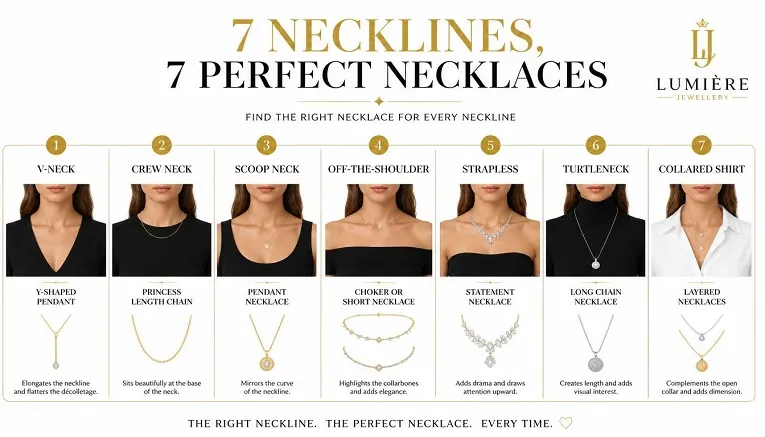
Your neckline decides which necklace shapes will sit well and which will fight against the fabric. Get this right first, because it is the single biggest factor in whether a necklace looks intentional or accidental.
Necklace Shapes for Every Neckline
Neckline to Necklace Quick Reference
| Neckline | Best necklace style | What to avoid |
|---|---|---|
| V-neck | A pendant that follows the line of the V | Chokers, which compete with the neckline |
| Crew or round neck | A short statement piece or circle pendant | Long layered chains that disappear into the fabric |
| Off the shoulder | A choker or short necklace | Long pendants, which pull focus from the collarbone |
| Scoop neck | A layered short necklace | Bulky bib necklaces, which overwhelm the shape |
| Polo neck or turtleneck | A long single chain, or a brooch instead | Anything short that sits on the fabric roll |
| Strapless | A statement necklace or bold choker | Delicate chains that get lost against bare skin |
| Shirt or collared top | A delicate chain tucked under the collar, or none at all | Wide statement pieces that clash with the collar shape |
For more detail on chain lengths themselves, our necklace length guide breaks down exactly where each style sits on the body.
What to Do When You Are Not Wearing a Necklace at All
High necklines, polo necks and busy prints often work better without a necklace altogether. In this case, let earrings and a bracelet or ring carry the look instead. This is a scenario most guides skip, yet it covers a large share of everyday outfits, particularly in colder months when layers cover the neckline entirely.
Step Two: Match Your Jewellery to Your Outfit’s Colour and Fabric
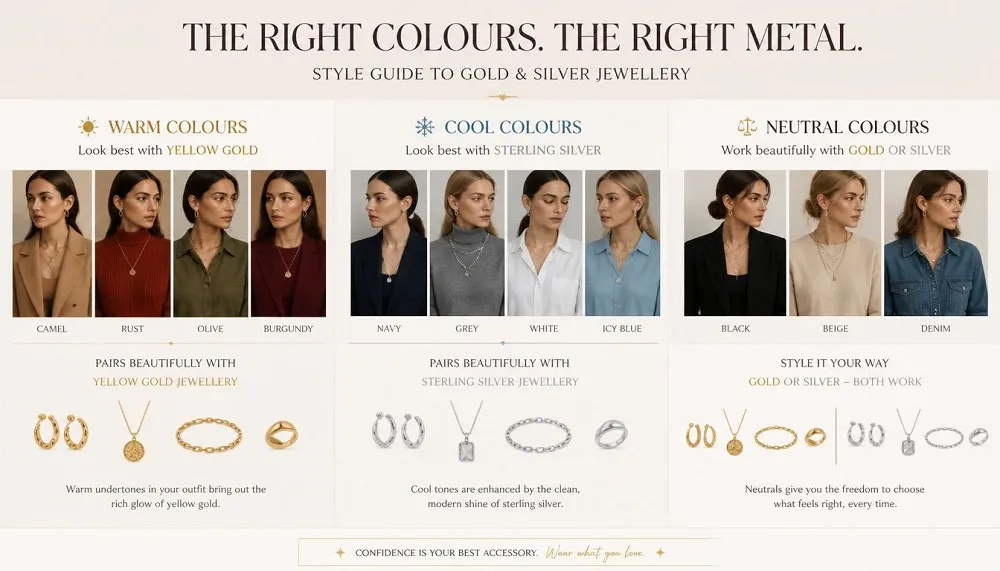
Warm Tones, Cool Tones and Neutral Outfits
This is about the colour of your clothing, not your complexion. Warm outfit colours such as camel, rust, olive and burgundy tend to sit beautifully against gold and warm gemstones. Cool outfit colours such as navy, grey, icy blue and true white pair naturally with silver and cooler stones. Neutral outfits, black, white, beige and denim, work with either metal, which makes them the easiest base to build from.
A Simple Colour Method for Choosing Metal and Gemstone
If your outfit has an accent colour, such as a green handbag or a burgundy scarf, you can echo it subtly through a gemstone rather than matching it exactly. This small repetition ties a look together without feeling forced. For a monochrome outfit, jewellery becomes the main source of colour, so this is where you can afford to be bolder.
Matching Fabric Texture and Formality to Jewellery Weight
Soft, flowing fabrics such as silk and chiffon pair well with delicate chains and refined pieces. Structured fabrics such as tweed, denim and tailored wool can carry heavier, more architectural jewellery without looking out of place. As a general rule, busy prints call for simpler jewellery, while plain, solid outfits give you room to experiment with something bolder.
Should jewellery match or contrast with your outfit? Neither approach is wrong. Matching creates a calm, cohesive look, while contrast creates a focal point. The safest starting point for most outfits is gentle coordination: pick one dominant colour or metal tone to echo, and let everything else sit quietly around it.
Step Three: Match Your Jewellery to the Occasion
British dress codes are specific enough that jewellery choices genuinely change from one setting to the next.
UK Occasion Jewellery Guide
| Occasion | Jewellery approach |
|---|---|
| Office or smart casual | Stud earrings, a slim bracelet or watch, a delicate pendant |
| Wedding guest | A coordinated set with one mid scale statement piece, kept below the bride’s own jewellery in impact |
| Black tie or formal evening | An elegant, matched set built around a single strong focal point |
| Casual weekend | Layered necklaces, stacked bracelets, hoop earrings |
| Date night | One confident piece rather than several competing ones |
What to Wear as a Wedding Guest Without Overdoing It
Wedding guest jewellery should feel polished but never louder than the occasion itself. A coordinated necklace and earring set in one metal tone, kept to a moderate scale, is almost always the safest and most flattering choice. Save the boldest, most dramatic pieces for occasions where you are the only focal point in the room.
Office Appropriate Jewellery That Still Feels Like You
Workplace jewellery works best when it is easy to wear all day: light enough for typing, quiet enough not to catch on phone calls, and simple enough to move from a desk to an evening plan without changing. Stud or small hoop earrings, a slim bracelet or watch, and a modest pendant cover most office dress codes comfortably.
Step Four: Matching Earrings to Your Outfit and Face Shape
Earrings deserve their own set of rules, since they sit closest to your face and interact with your hairstyle as much as your outfit.
Earring Shapes for Face Shape
As a general starting point, rounder faces are often flattered by longer, drop shaped earrings, which add length. Oval faces tend to suit nearly every earring style. Squarer faces are frequently softened by curved or rounded shapes rather than sharp geometric ones. These are starting points rather than rules, and personal preference should always take priority.
Earring Scale for Neckline and Hairstyle
Hairstyle matters here as much as neckline. Hair worn up exposes the ears fully, so this is the moment to wear a statement pair. Hair worn down naturally frames and partially hides smaller studs, so a slightly larger earring will still read clearly through the hair. Pairing statement earrings with an off the shoulder or strapless neckline creates a natural line from ear to collarbone that feels deliberate rather than accidental.
If sensitive ears have limited your earring choices in the past, our guide to the best earrings for sensitive ears covers materials worth trying.
The One Statement Rule, and When to Break It
Choose one focal point and let the rest of your jewellery support it quietly. If you are wearing bold earrings, keep the necklace simple or leave it out entirely. If you are wearing a statement necklace, choose small studs instead of another large piece. This single principle solves more outfit related jewellery mistakes than any other.
How Much Jewellery Is Too Much?
There is no fixed number, but a useful check is to count your focal points rather than your pieces. Wearing a necklace, earrings, a bracelet and several rings can look completely balanced if only one of those areas is doing the heavy lifting and the rest stay simple. It becomes too much when two or more areas are competing for attention at the same volume.
The main exception to the one statement rule is intentional layering, where several delicate pieces are worn together as a single cumulative look rather than as separate statements. Layered necklaces of varying lengths or a stack of thin rings both work because each individual piece is quiet, even though the combined effect is not.
Mixing Metals with Confidence
Mixing gold and silver in one outfit is no longer considered a styling mistake, provided it looks intentional rather than accidental. Our skin tone guide covers the full layering ratio for building a mixed metal look from scratch, so if you want the complete method, that is the place to start. As a simple outfit focused rule, repeat each metal at least twice across your look, for example silver earrings and a silver ring alongside a gold necklace and a gold bracelet, rather than using each metal only once.
When to Keep Metals Matching Instead
Formal events, bridal jewellery and very traditional dress codes still tend to favour a single matched metal. When in doubt for a big occasion, one consistent tone is the safer choice.
Jewellery for Different Garment Types
Most guides stop at dresses. Real wardrobes contain far more than that.
Jewellery with Blazers and Tailoring
Structured jackets can carry stronger jewellery. A statement brooch on a lapel, a cuff bracelet visible below the sleeve, or bold earrings all work well against tailoring, since the fabric itself already reads as polished and considered.
Jewellery with Jumpers and Knitwear
Knitwear tends to catch on delicate chains, so simpler earrings and a single ring or bracelet usually work better than a necklace. A pendant on a slightly longer chain, worn over a crew neck jumper, is one exception that reliably works.
Jewellery with Jumpsuits and Playsuits
Jumpsuits often have a single strong neckline and no waist definition to draw the eye elsewhere, which makes them a good canvas for a statement necklace or a stack of bracelets, depending on which area you want to highlight.
Jewellery with Coats in Layering Season
Once outerwear covers most of your outfit, earrings become the main jewellery decision of the day. This is worth remembering in the colder months, when a bold pair of earrings can do more visible work than any necklace hidden under a coat.
Fashion Jewellery Versus Fine Jewellery for Outfit Styling
| Fashion jewellery | Fine jewellery | |
|---|---|---|
| Best suited to | Trend pieces, bold colour, frequent changes | Everyday staples, long term investment pieces |
| Outfit pairing | Occasion specific, statement led | Versatile enough to suit most outfits |
| Practical considerations | Lower cost, easier to replace as trends shift | Needs proper care and storage over time |
Fashion jewellery is particularly well suited to outfit matching precisely because it is affordable enough to buy in the exact colour or metal tone a specific outfit calls for, rather than trying to make one expensive piece work everywhere. For care and storage advice on the finer pieces in your collection, see our guide to protecting your jewellery.
Building a Capsule Jewellery Wardrobe for Effortless Outfit Matching
The Core Pieces That Go With Almost Everything
A small, well chosen collection will outperform a large, mismatched one. A pair of simple studs, a medium pendant necklace, one statement necklace, hoop earrings, a couple of stackable rings and a slim bracelet or watch will cover the vast majority of outfits and occasions between them.
How to Edit Your Jewellery Box by Outfit, Not Just Occasion
Rather than sorting jewellery by when you might wear it, try sorting it by what it pairs with well. A piece that only works with one specific outfit is doing far less work in your collection than one that pairs easily with several. For gifting ideas built around genuinely versatile pieces, our jewellery gifts guide is worth a look.
Common Jewellery and Outfit Mistakes to Avoid
- Choosing the necklace before considering the neckline, rather than the other way round.
- Wearing two statement pieces at once, so neither gets to be the focal point.
- Ignoring fabric texture, pairing delicate chains with heavy knitwear where they simply disappear.
- Matching colours too literally, which can look dated rather than considered.
- Mixing metals without repetition, so the look feels accidental instead of deliberate.
- Forgetting proportion, choosing jewellery scaled for a different body or a different sized outfit detail.
Frequently Asked Questions
How do I match my jewellery to my outfit?
Start with your neckline to choose necklace shape, then consider your outfit’s colour and fabric to choose metal tone, then let the occasion set the overall scale. Pick one focal point and keep the rest of your jewellery simple.
Should jewellery match or contrast with an outfit?
Both work. Matching creates a calm, cohesive look, while contrast creates a clear focal point. For most everyday outfits, gentle coordination around one dominant colour or metal tone is the easiest approach to get right.
Is it okay to mix gold and silver jewellery?
Yes. Mixing metals looks intentional when each metal appears at least twice in your look, for example matching earrings and a ring in one tone alongside a necklace and bracelet in the other.
How much jewellery is too much?
Jewellery becomes too much when two or more pieces compete for attention at the same volume. A necklace, earrings, bracelet and rings can all be worn together comfortably as long as only one area is the true focal point.
What jewellery goes with a black dress?
A black dress is one of the easiest bases to style, since it works with any metal tone. Use the dress as your canvas and choose jewellery based on the neckline and the formality of the occasion rather than the colour itself.
What jewellery should I wear to a wedding as a guest?
A coordinated necklace and earring set in one metal tone, kept to a moderate rather than dramatic scale, is the safest choice for a wedding guest, since it should complement the day without competing with the bride.
How do I match earrings with my outfit?
Match earring scale to your neckline and hairstyle first, choosing bolder pieces for exposed necklines or hair worn up, then let your face shape guide the final choice between drop, stud or hoop styles.
Final Thoughts
Matching jewellery to an outfit becomes far simpler once you stop treating every piece as a separate decision and start reading the outfit itself: the neckline, the colour and fabric, and the occasion. From there, choosing one focal point and letting everything else sit quietly around it will carry you through almost any outfit with confidence.
Ready to build out your collection? Browse our necklaces, earrings and bracelets to find pieces that work across more than one outfit.
This guide was written by the Chic Fashion Jewellery editorial team, who research and test styling advice across metals, gemstones and everyday wardrobes to put together practical, wearable guidance for readers across the UK. Our editorial approach favours tested, specific advice over generic trends, and every guide is reviewed for accuracy before publishing.