
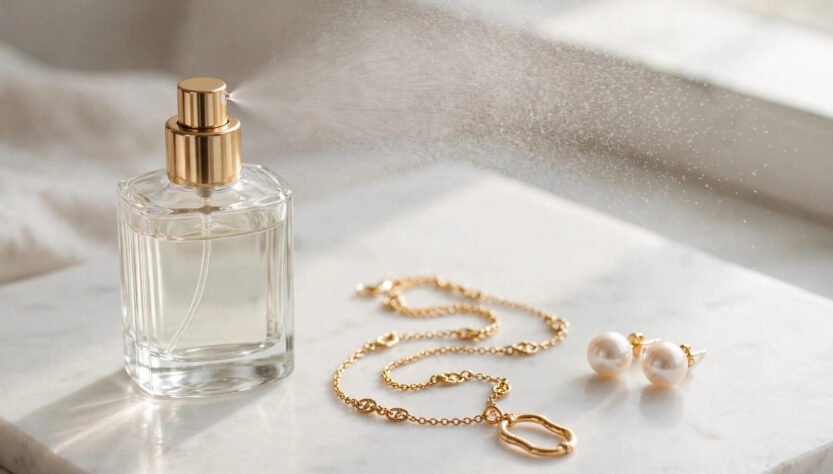
The Short Answer: Yes, Perfume Damages Most Jewellery
Yes, perfume damages most jewellery. Perfume is mostly alcohol and water mixed with fragrance oils and fixatives. Those chemicals attack plating, speed up tarnish on silver, and dull the surface of pearls and soft stones. Solid gold and platinum resist damage far better, but perfume still leaves a film on them. The fix is simple. Spray your perfume first, let it dry, and only then put your jewellery on.
Most people get this order wrong. They put their jewellery on first, then spray perfume over it. That single habit does more daily damage to fashion jewellery than almost anything else. This guide explains what perfume does to each material, the safe routine that takes 30 seconds, and what to do if perfume has already landed on a piece you love.
What Perfume Contains: Alcohol, Oils and Fixatives That Attack Metal and Stones
Perfume is a mixture, not a single ingredient. The three parts that matter for jewellery are alcohol, fragrance oils, and fixatives.
Alcohol is the largest part of most sprays. It evaporates fast, which is why perfume dries on skin. On jewellery, alcohol acts as a solvent. It dissolves the thin layers that protect plated pieces, and it strips the natural surface of porous stones.
Fragrance oils give perfume its scent. Oils cling to metal and stones. They leave a film that dulls shine, traps dust, and works its way into settings where it builds up over time.
Fixatives slow evaporation so the scent lasts longer. They are sticky by design. On jewellery, that stickiness holds residue against the surface for hours, which gives the alcohol and oils more time to react.
Put together, one spray delivers a solvent, a film, and a glue. That is why perfume is harder on jewellery than water alone.
Perfume and Plated Jewellery: Why Plating Fails First
Plated jewellery has a thin layer of metal over a cheaper base metal. That layer can be a fraction of a micron thick on fashion pieces. It is the most vulnerable part of the piece, and perfume attacks it directly.
Alcohol softens and wears the plating. Repeated sprays thin it until the base metal shows through. That is when a gold plated necklace starts to look patchy, or a silver plated ring develops dark spots that will not polish away.
Perfume also creeps into edges and joins. Clasps, chain links, and the back of a pendant hold residue longest. Those are the places where plating usually fails first.
If most of your collection is plated fashion jewellery, perfume is the single biggest threat to how long it looks new. Our guide to gold plated jewellery explains how plating works and why it needs gentler care than solid metal. The fashion jewellery category has more detail on what these pieces are made of.
Perfume and Pearls, Opals and Soft Stones: The Highest Risk Group
Pearls, opals, turquoise, and other soft or porous stones are the highest risk group. Perfume can cause damage that cleaning cannot undo.
A pearl gets its shine from nacre, a coating of calcium carbonate layers. Alcohol and chemicals in perfume dissolve and dull nacre. A pearl that has been sprayed often turns flat and chalky. That change is permanent.
Opal and turquoise are porous. They absorb liquids. Perfume can soak in and change the colour of the stone from the inside. Once that happens, no cloth or cleaner can pull it back out.
If you own pearls, treat perfume as a hard rule, not a suggestion. Never spray perfume while wearing pearls. Wait until the perfume has fully dried, then put the pearls on. For cleaning, follow our guide on how to clean pearl jewellery at home, which uses only gentle methods that are safe for nacre.
Perfume and Gold, Silver and Platinum: Lower Risk, Still Not Safe
Solid gold is the most resistant common jewellery metal. Perfume will not dissolve solid gold. It will still leave a film that dulls the shine, and it can settle into engraving and settings. A quick wipe after wear keeps solid gold looking bright.
Sterling silver is more sensitive. Perfume speeds up tarnish, the darkening that silver develops when it reacts with air and chemicals. A silver piece that is sprayed often will need polishing more often, and heavy polishing slowly wears the surface.
Platinum is the toughest of the three. It resists perfume well. Even so, perfume residue can sit on a platinum setting and dull the stones it holds, especially small diamonds and pave work.
The honest rule is this. Perfume will not ruin solid gold or platinum in a day. It will shorten the life of plating, speed up silver tarnish, and can permanently damage pearls and soft stones. For daily care of solid pieces, see our guide on how to clean gold jewellery at home.
The Safe Routine: Spray First, Wait, Then Put Jewellery On
Follow these steps every morning. The whole routine takes about 30 seconds.
- Finish your shower, skincare, and hair styling first.
- Spray your perfume on your skin, not on your clothes or jewellery.
- Wait until the perfume has fully dried. Two to three minutes is enough.
- Apply lotion and sunscreen, and let those dry too.
- Put your jewellery on last.
- At the end of the day, take your jewellery off first, before you wash your face or change clothes.
Jewellery goes on last and comes off first. That one rule prevents most perfume damage.
What to Do If Perfume Gets on Jewellery: Immediate Steps
If perfume lands on a piece, act quickly. Fresh residue is easy to remove. Dried residue is harder.
- Blot, do not rub. Press a soft, dry cloth against the piece to lift the liquid.
- Wipe gently with a clean, soft cloth. Use a fresh part of the cloth for each pass.
- For solid gold, silver, and platinum, a cloth barely dampened with plain warm water can help. Dry the piece fully afterwards.
- For pearls, opals, turquoise, and plated pieces, use a dry cloth only. Do not use water, soap, or any cleaner unless you are sure it is safe for that material.
- Leave the piece out to air dry for a few minutes before you put it back in its box.
If a plated piece has already gone patchy, or a pearl has gone chalky, home cleaning will not reverse it. Take valuable pieces to a professional jeweller and ask whether re-plating or restringing is possible.
Perfume, Hairspray, Lotion and Sunscreen: The Full Chemical Order
Perfume is not the only product that reaches your jewellery. Hairspray, lotion, sunscreen, and makeup all carry chemicals that harm it. The order you apply them matters.
Apply products in this order: shower, hair products, perfume, lotion and sunscreen, makeup, then jewellery. Hairspray goes early because its mist travels. It coats jewellery with polymers that are hard to remove. Perfume goes next, on skin only. Lotion and sunscreen go after, because their oils transfer to anything they touch.
Sunscreen deserves its own warning. It contains oils and chemical filters that dull metal and cloud stones. Never put a ring on over freshly applied sunscreen. Wait for it to absorb, then put jewellery on.
Makeup is the last product before jewellery. Powders and foundations settle into settings and clasps. If you wear rings daily, check the underside of the setting each week and wipe it clean.
Everyday Wear Rules Beyond Perfume: Shower, Sleep, Pool and Beach
Perfume is the most common daily risk, but four other routines cause similar damage.
Shower. Soap, shampoo, and hot water leave residue on jewellery. Hot water also loosens the glue that holds stones in fashion pieces. Take jewellery off before you shower.
Sleep. Chains tangle, earring posts bend, and rings catch on bedding. Take jewellery off at night and store each piece separately.
Pool. Chlorine attacks plating and can weaken prongs over time. Cold water also shrinks your fingers, which makes rings slip off. Leave jewellery in your bag or locker before you swim.
Beach. Salt water speeds up tarnish, and sand scratches metal and stones. Sunscreen adds oils on top. Take jewellery off before you go to the beach.
Can You Wear Jewellery to the Gym: Sweat, Weights and Safety
Gym wear is a separate topic with its own rules, and it will get a full guide of its own. Here is the short version.
Sweat is salty and slightly acidic. It speeds up tarnish and wears plating, the same way perfume does. Rings face a bigger problem. A ring can catch on a barbell or a machine. That kind of catch can injure a finger badly. For that reason alone, rings should come off before any weights session.
Necklaces and bracelets can snag on equipment too. Earrings are lower risk, but sweat still dulls them. The safest choice is to take all jewellery off before you train and put it back on afterwards. A small pouch in your gym bag keeps pieces separate and safe.
A Material-by-Material Wear Guide: What Survives What
Use this table as a quick check before you get dressed.
| Material | Perfume risk | Shower and pool | Safe routine |
|---|---|---|---|
| Gold plated | High. Plating thins and flakes. | No. Water and chlorine speed up plating loss. | Spray first, wait, wear last. Wipe after wear. |
| Silver plated | High. Tarnish and plating loss. | No. Tarnish speeds up in water. | Spray first, wait, wear last. Store dry. |
| Sterling silver | Medium. Tarnish speeds up. | Avoid. Chlorine and soap dull the surface. | Spray first, wait, wear last. Polish when needed. |
| Solid gold | Low. Film and dullness only. | Occasional is fine, daily is not ideal. | Spray first, wait, wear last. Wipe after wear. |
| Platinum | Low. Residue dulls stones, not the metal. | Fine, but wipe afterwards. | Spray first, wait, wear last. Clean settings weekly. |
| Pearls | Highest. Nacre damage is permanent. | No. Water and chemicals harm nacre. | Perfume fully dry first. Dry cloth only. |
| Opal and turquoise | Highest. Porous stones absorb perfume. | No. Water and chemicals soak in. | Perfume fully dry first. Dry cloth only. |
| Diamonds | Low. Film dulls sparkle. | Fine, but check settings. | Spray first, wait, wear last. Clean regularly. |
| Stainless steel | Low. Resistant to most chemicals. | Fine for most wear. | Spray first, wait, wear last. Wipe after wear. |
| Resin, glass and beads | Medium. Alcohol can cloud resin. | Avoid. Water loosens glue. | Spray first, wait, wear last. Dry cloth only. |
Frequently Asked Questions About Perfume and Jewellery
Does perfume damage jewellery?
Yes, for most pieces. Perfume attacks plating, speeds up silver tarnish, and can permanently dull pearls and soft stones. Solid gold and platinum resist damage well but still collect a film. Spray perfume first, let it dry, then put jewellery on.
Does perfume damage gold jewellery?
Solid gold is resistant. Perfume leaves a film that dulls the shine, but it does not dissolve the metal. Gold plated jewellery is different. Perfume wears the thin plating until the base metal shows through.
Does perfume damage pearls?
Yes. Perfume damages the nacre that gives pearls their shine. That damage is permanent. Never spray perfume while wearing pearls, and clean pearls with a dry soft cloth only.
Can I spray perfume on my clothes instead?
Spraying on clothes is safer for jewellery, but it is not risk-free. Perfume mist still drifts, and it can stain fabric. The safest habit is to spray on skin, wait for it to dry, then put jewellery on.
What if I already sprayed perfume on my jewellery for years?
Check each piece in good light. If plating looks patchy or a pearl looks chalky, that damage is usually permanent. If the piece only looks dull, gentle cleaning may restore it. Take valuable pieces to a professional jeweller for an honest assessment.
Should I take jewellery off before applying sunscreen?
Yes. Sunscreen oils dull metal and cloud stones. Apply sunscreen, let it absorb, then put jewellery on. This matters most for rings, which sit where sunscreen is applied.
Is body mist safer than perfume for jewellery?
Body mist has less fragrance oil, but it still contains alcohol and water. It is gentler than strong perfume, not harmless. Use the same spray first, wait, then wear routine.
Conclusion
Perfume and jewellery can share a routine, but only in the right order. Spray first, let it dry, then put jewellery on last. That one habit protects plating, slows tarnish, and keeps pearls safe. If perfume does land on a piece, blot it, wipe it with a soft cloth, and leave it to air dry. For more care guides, see the Jewellery Protection category.