
UK Ring Size Guide: How to Measure Your Ring Size at Home (mm, cm & Letters)
Quick Answer
UK ring sizes run from A to Z, then continue as Z+1, Z+2 and so on for larger fingers. Each letter matches a specific inside circumference in millimetres. The most common UK sizes are L to N for women and R to T for men. To find yours, wrap a strip of paper or string around the base of your finger, measure the length in mm, then match it to the ring size chart below.
If you only need one number: the average UK women’s ring size is L to M, and the average UK men’s ring size is S to T.
How UK Ring Sizes Work
Most countries measure ring size differently, and that trips people up constantly. The UK, Ireland, Australia and South Africa all use a letter-based system, running from A (smallest) through to Z and beyond for larger sizes. Each letter is tied to a fixed inside circumference, measured in millimetres, so a size N in London is the same physical size as a size N in Sydney.
Half sizes exist too, written as L½ or N½, which sit between two full letters. Jewellers add these because a jump of one full letter can be the difference between a ring that spins loosely and one that catches on your knuckle.
The system has British roots. It was formalised in BS 1283:1945 and later updated to align with the international ISO 8653 standard, which is why UK letter sizes now convert cleanly to European and Japanese sizing. Knowing this helps explain why brands from Pandora to Cartier can all use the same UK conversion chart, even though they design and manufacture very differently.
UK Ring Size Chart (mm and cm)
Use this chart once you have your finger’s inside circumference. Measure in millimetres for precision, or convert to centimetres if that’s easier to picture (1 cm = 10 mm).
| UK Size | Circumference (mm) | Circumference (cm) | Diameter (mm) | US Size |
|---|---|---|---|---|
| H | 47.8 | 4.78 | 15.2 | 4 |
| I | 48.6 | 4.86 | 15.5 | 4½ |
| J | 49.5 | 4.95 | 15.8 | 5 |
| K | 50.3 | 5.03 | 16.0 | 5½ |
| L | 51.2 | 5.12 | 16.3 | 6 |
| M | 52.0 | 5.20 | 16.6 | 6½ |
| N | 52.8 | 5.28 | 16.8 | 7 |
| O | 53.6 | 5.36 | 17.1 | 7½ |
| P | 54.4 | 5.44 | 17.3 | 8 |
| Q | 55.3 | 5.53 | 17.6 | 8¼ |
| R | 56.1 | 5.61 | 17.9 | 8¾ |
| S | 56.9 | 5.69 | 18.1 | 9 |
| T | 57.8 | 5.78 | 18.4 | 9½ |
| U | 58.6 | 5.86 | 18.7 | 10 |
| V | 59.4 | 5.94 | 18.9 | 10½ |
| W | 60.2 | 6.02 | 19.2 | 11 |
| X | 61.0 | 6.10 | 19.4 | 11½ |
| Y | 61.9 | 6.19 | 19.7 | 12 |
| Z | 62.7 | 6.27 | 20.0 | 12½ |
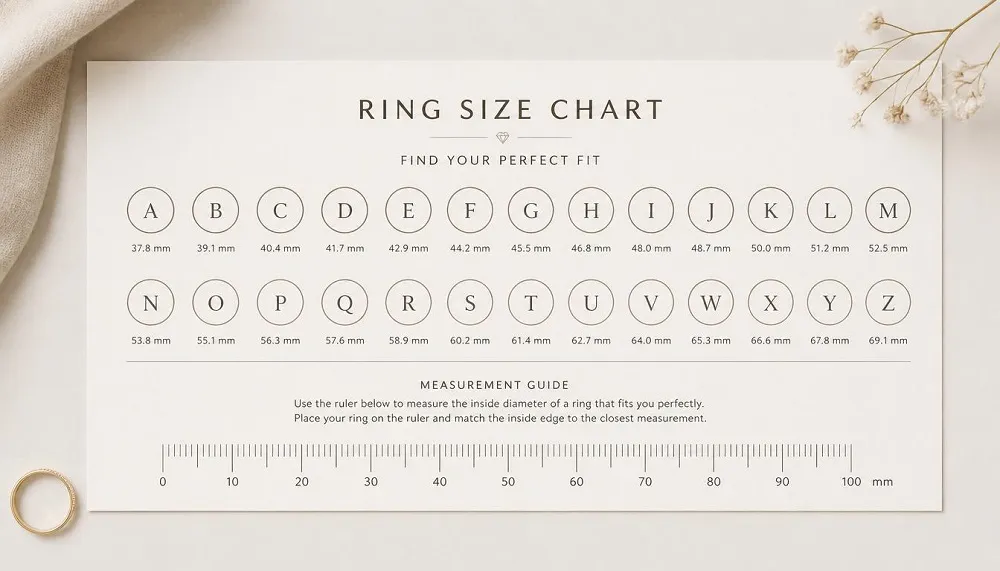
These figures follow the standard ISO conversion used by UK jewellers, though small rounding differences of a fraction of a millimetre exist between brands. If your measurement lands between two rows, size up rather than down. A ring that’s slightly loose is more comfortable day to day than one that pinches.
How to Measure Your Ring Size at Home
You don’t need a professional ring sizer to get a workable measurement. Two simple methods work well, and both take less than five minutes.
Method 1: The String or Paper Strip Test
This is the most reliable DIY option and the basis of most printable ring sizers.
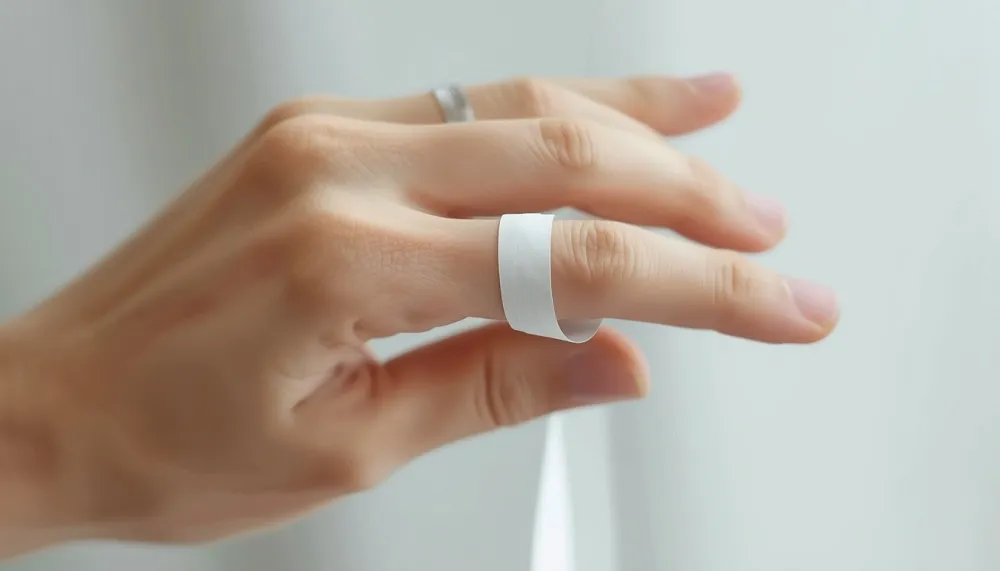
- Cut a thin strip of paper or a piece of non-stretchy string, about 10 cm long and no wider than 5 mm.
- Wrap it snugly around the base of the finger you’ll wear the ring on. It should sit comfortably, not tight enough to pinch.
- Mark the point where the strip meets itself with a pen.
- Lay the strip flat and measure the marked length with a ruler, in millimetres.
- Match that number to the circumference column in the chart above.
If you’re between two sizes, or your knuckle is noticeably bigger than the base of your finger, choose the larger size. It’s far easier to have a ring resized down than to force one over a knuckle it wasn’t built for.
Method 2: Measure an Existing Ring
If you already own a ring that fits the right finger well, this is quicker and often more accurate than the string method.
- Take the ring and lay it flat on a ruler.
- Measure the inside diameter, from one inner edge straight across to the other.
- Match that figure to the diameter column in the chart above.
A word of caution: measure the inside of the band, not the outside. It’s an easy mistake, and it will push your result up by a size or two.
Tips for an Accurate Result
- Measure in the evening. Fingers are naturally slightly larger later in the day, once you’ve been up and about.
- Avoid measuring when cold. Cold fingers shrink, which can throw your result off by half a size.
- Measure two or three times and take the most common reading rather than trusting a single attempt.
- Account for band width. Wide bands, above about 6 mm, fit more snugly than thin bands, so size up half a size if you’re choosing a chunky ring.
- Your dominant hand is usually slightly larger. Measure the actual hand and finger you plan to wear the ring on.
UK Ring Sizes in cm: Quick Reference
Some people find millimetres fiddly to visualise, so here’s the same data in centimetres for a faster mental check. A typical UK size L sits at 5.12 cm circumference, roughly the width of a AA battery wrapped end to end. Size N, the most common women’s size, comes in at 5.28 cm. Size T, the most common men’s size, measures 5.78 cm. If your household tape measure only shows cm, round to one decimal place and use the cm column in the main chart rather than converting back to mm, since that avoids introducing rounding errors.
Ring Sizes: Numbers to Letters (UK Conversion)
If you’ve bought jewellery abroad, or you’re shopping a US or European site, you’ll run into numbers instead of letters. Here’s how the systems line up for the sizes people search for most:
- US 5 = UK J (small)
- US 6 = UK L
- US 6½ = UK M
- US 7 = UK N (average women’s size)
- US 8 = UK P
- US 9 = UK S
- US 9½ = UK T (average men’s size)
- US 10 = UK U
- US 12 = UK Y
European sizes work differently again. Rather than letters or the US half-and-whole-number scale, EU sizing is simply the circumference in millimetres, sometimes rounded. A UK size N is roughly an EU size 54. Japanese sizing uses its own numbered scale based on inside diameter, increasing in small, consistent steps, so always check a dedicated JP conversion chart if you’re ordering from Japan.
Average Ring Size Guide: Women and Men
Average figures are only ever a starting point, since hand size varies enormously between individuals regardless of gender. That said, they’re genuinely useful for gift buying when you can’t measure directly.
Average ring size guide for women
Most UK women fall between K and P, with L to N covering the largest share of the population. If you’re buying a surprise engagement ring and have no other information, size N is the safest single guess.
Average ring size guide for men
Most UK men fall between Q and V, with R to T being the most common range. Size S is a reasonable default guess if you’re buying blind, though men’s hands vary more widely than women’s, so treat this as a rough starting point rather than a reliable answer.
Build and height correlate loosely with finger size in both cases, but the relationship isn’t strong enough to rely on. A petite build tends to mean a smaller ring size, while a taller, larger-framed person tends to need a larger one, but there are plenty of exceptions.
How to Measure Someone Else’s Ring Size Secretly
Buying a surprise engagement ring means solving a genuine puzzle: how do you get an accurate measurement without giving the game away? A few methods work well.
Borrow an Existing Ring
Take a ring they already wear on the correct finger, ideally the third finger of the left hand for an engagement ring, and measure its inside diameter using the method above. If that finger is bare, borrow a ring from the middle finger of the same hand instead and go down half a size, since middle fingers tend to run slightly larger.
Trace the Inside of a Ring
If you can’t take the ring away, place it on paper and trace carefully around the inner edge with a sharp pencil, then measure the traced circle’s diameter.
Ask Someone They Trust
A close friend or sibling can often get a natural opportunity to ask directly, or to borrow a ring “to try on,” without raising suspicion the way you might.
Use the Sleeping Method as a Last Resort
Wrapping string around a sleeping partner’s finger works in principle, but it’s the least reliable option and easy to get wrong. Treat any result from this method as a rough estimate and consider going up half a size, since a ring that’s slightly loose can be resized far more easily than a proposal that goes wrong at the worst possible moment.
Nose Ring Size Guide
Nose ring sizing works on a completely different scale to finger rings, and it’s worth knowing before you order online. Nose rings and studs are measured by two separate figures: gauge (the thickness of the wire) and diameter (the inside width of the hoop).
Standard nose ring gauges run from 20G (thinnest, around 0.8 mm) to 18G (0.9 mm) and 16G (1.2 mm), with 20G and 18G being the most common for a first piercing or fine fashion jewellery. Hoop diameter typically ranges from 6 mm for a tight, close-fitting nostril hoop up to 10 mm for a looser, more visible style. A fresh piercing usually needs a slightly larger diameter to accommodate swelling, with many piercers recommending sizing down once healing is complete, usually after two to three months.
If you’re unsure, checking the gauge of a piece you already wear comfortably, using digital callipers if you have access to them, is far more reliable than guessing from photos on a product page.
Smart Ring Sizing: Oura, RingConn and Ultrahuman
Smart rings need their own sizing process, and this catches a lot of people out because it doesn’t match standard jewellery charts. Devices like Oura, RingConn and Ultrahuman sit thicker and heavier on the finger than a plain fashion ring, and they need to stay snug enough to keep sensor contact with your skin without cutting off circulation.
Every smart ring brand sells a free or low-cost physical sizing kit before you commit to buying the actual device, and using it is strongly recommended over guessing from a standard UK or US ring size. Because the internal electronics sit flush against the skin, a size that’s correct for a thin gold band can feel noticeably tighter once translated into a smart ring’s thicker profile. Order the sizing kit, wear each test ring for several hours including overnight, and pick the one that stays comfortable through temperature changes and hand swelling, rather than the one that simply slides on easiest.
Do Different Brands Use the Same Ring Size Guide?
Most established jewellers, including Pandora, Cartier and Vivienne Westwood, follow the standard UK letter system described in this guide, so a UK size N from one of those brands should match a UK size N from another. Where it gets less predictable is with fast-fashion and accessory brands. Retailers like Shein and smaller independent sellers such as Bohomoon sometimes use their own simplified small, medium and large labelling, or a numbered scale that doesn’t map cleanly onto UK letters. Always check the specific brand’s own size chart on the product page before ordering, and where possible, measure using the method in this guide rather than relying on a generic small/medium/large label.
Common Mistakes When Measuring Ring Size
A few errors come up again and again, and they’re easy to avoid once you know what to watch for.
- Measuring the outside of an existing ring instead of the inside. This consistently produces a result that’s one or two sizes too large.
- Measuring first thing in the morning. Fingers are at their smallest then, which leads to a ring that feels tight later in the day.
- Ignoring band width. A wide statement ring needs a size up from a thin band, even on the same finger.
- Only measuring once. A single reading can be thrown off by how tightly you pulled the string. Always check two or three times.
- Assuming both hands match. Your dominant hand is often half a size larger than the other, so measure the actual hand you’ll wear the ring on.
Frequently Asked Questions
What is the most common UK ring size?
For women, it’s L to N. For men, it’s R to T. Size N for women and size S or T for men are the safest single guesses when buying a surprise gift.
How do I convert ring size numbers to letters in the UK?
Match the number from a US or international chart to its circumference in millimetres, then find that same circumference in the UK letter column. As a quick reference, US size 6 equals UK L, and US size 7 equals UK N.
Can I print a ring size guide at home?
Yes, though accuracy depends entirely on your printer scaling the page correctly at 100%, with no “fit to page” setting applied. Always double-check a printed ring sizer against a ruler before trusting the result.
Does ring size change over time?
Yes. Weight changes, pregnancy, arthritis, and even long-term exercise can shift ring size by half a size or more. It’s worth remeasuring every few years, particularly around major life changes.
What if I’m between two sizes?
Choose the larger size. A slightly loose ring is more comfortable and less likely to cause circulation problems than one that’s too tight.
About the Author
Sarah Mitchell is a UK-based jewellery writer with 8 years of experience covering fine and fashion jewellery, sizing standards and buying guides for independent retailers.