
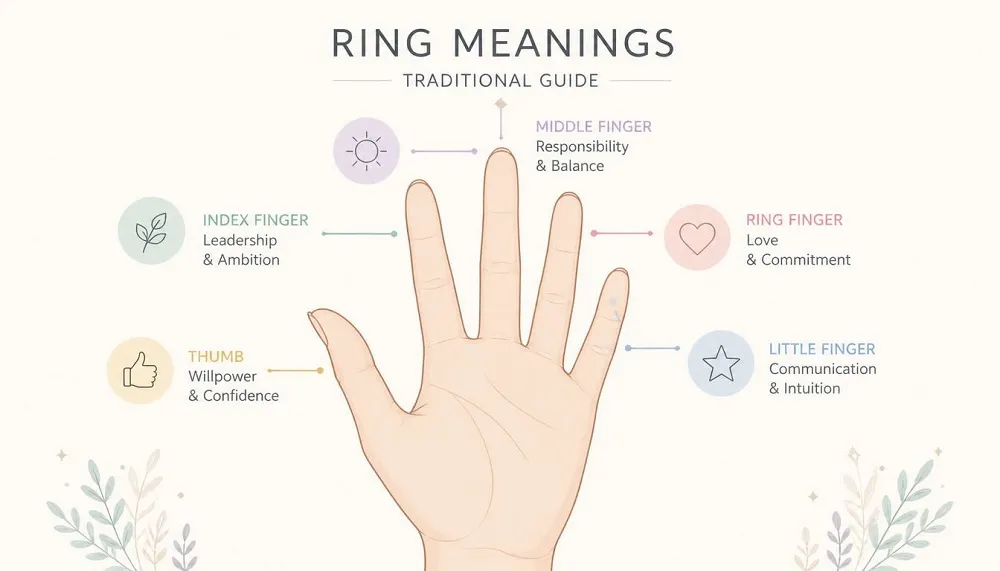
There’s no single rulebook for where a ring goes. Some placements carry centuries of tradition, like the wedding ring on the fourth finger. Others are entirely modern, like where a smart ring gets the most accurate reading. This guide covers both: the symbolism behind each finger, how it differs for men and women, and practical placement advice for everything from promise rings to health-tracking rings.
Does It Actually Matter Which Finger You Choose?
For most rings, no single finger is objectively correct. Placement is a mix of tradition, personal preference, and practical fit. That said, a few categories genuinely do have a right or best answer. Wedding and engagement rings follow strong cultural convention. Smart rings and health rings have a measurable best finger based on sensor accuracy. Everything else, from signet rings to fashion stacking pieces, comes down to what looks and feels right to you.
What Each Finger Traditionally Means
Understanding the general symbolism helps before diving into specific ring types, since most modern guidance builds on these older associations.
Thumb
The thumb is linked to willpower, confidence, and personal authority. Thumb rings tend to be broader and bolder, historically worn by people in positions of power. Today it’s mostly a style choice, favoured by anyone who wants a chunkier, statement piece.
Index Finger
The index, or pointer finger, has strong ties to leadership and status. Signet rings bearing family crests were traditionally worn here by nobility and officials. It’s a natural choice for a ring you want people to actually notice, since it’s the most visible finger during everyday hand movement.
Middle Finger
The middle finger carries the least fixed symbolism of any finger. Its central, prominent position makes it a popular spot for statement or cocktail rings, but there’s no strong cultural rule attached to it either way.
Ring Finger
This is the finger most associated with romantic commitment, largely due to an old belief that a vein, once called the vena amoris, ran directly from this finger to the heart. In the UK, US, and much of the Western world, the left ring finger holds engagement and wedding rings. Several countries, including Germany, Russia, and India, instead use the right ring finger for the same purpose.
Pinky Finger
The smallest finger has a genuinely varied history. It’s been used to signal professional achievement (particularly in engineering, where graduates traditionally wore an iron ring on this finger), family heritage, and in some historical contexts, marital status when combined with a signet ring. It remains a popular spot for a subtle, low-key ring today.
Which Finger Should Men Wear a Ring On?
The Ring Finger for Male Wearers
For men, the ring finger carries the same core meaning as it does for women: it’s the traditional home for a wedding band, and the finger most people associate with marital status. Which is the ring finger for a male wearer specifically comes down to hand and culture rather than anatomy, since it’s the same fourth finger used across genders. In the UK and US, that’s the left hand. Some Eastern European and Orthodox Christian traditions place it on the right hand instead.
Signet Rings and Where They Belong
Signet rings sit slightly apart from other ring traditions because they were designed to be functional, originally used to press a wax seal. That practical history is why they’re traditionally worn on the pinky of the dominant hand, keeping the seal accessible while writing or handling documents. Many men today keep this placement out of tradition, though the index finger, which carried its own history of status and authority, is also a common and accepted choice.
Which Finger Should Women Wear a Ring On?
There’s more flexibility for women’s ring placement outside of engagement and wedding rings, largely because fashion rings for women have never carried the same strict rules that bridal jewellery does. The ring finger remains the clearest signal of romantic commitment. Beyond that, the index and middle fingers are popular for statement pieces since they’re highly visible, while the pinky suits daintier, more personal rings such as birthstone pieces or family heirlooms.
Which Finger Shows You’re Single?
For Single Women
If you want a ring on your hand without suggesting you’re in a relationship, avoid the left ring finger, and the right ring finger too if you’re in a country where that hand carries the same marriage tradition. The middle, index, and pinky fingers on either hand carry no marital association in Western culture, making them the safest choices for fashion rings that won’t send an unintended message.
Which Finger to Wear a Ring for Single Men
The same logic applies to men. Wearing a ring on the middle, index, or pinky finger avoids any confusion about marital status, while the ring finger, particularly on the left hand in the UK, is the one most likely to be read as a wedding band by people who don’t know you well.
Engagement, Wedding, and Promise Ring Placement
Engagement and wedding rings both belong on the ring finger, typically stacked together once married, with the wedding band worn closer to the hand as the “guard” ring. Most UK couples follow the left-hand tradition, though this isn’t a fixed rule and some couples choose the right hand for personal or cultural reasons.
Which Finger for a Promise Ring
A promise ring has no fixed rule, which is part of its appeal. Many people deliberately choose a finger other than the left ring finger, often the right hand’s ring finger or the middle finger, specifically to avoid it being mistaken for an engagement ring. If you’re weighing up a promise ring against a full engagement ring and want to understand the difference in meaning and cost, our guide on promise ring vs engagement ring covers that comparison in full.
Which Finger Should You Wear a Smart Ring On?
Smart rings, including popular devices like Oura and similar health trackers, are different from fashion rings because placement genuinely affects performance. These rings use PPG sensors that read blood flow through your skin, and some fingers give a clearer signal than others.
Health and Fitness Ring Accuracy by Finger
Most smart ring manufacturers recommend the index finger as the best default, since it typically has strong, well-positioned blood vessels and a fairly consistent width from base to knuckle, which helps the ring stay snug and in position overnight. The middle and ring fingers are generally accepted as solid alternatives with comparable accuracy. The thumb and pinky are usually not recommended, since the thumb’s blood vessel structure differs enough to affect signal quality, and the pinky is often too narrow for a secure, consistent fit. Many people also choose their non-dominant hand for a fitness or health ring, since it moves less during the day and while sleeping, which reduces the motion interference that can distort readings.
Which Finger Should You Wear a Calmi Ring On?
Calmi rings and similar magnetic wellness or acupressure rings are typically designed to be resizable and adjustable, so they don’t carry the same sensor-accuracy requirements as a smart health tracker. Manufacturer guidance generally allows any finger, with comfort and secure fit being the main considerations rather than a specific required placement. Some wearers choose the index finger, since acupressure traditions associate it with focus and tension relief, though this reflects belief rather than established clinical evidence.
Which Finger Should You Wear a Copper Ring On?
Copper rings are worn across a wide range of fingers depending on the wearer’s goal. Some people choose the ring finger specifically, following older beliefs tied to circulation and energy flow, while others prioritise whichever finger has joint discomfort they’re hoping to ease, most often a finger affected by stiffness. It’s worth being clear that claims about copper rings easing joint pain or arthritis symptoms are based on tradition and anecdotal reports rather than strong scientific evidence, so anyone with a diagnosed joint condition should treat a copper ring as a personal comfort choice rather than a medical treatment.
Which Finger Should You Wear a Jade Ring On?
Jade rings are often worn on the ring finger, partly because jade has long been associated with love, beauty, and harmony in various cultural traditions, which pairs naturally with the ring finger’s own romantic symbolism. Outside of that association, jade works well on any finger, and many people choose the middle or index finger simply because these positions show off a coloured stone more clearly.
Which Finger Should You Wear a Silver Ring On?
Silver rings don’t carry finger-specific rules the way metals like copper sometimes do within wellness traditions. The main practical consideration is fit and comfort rather than symbolism, though sterling silver can react with skin oils and sweat over time, so a finger that gets less moisture exposure, such as through frequent hand washing, may show less tarnish build-up between cleans.
Which Finger Should You Not Wear a Ring On?
There isn’t a finger that’s off-limits for everyone, but there are situations worth avoiding. Skip the left ring finger for a non-committed relationship ring if you don’t want people assuming you’re engaged or married. Avoid the thumb and pinky for smart or fitness rings, since sensor accuracy tends to drop on both. And if you do manual work with your hands, it’s worth avoiding rings with raised stones or delicate settings on your dominant hand’s index and middle fingers, since these see the most contact and are most likely to catch or damage.
Left Hand vs Right Hand: Does It Change the Meaning?
In the UK and most Western countries, the left hand carries the marriage association, while the right hand is generally considered neutral or open for personal style. This flips in several other cultures. Germany, Russia, Norway, and India, among others, traditionally use the right ring finger for both engagement and wedding rings. Outside of marriage symbolism, hand choice mostly comes down to which one you use less during the day, since your dominant hand’s rings see more wear from typing, washing, and general use.
Frequently Asked Questions
Which finger is the ring finger?
The fourth finger, next to the pinky, on either hand. In Western tradition it’s the left hand’s fourth finger that holds engagement and wedding rings.
Can men wear a ring on any finger?
Yes. Outside of wedding ring tradition, there’s no rule restricting which finger a man can wear a ring on, though certain fingers, like the pinky for a signet ring, carry stronger traditional associations than others.
Does wearing a ring on the middle finger mean anything?
Not traditionally. The middle finger has the least fixed symbolism of any finger, which is exactly why it’s a popular, low-pressure choice for statement rings.
Which finger is best for a health or fitness tracking ring?
The index finger is the most commonly recommended by manufacturers, with the middle and ring fingers as reliable alternatives. The thumb and pinky are generally best avoided for tracking accuracy.
Is it true a vein runs from the ring finger to the heart?
This is a popular historical belief, often called the vena amoris, but it isn’t anatomically accurate. Human anatomy doesn’t support a direct vein connection unique to that finger, though the belief still shapes ring-wearing tradition today.
Whether you’re following centuries-old tradition or just working out where your new smart ring fits best, the right finger usually comes down to a mix of meaning, comfort, and what actually works for your daily life. If you’re building a full look rather than choosing a single piece, our ring stacking style guide covers how to combine multiple rings across your hand without it looking cluttered.
About the author
Naomi Pearce is a UK-based jewellery writer with 6 years of experience covering ring symbolism, buying guides, and jewellery styling for everyday and special occasion wear.