
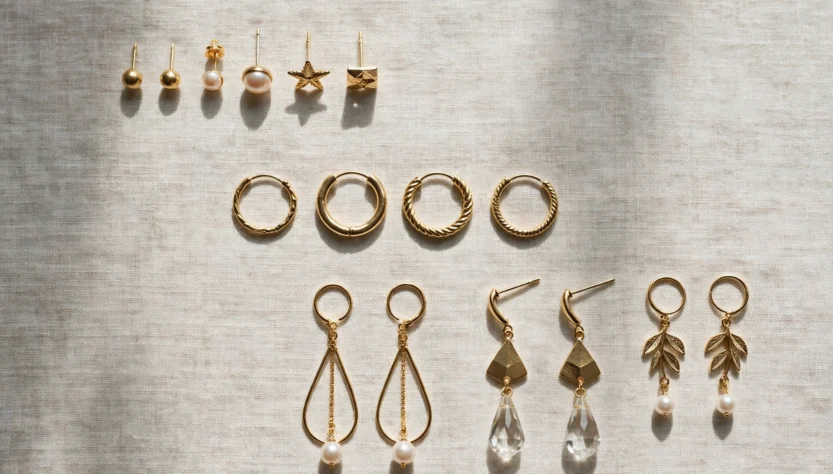
Earrings are one of the easiest ways to change a whole outfit, yet the names can be confusing. Studs, hoops, drops, dangles and cuffs are not just different shapes. They sit on the ear in different ways, move differently and suit different occasions, necklines and face shapes.
This guide explains each type in plain English, then shows how to choose a pair you will actually wear.
What counts as each type of earring
The easiest way to tell earrings apart is to look at how they are fixed to the ear and where they hang. A stud stays close to the lobe. A hoop passes through the piercing and closes into a loop. A drop hangs below the lobe but does not swing much. A dangle also hangs below the lobe, but it moves freely.
| Type | How it sits | Best for |
|---|---|---|
| Stud | Sits on the earlobe | Everyday wear, work and first piercings |
| Hoop | Forms a loop through the piercing | Casual, smart and evening looks |
| Drop | Hangs below the earlobe | Dressier looks, events and longer styles |
| Dangle | Swings below the earlobe | Evenings and statement looks |
| Ear cuff | Hugs the outer ear | A no piercing look, often worn with studs |
These labels overlap. A drop can also be a dangle, and a hoop can be small enough to work as an everyday stud alternative. The name is a starting point, not a strict rule.
Studs explained
Studs sit flat against the earlobe and are held by a post and a back. They are the smallest and most practical option, and they work for work, school runs, sport and everyday wear. Simple ball, pearl and crystal studs go with almost anything.
Choose studs if you want comfort, a neat finish or a pair you can leave in. They are also the usual choice for a first piercing, because they sit still and are easy to clean.
Hoops explained
Hoops form a loop that passes through the piercing and closes on the other side. Small hoops sit close to the ear and read as neat and casual. Medium hoops are the most versatile size for daily wear. Large hoops make a stronger statement and are better for evenings.
Hoops suit most outfits, from jeans to a simple dress. If a hoop feels heavy, choose a thinner or hollow design, or drop down a size.
Drops and dangles explained
Drops hang below the earlobe on a fixed hook, post or chain. They add length and movement without swinging as freely as a dangle. A single stone, pearl or teardrop is an easy way to dress up a plain outfit.
Dangles are the freest moving type. They may have chains, beads or charms that swing as you move, which makes them best for evenings, weddings and special occasions rather than busy workdays.
Backs and closures
The back matters as much as the front. A poor back can slip, pinch or irritate the ear, so check it before you buy.
- Butterfly backs: the most common stud back, easy to use but can loosen over time.
- Screw backs: twist onto the post and are the most secure choice for valuable studs.
- Latch backs: a hinged wire that clicks into place, often used for hoops.
- Lever backs: a lever that closes behind the ear, common for drops.
- Hoop click tops: a hinged hoop that clicks shut, with no separate back to lose.
Check the closure before you buy. It should close firmly, sit flat and not catch on hair or clothing.
Choosing earrings for your face shape
The aim is balance. If your face is long, add width. If it is wide, add length. If it is angular, soften the edges. You do not need to follow these ideas strictly, but they are a useful starting point.
Best earrings for round faces
Round faces suit longer shapes, such as drops, dangles and oval hoops, which add length and draw the eye down.
If you have a round face, avoid large round hoops and studs that sit at the widest point of the cheek, since they can make the face look wider. If you love studs, choose an elongated teardrop or marquise stone rather than a round one.
Other face shapes at a glance
Oval faces suit almost every style, so let the occasion decide. Square faces suit softer shapes, such as rounded drops and curved hoops, which balance a strong jawline. Heart shaped faces suit styles wider at the bottom, such as teardrop drops, which balance a narrower chin. Long faces suit wider shapes, such as round studs and medium hoops.
Neckline and hair
High necklines and scarves suit studs and small hoops, because longer styles can tangle or hide. Open necklines suit drops and dangles, which have room to move. Hair worn up shows off longer styles. Hair worn down can hide small studs, so choose a drop that peeks out below the ends.
Sensitive ears and materials
Sensitive ears react most often to nickel, which appears in some low cost alloys and plated metals. If your ears itch, redden or swell, try a different metal before giving up on earrings. Sterling silver, gold, titanium and surgical steel suit many sensitive ears. Look for pieces marked nickel free. Plated jewellery can wear away and expose the base metal underneath. Fresh piercings need simple studs in a suitable metal, left in place while they heal. Clean your earrings regularly with a soft cloth.
How to store earrings without tangling or losing pairs
Keep pairs together in a lined jewellery box, or use a stand with hooks for hoops and drops. Store studs with their backs on, so the pairs stay matched. Keep long dangles hanging rather than piled in a drawer, since chains and hooks tangle fast. When you travel, use a small zipped pouch with separate sections for each pair. For more packing ideas, read our guide to storing jewellery when travelling, which covers pouches, rolls and what to pack first. Check backs and clasps weekly to catch loose fittings before an earring goes missing.
Frequently asked questions
Can you sleep in studs?
Yes, small smooth studs are usually fine overnight. Take out large or textured studs before bed, since they can press into the skin.
Do heavy earrings stretch ear lobes?
Heavy earrings can stretch lobes over time. Choose lighter pairs for daily wear and save heavier styles for short occasions.
What backs are most secure?
Screw backs are the most secure choice for studs, latch backs hold hoops well, and lever backs suit drops. Replace any back that feels loose.
Are hoops suitable for work?
Small and medium hoops suit most workplaces, especially plain designs. Save very large hoops for evenings and weekends.
How do I stop earrings irritating my ears?
Switch to sterling silver, gold or titanium, and choose nickel free pieces. Clean your earrings before each wear, and rest your ears if they feel sore.
What size hoop suits a first pair?
A medium hoop of about two to three centimetres across suits most people as a first pair. It shows clearly without feeling heavy.
How do I keep pairs matched?
Store each pair in its own compartment or pouch, and fasten the backs before putting studs away.
Conclusion
Studs are the everyday staple, hoops add easy polish, drops add length, and dangles add movement. Start with comfort, fit and a secure back, then choose a shape that balances your face and suits your neckline. With those basics covered, it is easy to build a small collection you will reach for again and again.