
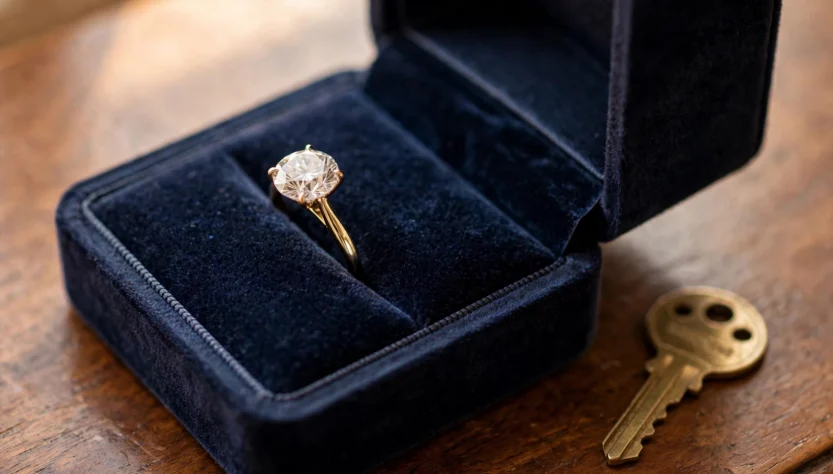
Yes, you should insure your engagement ring in the UK. A ring is small, valuable and easy to lose, and you wear it every day. If it is stolen, lost or damaged, replacing it can cost thousands of pounds. Insurance does not stop that happening, but it makes the cost of putting it right far easier to bear.
Many people assume their home contents policy already covers a ring, but often it does not cover the full value. This guide explains when cover is worth it, how the two types of cover compare, what it costs, and how to keep jewellery safe at home.
This article gives general information only, not regulated financial advice. If you need advice about your own situation, speak to a regulated adviser or broker.
Should You Insure an Engagement Ring: When Cover Is Worth It
An engagement ring is different from most things in your home. You take it out with you every day. You wear it on public transport, at work, on holiday and in the gym. That daily wear raises the risk of loss and damage. A ring can slip off in cold water.
Insurance is worth it when the cost of replacing the ring would hurt. For a ring worth several thousand pounds, most owners choose cover. Insurance cannot restore the meaning of a ring, but it can pay for a like-for-like replacement. The risk starts the day you first wear it, so a short delay while you get a valuation is normal, but a delay of months is a gamble.
Home Contents Insurance vs Specialist Jewellery Insurance: Cover Compared
Most people in the UK cover a ring in one of two ways. The first is through a home contents policy. The second is through a standalone specialist policy.
A home contents policy covers the things inside your home. Many policies also cover personal possessions away from home, but only if you add that option. Even then, a single-item limit often applies. That limit caps what the insurer will pay for any one item. If your ring is worth more than the limit, you must list it separately, or the gap falls on you. A specialist policy covers the ring itself, wherever you are, and it usually covers theft, loss and accidental damage as standard.
| Feature | Home contents policy | Specialist jewellery policy |
|---|---|---|
| Cover at home | Usually included, subject to a single-item limit | Included as standard |
| Cover away from home | Only with personal possessions cover added | Usually included as standard |
| Single-item limit | Often around 1,000 to 2,000 pounds | Set by the value you insure |
| Accidental damage | Sometimes included, sometimes an extra | Usually included as standard |
| Choice of repairer | Often the insurer chooses | Often you choose your own jeweller |
| Effect on home no-claims discount | A claim can reduce it | No effect on a home policy |
Home contents cover is often cheaper. That is its main strength. If your ring is modest in value and you rarely take it far from home, it may be enough. Specialist cover is usually more complete. Its main strength is that it is built around the ring, not around the house. Read the single-item limit before you assume you are covered: if your ring is worth 4,000 pounds and the limit is 1,500 pounds, you are not fully covered.
What Jewellery Insurance Actually Covers: Theft, Loss, Damage and Accidental Loss
Four types of event matter most: theft, loss, damage and accidental loss. A policy may treat them in different ways.
Theft is the clearest case. If someone steals your ring, a good policy pays for a replacement. The insurer will want a crime reference number from the police. It will also want proof of value, such as a valuation or a purchase receipt. Keep those documents safe.
Loss is different from theft. Loss means the ring is gone, but no crime took place. You may have taken it off at the gym or lost it while swimming. Many home contents policies do not cover simple loss. They cover theft and damage only. Specialist policies often cover loss as well. This is one of the main reasons people choose specialist cover.
Damage covers a broken shank, a bent claw or a chipped stone. Accidental damage is a wider term. It covers damage caused by an accident, such as dropping the ring on a hard floor. Some policies include accidental damage as standard. Some charge extra for it. Some leave it out altogether. Check this point before you buy, and note that most policies do not cover wear and tear.
Single-Item Limits and Exclusions: The Clauses That Catch People Out
The single-item limit is the clause that catches most people out. It is the maximum an insurer will pay for any one item under a home contents policy. Standard home contents policies in the UK often set this limit around 1,000 to 2,000 pounds. A ring worth more than that is not fully covered unless you list it separately.
Listing an item is simple. You tell the insurer the item, its value and usually its description. The insurer notes it on the policy. You may pay a small extra premium. In return, the ring is covered up to its full listed value. This is sometimes called specifying an item. It is worth doing for any ring above the single-item limit. Some policies also cap the total value of valuables in the home, so add up what you own and raise the cap or list items separately if the total is near it.
Exclusions are the other trap. Common exclusions include loss or theft when the ring was left unattended in a public place, such as in an unlocked car or a changing room. Some policies also exclude cover when the ring is worn outside the UK for more than a set number of days. An insurer may also ask for proof of ownership, such as a valuation, a receipt or photographs. Keep those in a safe place, with a copy away from the home, for example in an email folder or a cloud drive.
Valuation: How Often, Who Does It, and What It Must Say
A valuation is a written statement of what a ring is worth. Without a current valuation, you risk being underinsured and paid less than the cost of replacing the ring.
The National Association of Jewellers advises revaluing about every three years. That is a useful guide. Prices for gold and gemstones move over time. A ring valued five years ago may cost far more to replace today. An out of date valuation leaves a gap you would pay yourself.
Have the ring valued by a qualified valuer. Many independent jewellers offer a valuation service, and some employ a valuer registered with a professional body. A good valuation should say what the ring is made of, the weight of the metal, the type and weight of each stone, the quality of each stone, and the design. It should give the replacement value as new in the UK. That is the figure you insure for. It is what it would cost to have the same ring made again today, in the UK.
Keep the valuation with your insurance documents. Keep a photograph of the ring with it. A clear photograph helps a jeweller remake the ring if it is lost. Take photographs in good light, from several angles. Revalue after a resize, reset or repair, as the value may change.
What Insurance Costs in the UK: Premiums, Excess and No-Claims Reality
The answer depends on the value of the ring, the type of cover, the excess and where you live. There are no fixed prices, only typical ranges.
Standalone specialist cover typically costs about 1.5 to 3 percent of the ring’s insured value per year. A ring insured for 5,000 pounds typically costs roughly 75 to 150 pounds a year on that basis. Some standalone premiums start from around 58.60 pounds a year.
| Insured value of the ring | Typical yearly premium at 1.5 percent | Typical yearly premium at 3 percent |
|---|---|---|
| 1,000 pounds | About 15 pounds | About 30 pounds |
| 2,500 pounds | About 38 pounds | About 75 pounds |
| 5,000 pounds | About 75 pounds | About 150 pounds |
| 10,000 pounds | About 150 pounds | About 300 pounds |
Adding a ring to a home contents policy is often cheaper. The extra premium may be small, sometimes only a few pounds a month. The trade off is narrower cover, and the excess may be higher. The excess is the first part of any claim that you pay yourself. A policy with a 100 pound excess and a 60 pound premium may look cheap. A claim for a 250 pound repair would leave you with only 150 pounds from the insurer. A policy with a 250 pound excess would pay nothing on that claim.
Your home no-claims discount is another cost to weigh. A claim on a home contents policy can reduce that discount. A lower discount means a higher premium at renewal. A standalone policy avoids this problem, as a claim on it does not affect a home no-claims discount. Do not choose cover on price alone: compare what is covered, the excess, the single-item limit and the claims process.
How to Keep Jewellery Safe at Home: Safes, Hiding Places and Habits
Insurance pays after a loss. Good habits reduce the chance of a loss.
Start with a fixed place for the ring. Choose one spot, and always use it. A ring that always goes to the same place is hard to lose. A ring that is put down in a new place each time is easy to forget. Do not leave a ring by a sink or a bath. Water makes fingers shrink, so a ring can slip off or fall into a drain. Take it off before you wash up, shower or swim, and put it in its fixed place first.
Keep the ring out of sight when you are not wearing it. A ring left on a windowsill or a hall table is visible from outside, while a ring in a closed drawer is far safer. If you have a safe, use it for pieces you are not wearing. Lock the front door even when you are at home. Many thefts happen when a door is left unlocked for a short time. A thief needs only a minute. Be careful with social media too: do not post that you are away on holiday while the home is empty.
Home Safe vs Safety Deposit Box: Cost, Access and What Suits Fashion Jewellery
A home safe and a safety deposit box both protect jewellery. They suit different needs. A home safe is close and easy to use, while a safety deposit box is held in a secure building.
A home safe is best for pieces you wear often. A good home safe is fixed to a wall or floor, as a safe that can be carried away is little better than a drawer. Choose a safe with a cash rating that fits the value inside it. Ask a locksmith or a safe supplier for advice.
A safety deposit box suits pieces you wear rarely. A family ring, a piece kept for a special occasion, or a collection you do not wear every day can live there. Access is limited to set hours, which is the point, but it also means the box is wrong for a ring you wear daily. Cost differs too. A home safe is a one-off purchase plus fitting, while a safety deposit box is a yearly fee. For fashion jewellery of modest value, a box may cost more than the cover is worth, and a fixed place in a drawer, out of sight, is usually enough.
What to Do If Jewellery Is Stolen: Police, Insurer and Records
If your ring is stolen, act quickly. The first hours matter.
First, call the police. Report the theft and get a crime reference number. The insurer will ask for it. Give the police a clear description of the ring. Second, tell your insurer. Do this as soon as you can. Most policies set a time limit for reporting a claim. A late report can slow a claim or lead to a refusal. Have your policy number, the crime reference number, the valuation and photographs ready.
Third, gather your records. The insurer will want proof of value and ownership. A valuation, a purchase receipt, photographs and a description all help. Fourth, do not buy a replacement before the insurer agrees the claim. An insurer may want to approve the replacement jeweller or the design first. If you buy first, the insurer may refuse to pay, or may pay less than you spent. Ask how the claim will be settled. Keep copies of everything you send, and a note of every call with the date and the name of the person you spoke to.
A Fashion Jewellery Note: When Insurance Is Not Worth It
Not every piece of jewellery needs insurance. Fashion jewellery is the clearest example. Most fashion jewellery is modest in price. It is made from base metals, plated metals, glass, resin or imitation stones. Insuring a piece worth 40 pounds rarely makes sense. The premium and the excess would often cost more than the piece itself.
To see why, think about what fashion jewellery is made of. The materials are chosen for looks and for price, not for lasting value. A plated ring will wear over time. A glass stone will not hold value like a diamond. Insurance is built for value. Where there is little value, cover adds little. Some fashion jewellery uses sterling silver or semi-precious stones and costs several hundred pounds, so if the total value of your collection is high, check the total valuables limit on your home policy.
For a single fashion piece, a better use of money is care. Keep it dry, away from perfume and hairspray, and stored in a lined box so it does not scratch. Insurance earns its keep when the value is high and the loss would hurt. A fine engagement ring meets that test, and a fashion ring bought for a season does not. If a ring needs resizing, get it done by a jeweller and ask about the ring resizing cost in the UK before you agree. A resize changes the ring, so have it revalued afterwards.
Frequently Asked Questions About Jewellery Insurance and Home Safety
Should I insure my engagement ring if I already have home insurance?
Check the single-item limit first. Standard home contents policies often set it around 1,000 to 2,000 pounds, so if your ring is worth more, list it separately or take out a standalone policy.
Does home insurance cover a ring lost outside the home?
Only if your policy includes personal possessions cover away from home. Many standard policies do not. Even with that cover, simple loss may be excluded. Specialist policies usually cover loss away from home as standard.
How much does engagement ring insurance cost in the UK?
Standalone specialist cover typically costs about 1.5 to 3 percent of the ring’s insured value per year. A 5,000 pound ring typically costs roughly 75 to 150 pounds a year. Some standalone premiums start from around 58.60 pounds a year.
How often should I have my ring valued?
The National Association of Jewellers advises revaluing about every three years. Insure for the replacement value as new in the UK, not the price you originally paid.
Is a home safe worth it for an engagement ring?
Yes, if the ring is valuable and you take it off at home. A safe fixed to a wall or floor protects the ring when you are out and asleep. A safety deposit box suits pieces you wear rarely.
What should I do first if my ring is stolen?
Call the police and get a crime reference number. Then tell your insurer as soon as you can. Do not buy a replacement before the insurer agrees the claim and the settlement method.
Conclusion
For most people, insuring an engagement ring in the UK is worth it. The ring is valuable, it is worn every day, and it is easy to lose. Home contents cover can work for a modest ring, but a single-item limit often leaves a gap. Specialist cover costs more, yet it usually covers loss, damage and theft wherever you are.
The practical steps are simple. Get a current valuation. Insure for the replacement value as new. Read the single-item limit, the excess and the exclusions. Store the ring safely, check it yearly, and keep your records in order. Insurance does not replace the meaning of a ring, but it does make sure a loss is a sad event, not a costly one as well.