
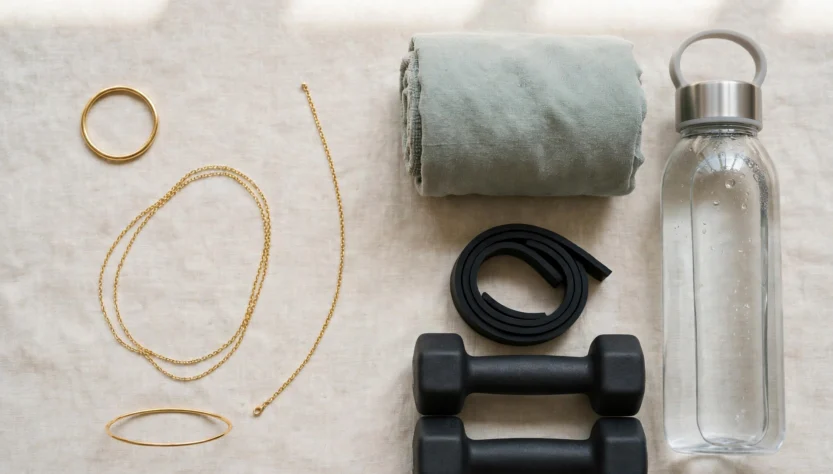
Can you wear jewellery to the gym? Yes, you can wear some jewellery to the gym, but not every piece and not for every workout. Small, secure studs and a plain, close fitting bracelet are usually fine for a gentle session. Rings, long necklaces and dangling earrings are a different story. They can catch on equipment, get damaged by sweat, and, in the case of rings, carry a real safety risk.
Match the jewellery to the workout. Leave the pieces that can catch, snag or trap sweat at home, and keep the pieces that sit flat and cope with moisture. This guide covers each workout type, each piece of jewellery and each common material.
The Short Answer by Workout Type
There is no single rule for gym jewellery. A yoga class and a heavy weights session place very different demands on it.
Weights and Strength Training
Weights are the hardest workout for jewellery. Barbells and dumbbells press, rub and trap metal against your skin. Rings can catch on a barbell or a cable handle, and they can press into your finger when you grip a heavy bar. Necklaces can catch on a bench, and bracelets can get trapped between your wrist and a dumbbell handle.
For weights, remove rings, necklaces and bracelets before you start. Small stud earrings are usually fine because they sit flat and do not interfere with your grip. Keep a watch or fitness tracker snug so it does not slide into your grip.
Cardio
Cardio is kinder to jewellery than weights, but sweat is the main problem. Running, cycling and rowing all make you sweat heavily. Sweat is salty water, and salt speeds up tarnish on silver and plated pieces. It can also work its way under stones and into clasps.
For cardio, small studs and a simple chain that sits close to the neck are usually fine. Long necklaces can bounce and tangle while you run, so a shorter chain is better. Remove bracelets that slide around, because they can rub your wrist raw over a long session. Rings are less of a catching risk on a treadmill, but sweat collects under a ring band and can irritate the skin, so many people still take them off.
Yoga and Pilates
Yoga and Pilates are the most jewellery friendly workouts. You move slowly, you do not grip heavy bars, and you sweat less than in a cardio class. Even so, long necklaces swing forward in downward dog and in inverted poses. Dangling earrings can catch on a mat when you lie on your side, and bracelets can press into your wrist in plank positions.
For yoga and Pilates, small studs, a short necklace and a thin bracelet usually work well. Take off long necklaces, chunky bangles and any ring with a raised stone.
Swimming
Swimming is the workout where jewellery faces the harshest conditions. Pool water contains chlorine, and sea water contains salt. Both can damage jewellery, and both can loosen the grip of a setting over time. Cold water also makes your fingers shrink slightly, which makes a ring more likely to slip off and be lost in the pool.
For swimming, leave your jewellery in your locker. If you do wear anything in the water, choose a single solid piece, such as a plain stainless steel or titanium stud, and rinse it in fresh water straight after your swim. Pearls, plated pieces and anything with glued stones should never go in a pool.
Rings at the Gym: The Safety Risk
Rings deserve their own section because the risk is not just about damage to the ring. It is about injury to your finger. When a ring catches on equipment while your body keeps moving, the ring can pull hard against your finger. In rare but serious cases, this can strip skin and soft tissue from the finger. Doctors call this a degloving injury, and when it involves a ring it is often called ring avulsion. It is uncommon, but it is a recognised injury in gyms.
Most gym ring injuries happen in a simple way. A person jumps down from a pull up bar, catches a ring on a bolt or a hook, or snags a ring on a cable machine handle. The hand keeps moving and the ring does not, and the result can be serious enough to need hospital treatment.
Reduce the risk by taking rings off before any session that involves bars, cables, ropes or climbing. That includes weightlifting, CrossFit style training and gymnastics. A ring is safest in your locker or in a small pouch in your gym bag, not on your finger and not left loose on a bench where it can be forgotten or taken.
Some people wear a silicone ring at the gym instead of a metal one. Silicone rings are designed to break under force, so they are less likely to trap a finger if they catch.
A tight ring needs extra care. It traps sweat underneath it, and the skin can become sore and itchy after a sweaty session. A ring that is hard to remove after exercise is a sign that your fingers have swollen during the workout. If a ring ever becomes stuck, do not force it. Cool water and soap usually help. If you notice swelling, pain or a change in skin colour, seek medical advice promptly.
Necklaces, Bracelets and Earrings by Workout
Not all jewellery behaves the same way in a workout. A piece that is fine for a walk can be a nuisance on a rowing machine.
Necklaces. Short, fine chains are the safest necklaces for the gym. They sit close to the neck, they do not swing, and they do not catch on equipment. Long chains and pendant necklaces swing with every step, and they can catch on a bench or a bar. Heavy pendants bounce against your chest during running and can strain a fine chain until it snaps. Choose a short chain with a small pendant, and take it off for any session that involves lying on a bench.
Bracelets. A thin bracelet that fits close to the wrist is usually fine for cardio and yoga. Loose bangles are a problem. They slide up and down your arm, they clatter against equipment, and they can trap sweat against your skin. A hard knock against a dumbbell can also damage a tennis bracelet clasp or loosen a stone. Choose one that fits snugly, and remove it for any weights session.
Earrings. Small studs are the best earrings for the gym. They sit flat, they do not move, and they rarely catch on anything. Small hoops are usually fine for cardio and yoga, as long as they sit close to the ear. Large hoops and long drop earrings are a poor choice for any workout. They swing, they catch on hair and clothing, and they can be pulled if they snag on equipment. Check the backs before your session, because sweat and movement can loosen them.
Watches and fitness trackers. A watch or a fitness tracker is the one item most people keep on at the gym, and it is usually fine. Keep the strap snug so it does not slide into your grip during weights. Rinse a metal strap after a sweaty session, and dry the skin underneath it.
What Sweat Does to Jewellery
Sweat is the quiet enemy of gym jewellery. It is mostly water, but it also contains salt from your skin. Salt speeds up tarnish, dulls a polished finish, and works into tiny gaps around stones and clasps. One sweaty session will not ruin a piece, but repeated exposure without cleaning will.
The material decides how much damage sweat can do. Some materials cope well, some cope badly, and some should never be worn to the gym. If you are unsure what your jewellery is made of, our guide to what fashion jewellery is made of explains the common materials.
| Material | Sweat | Gym verdict |
|---|---|---|
| Solid gold | Copes well, shine dulls over time | Fine for light sessions |
| Silver | Tarnishes faster | OK for cardio and yoga |
| Stainless steel | Very resistant | One of the best choices |
| Titanium | Very resistant | One of the best choices |
| Gold plated | Plating wears away | Best left at home |
| Costume and resin | Clouds resin, loosens glue | Best left at home |
| Pearls | Surface damage | Never wear to the gym |
Solid Gold
Solid gold copes better with sweat than most materials. Gold does not rust and it does not tarnish the way silver does. Sweat can still dull the shine over time, so wipe a gold piece after each session. The bigger risk at the gym is physical damage. Gold is a soft metal, and a ring or bracelet can be scratched or bent by a barbell. Keep gold for light sessions and leave it at home for heavy weights.
Silver
Silver tarnishes, and sweat speeds the process up. The salt in sweat reacts with the surface and leaves a dark film. This is not permanent damage. A silver cleaning cloth usually restores the shine, but tarnish builds up quickly if you wear silver every day without cleaning it. Wipe it after every session and store it in a dry place. Remove silver rings for weights, because silver is soft and a ring can be bent out of shape by a heavy bar.
Stainless Steel
Stainless steel is one of the best materials for gym jewellery. It resists sweat, it does not tarnish easily, and it is harder than gold or silver, so it stands up to knocks better. A plain steel stud or a simple steel chain is a sensible choice for training. A steel ring still carries the same catching risk as any other ring, so the safety advice about rings still applies.
Titanium
Titanium is light, strong and very resistant to sweat and moisture. It does not tarnish, and it is less likely to cause skin irritation than some other metals. That makes it a good choice for earrings and necklaces worn during exercise. A titanium ring still needs to come off for weights because of the catching risk.
Gold Plated Jewellery
Gold plated jewellery has a thin layer of gold over a base metal, and sweat is one of the fastest ways to wear that layer away. Salt and moisture attack the plating, and rubbing against skin and equipment speeds the wear up further. Once the plating wears through, the base metal shows, and the piece looks patchy. Plated jewellery is best left at home on gym days.
Costume Jewellery and Resin
Costume jewellery and resin pieces are not made for sweat. Many costume pieces use glue to hold stones in place, and sweat and heat can weaken that glue. Resin can cloud when it is exposed to moisture and body heat over and over again, and painted pieces can flake where sweat sits against the surface. Leave costume jewellery and resin pieces at home.
Pearls
Pearls should never be worn to the gym. A pearl is an organic gem, and its surface is delicate. Sweat, perfume, sunscreen and chlorine can all damage the lustre of a pearl, and the damage is often hard to reverse. The thread that holds a pearl necklace together can also weaken when it absorbs moisture again and again. Keep pearls for occasions away from the gym. For more on everyday products and jewellery, see our guide on whether does perfume damage jewellery.
What to Wear Instead
Leaving your jewellery at home does not mean going without.
For weights, wear nothing on your hands or wrists except a snug fitness tracker. Small stud earrings are fine, and everything else stays in your locker.
For cardio, choose small studs and a short, fine chain. Skip long necklaces, loose bangles and rings. If you run outdoors, a chain can bounce and rub the back of your neck, so no necklace is often more comfortable.
For yoga and Pilates, small studs, a short necklace and a thin bracelet work well. Remove anything long, loose or chunky before you get on the mat.
For swimming, leave your jewellery in your locker. If you must wear something, a single plain steel or titanium stud is the least risky choice, and it still needs a fresh water rinse afterwards.
If you wear a wedding ring or an engagement ring, the gym is a good time to take it off. A ring pouch or a small zip pocket inside your gym bag keeps it safe. If your ring has ever needed resizing, or if it feels loose after a session, our guide to ring resizing cost in the UK explains what to expect from a jeweller.
Caring for Gym-Worn Jewellery
A piece that goes to the gym needs a little more care. A short routine after each session will keep it looking good.
First, wipe each piece with a soft, dry cloth as soon as you finish. This removes sweat and salt before they dry on the surface. Pay attention to the back of a pendant, the inside of a ring band and a bracelet clasp, where sweat collects.
Second, let the piece dry fully before you put it away. Do not drop a damp piece straight into a closed jewellery box. Leave it on a clean cloth for a few minutes, then store it in a dry pouch. Damp storage speeds up tarnish, especially on silver.
Third, clean your gym pieces more often than the rest of your collection. A mild soap and lukewarm water wash works for solid gold, stainless steel and titanium. Dry the piece fully afterwards, and use a silver cloth for silver. Do not use harsh cleaners, toothpaste or abrasive cloths.
Fourth, check clasps, settings and earring backs regularly. Sweat and movement loosen them over time, and a quick check before each session can save a lost earring or a broken chain.
Finally, rotate your gym pieces. Wearing the same piece every day gives sweat no break and wear builds up faster, so keep one or two simple pieces for training and your finer pieces for the rest of the day.
Frequently Asked Questions
Can I wear my engagement ring to the gym?
It is best not to. An engagement ring usually has a raised stone, which can catch on equipment or press into your finger during a heavy lift. Sweat can also collect under the setting. Leave it in a ring pouch in your gym bag and put it back on after your session.
Can I wear a necklace to the gym?
A short, fine chain is usually fine for cardio and yoga. A long chain or a heavy pendant is not, because it swings, catches on equipment and can strain the chain until it snaps. Take necklaces off for weights and for bench work.
Can I wear earrings to the gym?
Yes, small studs are the safest earrings for the gym. They sit flat and rarely catch on anything. Small hoops that sit close to the ear are usually fine too. Avoid large hoops and long drop earrings, because they swing and can snag on hair or equipment.
Does sweat damage gold jewellery?
Sweat does not ruin solid gold, but it can dull the shine over time. Wiping a gold piece after each session and cleaning it regularly will keep it looking good. Sweat is much harder on gold plated jewellery, because it wears the thin plating away.
Can I wear jewellery in the swimming pool?
It is best not to. Chlorine can damage many materials, including gold plating, pearls and costume pieces, and cold water can make a ring slip off your finger. If you do wear a piece in the pool, rinse it in fresh water immediately afterwards.
What is the safest jewellery to wear to the gym?
Small stainless steel or titanium studs and a short, fine chain are the safest choices. They cope well with sweat, they sit close to the body, and they do not catch on equipment. Rings, long necklaces and loose bangles are the pieces to leave at home.
Conclusion
Can you wear jewellery to the gym? Yes, but only the right pieces for the right workout. Small studs and a short chain suit most sessions. Rings are the piece to take off first, because of the catching risk. Long necklaces, loose bangles and dangling earrings are best left at home, and pearls and plated pieces should never go to the gym at all.
Decide before you leave the house. Take off the pieces that can catch or trap sweat, keep the pieces that sit flat and cope with moisture, and wipe everything down when you finish.