
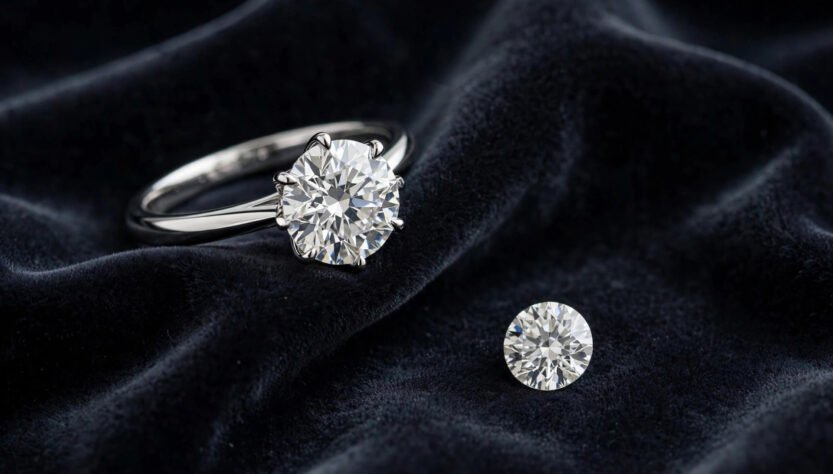
A lab-grown diamond is a real diamond. It has the same chemical makeup as a natural diamond, the same hardness, and the same sparkle. The difference is where it comes from. One grows deep inside the earth over a very long time. The other grows in a laboratory over weeks. This guide compares the two honestly for UK buyers, covering price, resale value, certification, and ethics, so you can choose with your eyes open.
The short answer is simple. If you want the biggest, brightest stone for your budget, a lab-grown diamond usually wins. If you want a stone that holds more of its value over time, or a stone with a traditional story, a natural diamond usually wins. Neither choice is wrong. The mistake is buying one while expecting the benefits of the other.
What a Lab-Grown Diamond Is: Real Diamond, Lab Origin
A lab-grown diamond is not a fake diamond. It is not glass, and it is not a simulant. It is carbon arranged in a crystal structure, exactly like a natural diamond. It scores 10 on the Mohs hardness scale, exactly like a natural diamond. It handles everyday wear in the same way.
The only real difference is origin. Natural diamonds formed under heat and pressure deep in the earth. Lab-grown diamonds are grown by people in controlled conditions. A trained gemmologist with lab equipment can tell them apart, because the growth process leaves tiny clues. To the naked eye, there is nothing to tell apart.
One point of honesty matters here. A UK seller must make it clear when a diamond is lab-grown. If a listing is vague about origin, or if it calls a stone natural without proof, walk away. Clear labelling is the first sign of a trustworthy seller.
How Lab-Grown Diamonds Are Made: CVD and HPHT in Plain English
There are two main ways to grow a diamond in a lab. Both produce real diamonds. Neither method is better in every case.
CVD stands for chemical vapour deposition. A tiny diamond seed sits in a chamber. Carbon-rich gas fills the chamber. The carbon settles on the seed, layer by layer, and a diamond crystal grows. Most lab-grown diamonds sold today are made this way.
HPHT stands for high pressure, high temperature. This method copies the conditions inside the earth. A small diamond seed sits in carbon under very high pressure and very high heat. A diamond grows around the seed. HPHT stones sometimes need extra treatment to improve their colour, and a good grading report will note any treatment.
You do not need to choose a method as a buyer. What matters is the finished stone: its cut, colour, clarity, and carat weight, plus an independent grading report. The method is background detail, not a buying decision.
Lab-Grown vs Natural Diamond: The Chemical and Visual Truth
Chemically, the two are the same material. Visually, they are the same to anyone without lab equipment. A lab-grown diamond sparkles in the same way, because sparkle comes from cut quality and the way light moves through the stone, not from where the stone grew.
There is one old confusion worth clearing up. Some older web pages suggest that lab-grown diamonds are softer, or that they cloud over time. That is wrong. A lab-grown diamond is just as hard and just as durable as a natural diamond. It will not cloud, fade, or wear down faster. If a seller or a blog tells you otherwise, that source is unreliable.
| Property | Lab-grown diamond | Natural diamond |
|---|---|---|
| Material | Crystallised carbon | Crystallised carbon |
| Hardness | 10 on the Mohs scale | 10 on the Mohs scale |
| Appearance | Identical to the eye | Identical to the eye |
| Origin | Grown in a laboratory | Mined from the earth |
| Grading | Graded on cut, colour, clarity, carat | Graded on cut, colour, clarity, carat |
| Resale value | Usually low | Holds more value, but not guaranteed |
Price in the UK: What You Pay per Carat and Why the Gap Exists
Lab-grown diamonds cost much less than natural diamonds of the same size and quality. That is the main reason most UK buyers consider them. A lab-grown stone lets you buy a larger carat weight, a better colour grade, or a better clarity grade for the same budget.
The gap exists for a simple reason. Mining is slow, costly, and limited by what the earth provides. Growing a diamond in a lab is faster, and supply can increase when demand rises. When supply can grow, prices fall. That is exactly what has happened with lab-grown diamonds in recent years.
Be careful with advertised savings. Some sellers advertise very large percentage savings. Those figures depend on which stones are being compared, and they change often. The honest way to compare is like for like: same carat weight, same cut, same colour, same clarity, same grading lab. Get two quotes on that basis, and the real gap will be clear.
Also compare the full piece, not just the stone. The metal, the setting, and the workmanship make up part of the price. A cheap setting can spoil a good stone. Ask what metal is used, and whether the price includes the setting, the grading report, and any warranty.
Resale Value: Why Lab-Grown Diamonds Lose Value and Naturals Hold More
This is the section most seller guides soften, so here it is plainly. Lab-grown diamonds have poor resale value. If you sell a lab-grown diamond later, expect much less than you paid. That is because new lab-grown stones keep being produced, and buyers can always buy a new one instead of your used one.
Natural diamonds hold more of their value, because supply is limited and demand for natural stones remains. But hold more value is not the same as keep all value. Most natural diamonds also sell second hand for less than their retail price. The retail price includes cutting, setting, branding, and the retailer’s margin, and none of that comes back on resale.
Neither type of diamond is a reliable investment. Buy a diamond because you want to wear it, not because you expect it to make money. If resale matters a lot to you, a natural diamond is the safer choice. If you plan to keep the piece for life, resale matters far less, and a lab-grown diamond makes more sense.
Certification in the UK: IGI, GIA and What to Ask For
Always buy a diamond with an independent grading report. The report describes the stone’s cut, colour, clarity, and carat weight, and it confirms whether the stone is natural or lab-grown. Never accept a seller’s own description in place of a report.
Two labs dominate this market. IGI, the International Gemological Institute, grades a large share of lab-grown diamonds sold in the UK. GIA, the Gemological Institute of America, also grades lab-grown diamonds. Both are respected. What matters most is that the report comes from an independent lab, not from the seller.
Before you pay, ask for three things. First, the grading report, with a report number you can check with the lab. Second, a clear statement of whether the stone is lab-grown or natural. Third, a note of any treatments the stone has had, such as colour treatment on an HPHT stone. A good seller provides all three without hesitation.
Check the report number yourself. Both IGI and GIA let you verify a report online. It takes a minute, and it protects you from the small number of sellers who misdescribe stones.
Lab-Grown vs Moissanite and Cubic Zirconia: Not the Same Thing
Lab-grown diamonds are often confused with simulants, but they are different things. Moissanite and cubic zirconia look like diamonds, but they are not diamonds. They are different materials with different properties.
Moissanite is a hard, very sparkly stone. Many people like it, and it costs less than a diamond. But it is silicon carbide, not carbon crystal, and a gemmologist can identify it easily. Cubic zirconia is softer and cheaper still. It can look good when new, but it scratches and clouds with wear in a way that diamonds do not.
If you want a real diamond at a lower price, a lab-grown diamond is the answer. If you want the look for much less money and you accept a different material, a simulant may suit you. Just do not let anyone sell you a simulant as a diamond, lab-grown or otherwise.
Ethics and Environment: Mining Impact vs Energy Use, Honestly Stated
Neither option is free of impact, and honest guides say so. Diamond mining disturbs land, uses water, and has a long history of poor labour practices in some regions. Schemes such as the Kimberley Process aim to keep conflict diamonds out of the market, but they do not cover every ethical concern, and they say nothing about environmental damage.
Growing diamonds in a lab avoids mining, but it uses a large amount of energy. The environmental cost depends on where that energy comes from. A lab powered by renewable energy has a much smaller footprint than one powered by fossil fuels, and most sellers do not tell you which applies to their stones. Claims that lab-grown diamonds are automatically eco-friendly should be treated with scepticism.
If ethics drive your choice, ask questions. Ask where a natural diamond was mined, and what scheme covers it. Ask how a lab-grown diamond’s producer powers its labs. A seller who cannot answer either question is selling a story, not a standard.
When a Lab-Grown Diamond Is the Right Choice: Budget, Style and Occasion
A lab-grown diamond suits you if your budget matters more than resale, if you want a larger or higher quality stone for the same money, or if you like the idea of a diamond without mining. It is a strong choice for engagement rings when the couple agrees that size and sparkle matter more than tradition, and for everyday pieces you plan to keep.
It also suits anyone who wants to spend the saved money elsewhere, for example on a better setting, a honeymoon, or a house deposit. A ring is a symbol, not a test of spending. The size of the stone says nothing about the strength of the relationship.
When a Natural Diamond Is the Right Choice: Heirloom, Resale and Tradition
A natural diamond suits you if you want a stone that may be passed down, if resale value matters to you, or if tradition matters to you. Some buyers simply prefer a stone formed by nature over millions of years, and that preference is valid even though it costs more.
A natural diamond also suits buyers who want the widest resale market later. More jewellers buy natural diamonds second hand, and more buyers want them. If you think you may sell or upgrade one day, that wider market is worth paying for.
If your budget only stretches to a small natural diamond, weigh it against a larger lab-grown stone. A small, well cut natural diamond can look better than a larger, poorly cut lab-grown stone. Cut quality matters more than size in both cases.
Buying Checklist: Questions to Ask a UK Seller Before You Pay
- Is this stone lab-grown or natural, and does the grading report confirm it?
- What is the grading report number, and can I verify it with the lab?
- Has the stone had any treatment, and is it noted on the report?
- What are the cut, colour, clarity, and carat weight, in that order of importance?
- What metal is the setting made from, and is the price for the full piece?
- What is the returns policy, and what does the warranty cover?
- If I buy online from a UK seller, what are my rights if I change my mind?
- For a natural stone, where was it mined, and what scheme covers it?
- For a lab-grown stone, what powers the lab that grew it?
One last UK point. When you buy online from a UK seller, you usually have 14 days to change your mind and return the piece. Check the seller’s returns terms before you pay, because custom-made or engraved pieces sometimes carry different terms. Keep the grading report and the receipt together, somewhere safe.
FAQ
Are lab-grown diamonds real diamonds?
Yes. They are real diamonds with the same chemical makeup, hardness, and sparkle as natural diamonds. The difference is origin only: laboratory grown instead of mined.
Can a jeweller tell a lab-grown diamond from a natural one?
To the naked eye, no. A trained gemmologist with lab equipment can tell them apart from tiny growth clues, and a grading report states the origin clearly.
Do lab-grown diamonds last as long as natural diamonds?
Yes. Both score 10 on the Mohs hardness scale. A lab-grown diamond will not cloud, fade, or wear down faster than a natural diamond.
Why is the resale value of lab-grown diamonds so low?
Because supply can keep growing. When buyers can always buy a new lab-grown stone, a used one is worth much less. Natural diamonds hold more value because supply is limited, but they are still not a reliable investment.
Is IGI or GIA certification better for a lab-grown diamond?
Both are respected independent labs. What matters is that the report is independent, that you can verify its number with the lab, and that it states the stone’s origin and any treatment.
Should I buy a lab-grown diamond for an engagement ring?
It depends on what matters to you. If budget, size, and sparkle matter most, a lab-grown diamond is an excellent choice. If resale value, heirloom potential, or tradition matter most, a natural diamond fits better. Agree on the priority first, then choose the stone.
Conclusion
A lab-grown diamond and a natural diamond are the same material with different stories and different prices. Lab-grown wins on price and size for your budget. Natural wins on resale value and tradition. Certification protects you in both cases, and honest sellers welcome your questions.
Choose the stone that fits your budget, your values, and your plans for the piece. Then buy it from a seller who gives you a verifiable grading report, a clear returns policy, and straight answers. That matters more than which origin you pick.