
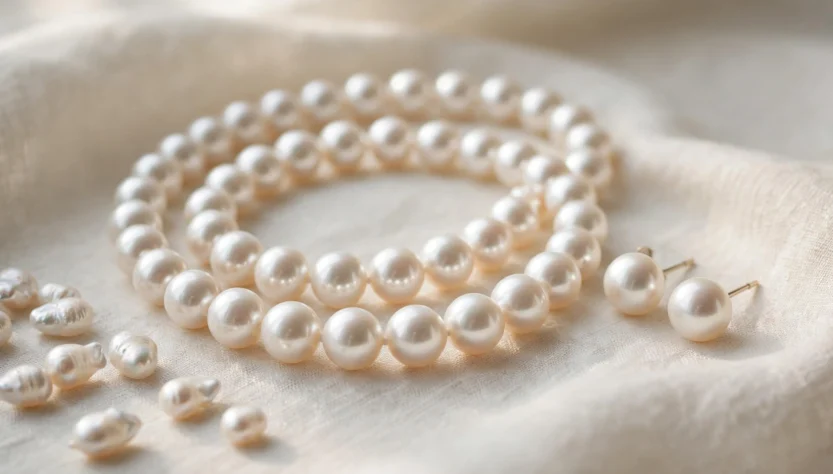
Freshwater vs Akoya pearls is the first choice most UK pearl buyers face, and it is also the choice most often explained badly. The two types look similar in a photograph, yet they differ in lustre, shape, price and durability. This guide compares them side by side, explains how pearls are graded, clears up the confusion around Edison pearls, and sets out what each budget buys in the UK.
The short answer is simple. Akoya pearls give you the classic look: near perfect roundness and a sharp, mirror-like lustre. Freshwater pearls give you larger sizes, more colours and far better value for money. The right choice depends on your budget and how often you will wear the piece. This guide gives you the facts you need to choose with confidence, whether you are buying your first strand or replacing one you have worn for years.
What Freshwater and Akoya Pearls Are: Origin, Shape and Nacre
A freshwater pearl is a cultured pearl grown in a freshwater mussel, almost always in China. A cultured pearl is a pearl that a farmer starts by placing a small piece of tissue inside the mollusc. The mollusc coats that tissue with layers of nacre, the smooth substance lining its shell. A freshwater pearl forms around tissue only, with no bead at its centre, so it is almost entirely nacre.
An Akoya pearl is a cultured saltwater pearl grown in the Akoya oyster, farmed mainly in Japan and China. The farmer places a round bead nucleus inside the oyster, and the oyster coats it with nacre. An Akoya pearl therefore has a bead core and a thin nacre layer around it.
Freshwater mussels can produce many pearls at once, often twenty or more per mussel. Akoya oysters usually produce only one pearl each, which is one reason Akoya pearls cost more. Freshwater pearls come in many shapes, from round to oval, button, drop and baroque. Akoya pearls are almost always round.
Nacre gives a pearl its glow. Freshwater pearls, with their solid nacre, are the tougher of the two in daily wear. Both are real cultured pearls. Imitation pearls are coated glass or plastic beads.
Freshwater vs Akoya Pearls: Lustre, Shape, Size and Price Compared
Lustre is the word jewellers use for the way light reflects from the surface of a pearl. Akoya pearls have a sharp, bright, mirror-like lustre. Freshwater pearls have a softer, satin-like lustre. Most freshwater pearls glow rather than shine.
Shape is the second clear difference. Akoya pearls are prized because they are so consistently round. Freshwater pearls vary more. A strand may mix round and near round pearls, Baroque freshwater pearls suit modern designs because they look less formal. Size also favours freshwater pearls. Akoya pearls usually measure between 6mm and 9.5mm. Freshwater pearls commonly run from 6mm to 11mm, and larger sizes are far easier to find.
Akoya pearls cost more because each oyster yields one pearl, while each freshwater mussel yields many. As a broad rule, an Akoya strand costs about two to four times as much as a freshwater strand of similar size and quality. The table below sets out the comparison at a glance.
| Factor | Freshwater pearls | Akoya pearls |
|---|---|---|
| Origin | Freshwater mussels, mainly China | Saltwater Akoya oysters, Japan and China |
| Nucleus | Tissue only, solid nacre | Bead nucleus, thin nacre coating |
| Lustre | Soft, satin-like glow | Sharp, mirror-like shine |
| Shape | Round, oval, button, drop, baroque | Almost always round |
| Size | Commonly 6mm to 11mm | Usually 6mm to 9.5mm |
| Colour | White, pink, peach, lavender | White, pink or silver overtones |
| Nacre | Thick, often the whole pearl | Thin, over a bead core |
| Durability | Tougher in daily wear | Needs gentler handling |
| Price | Lower, from around 50 pounds | Higher, from around 800 pounds |
| Best for | Everyday wear, larger sizes | Bridal, formal, classic look |
Edison Pearls Explained: The Confusion Buyers Run Into
Edison pearls cause more confusion than any other pearl type on the UK market. Shoppers see large, round, highly lustrous pearls at a price far below South Sea pearls and wonder what they are buying. Edison pearls are real freshwater pearls.
Edison is a trade name for a bead-nucleated freshwater pearl from China. Unlike ordinary freshwater pearls, Edison pearls grow around a bead nucleus, just like Akoya pearls. That bead lets them grow large and round, often 10mm to 15mm, with strong lustre and a clean surface. They are genuine cultured pearls, not imitation.
The confusion comes from how they are sold. Some sellers describe Edison pearls in ways that suggest they are South Sea pearls, because the size and lustre look similar. They are not. South Sea pearls grow in a different saltwater oyster in Australia, the Philippines and Indonesia, and they cost far more. Some sellers wrongly call them Akoya pearls. Edison pearls are freshwater pearls, and a trustworthy seller will say so plainly. If a listing avoids the word freshwater, shop elsewhere.
How Pearls Are Graded: The GIA 7 Factors in Plain English
How are pearls graded? Pearls are graded by looking at seven factors. The Gemological Institute of America, known as GIA, describes these seven factors as size, shape, colour, lustre, surface, nacre and matching. No single factor decides the grade.
Size is measured in millimetres across the widest part of the pearl. Larger pearls cost more, because fewer reach a large size. A 1mm increase can raise the price sharply. Shape describes how close the pearl comes to a perfect sphere. Round is the most valued shape for classic strands. Near round, oval, button, drop and baroque follow. Baroque pearls are simply irregular, and they suit modern designs.
Colour has three parts: the body colour, the overtone and the orient. The body colour is the main colour, such as white or pink. The overtone is a faint second colour, often pink or silver on white Akoya pearls. Orient is the rainbow shimmer seen on the finest pearls.
Lustre is the sharpness and brightness of the reflection on the pearl surface. High lustre pearls show a crisp reflection. Low lustre pearls look dull or chalky. Surface means the marks on the pearl. Almost every pearl has small blemishes, because pearls grow in nature. A clean surface is worth more than a heavily spotted one. Marks on the back matter less than marks on the front.
Nacre is the thickness and quality of the coating. Thick nacre gives a deeper glow and a longer life. Thin nacre may peel or wear through over time. Ask the seller about nacre thickness, especially for Akoya pearls. Matching describes how well the pearls in a strand or a pair sit together. A well matched strand has pearls of similar size, colour, lustre and shape. One dull or off-colour pearl breaks the flow of the whole strand.
Why AAA Pearl Grading Is Unregulated and What to Trust Instead
You will see AAA grading on pearl listings everywhere, from high street jewellers to online marketplaces. It sounds official. It is not. There is no single official body that defines what AAA means for pearls, and no regulator checks whether a seller uses the label correctly. One seller’s AAA can be another seller’s AA.
The letter system itself has no fixed standard. Some sellers use A, AA and AAA. Others add AAAA or plus signs. The letters suggest a ladder of quality, but the rungs are not defined anywhere. GIA teaches the seven factors, but GIA does not issue AAA grades for pearls. The letters are a trade shorthand, not a certificate. Reputable sellers use the letters consistently within their own stock. The problem is that you cannot compare AAA across sellers.
What should you trust instead? First, trust your eyes. Check the lustre, roundness and surface in good light. Second, trust a written description that names the seven factors. Third, trust a returns policy that lets you send the piece back if it does not match the description. Most pearl jewellery sold in the UK has no lab certificate, and that is normal. For everyday purchases, the description and the returns policy matter more than a letter grade.
How to Check Pearl Grading When Buying in the UK: Questions and Documents
Buying pearls in the UK is straightforward once you know what to ask. Start with the type. Ask whether the pearls are freshwater or Akoya, and ask the seller to confirm it in writing. Then ask about each of the seven grading factors. A seller who answers only with a letter grade has not given you enough.
Ask these questions before you pay:
- Are these pearls freshwater or Akoya, and is that stated on the receipt?
- What is the size in millimetres?
- How would you describe the lustre?
- What is the nacre thickness, especially if the pearls are Akoya?
- Are the pearls natural colour or treated, and has any treatment been disclosed?
- What is the returns policy?
- Is the strand knotted between each pearl?
Check the documents that come with the piece. A receipt should state the pearl type, the size and the metal used for the clasp or setting. Keep the receipt safe for insurance and any future resale. Shop with care online: read the full description and be wary of listings that show one perfect pearl and hide the rest. Under UK distance selling rules, you can return most online purchases within 14 days.
On the high street, hold the strand up in natural light near a window. Real pearls feel slightly gritty when rubbed against each other, while imitation pearls feel smooth. This tooth test is a traditional check, but it is not proof on its own. Use it alongside the questions above.
Price Tiers in the UK: What Each Budget Buys
Pearl prices in the UK span a wide range, from a modest fashion strand to a fine jewellery investment. The bands below are typical UK prices for a classic 16 to 18 inch strand. They are a guide, not a fixed price list.
| Budget band | Freshwater pearls | Akoya pearls |
|---|---|---|
| Under 100 pounds | Short strand, 6mm to 7mm, decent lustre. | Studs or a small pendant. |
| 100 to 400 pounds | Good strand, 7mm to 9mm, strong lustre. | Small strand or good studs. |
| 400 to 900 pounds | Premium strand, 9mm to 11mm, excellent lustre. | Classic strand, 7mm to 8mm, good lustre. |
| 900 to 3,000 pounds | Exceptional pearls, often with a gold clasp. | High quality strand, 8mm to 9mm, often with a gold clasp. |
| Over 3,000 pounds | Rare collector pieces and large Edison pearls. | Premium strands, 9mm to 10mm, from an established jeweller. |
Three rules help. First, size drives price fastest: moving from 7mm to 9mm can double or triple the cost of a strand. Second, the metal matters: a silver clasp costs far less than an 18 carat gold clasp. Third, a price that looks too good to be true usually is. A full strand of large round pearls for under 40 pounds is unlikely to be genuine cultured pearls, so walk away.
How Long Pearls Last: Durability, Care and Re-Stringing
Pearls are organic gems, and they are softer than most gemstones. On the Mohs hardness scale, pearls sit around 2.5 to 4.5, while a diamond sits at 10. That softness means pearls can scratch and chip if treated roughly. With sensible care, a good strand lasts for decades.
Freshwater pearls last longer in daily wear, because their nacre runs through the whole pearl. Akoya pearls need more care, because their nacre layer is thin. If it wears through, the bead core shows and the pearl cannot be repaired. Keep Akoya strands for occasions.
The silk thread fails first. It stretches and weakens with wear, moisture and body oils. A strand worn often should be re-strung about once a year. Ask your jeweller to knot the thread between each pearl. Knotting stops the pearls from rubbing and stops the whole strand scattering if the thread breaks. If the strand hangs longer than it used to, or the thread looks frayed near the clasp, take it to a jeweller. Store pearls separately in a soft pouch, away from harder gemstones, sunlight and dry heat.
How to Care for Pearls: Perfume, Water and Storage Rules
Pearl care mostly comes down to keeping chemicals away from nacre. Perfume is the biggest everyday threat. It contains alcohol and oils that dull the pearl surface over time. Always put your pearls on last, after perfume, hairspray and makeup. Our guide to why perfume damages jewellery explains which ingredients cause the damage.
Water needs care too. A brief splash will not ruin pearls, but chlorine and salt water can damage nacre and weaken the silk thread. Take pearls off before swimming or bathing. If they get wet, pat them dry and let them air dry fully.
Cleaning pearls is gentle work. Wipe them with a soft, damp cloth after each wear. For a deeper clean, use lukewarm water with a drop of mild soap, then rinse and dry flat. Never use ultrasonic cleaners, steam cleaners, jewellery dips, toothpaste or abrasive cloths on pearls. See our guide to how to clean pearl jewellery at home. Store pearls in a soft pouch, separate from other jewellery. Do not hang a pearl necklace, because the weight stretches the silk. Lay it flat instead.
Which Pearl Suits Which Occasion: Everyday, Bridal and Gifting
The best pearl is the one you will actually wear, and that depends on the occasion. For everyday wear, freshwater pearls are the natural choice. They are tougher, they cost less, and their softer lustre suits casual outfits. A freshwater pendant or studs work with jeans and work clothes alike. Larger and baroque pearls add character without looking formal.
For bridal wear, Akoya pearls are the classic choice. Their sharp lustre photographs beautifully. A classic Akoya strand with matching studs is the traditional bridal set. Freshwater pearls also work for weddings, especially for a softer bridal style.
For gifting, a pair of pearl studs is a safe first gift, because studs suit almost everyone and need no sizing. A strand suits a milestone birthday, an anniversary or a graduation. Freshwater pearls make a generous gift at a modest price, while Akoya pearls make a gift that feels like an occasion in itself. Pearls differ from fashion jewellery materials such as plated base metals and resin, which follow trends at low prices. Pearls are natural gems with a long life.
Frequently Asked Questions About Pearls
What is a freshwater pearl?
A freshwater pearl is a cultured pearl grown in a freshwater mussel, almost always in China. The farmer places a small piece of tissue inside the mussel, and the mussel coats it with layers of nacre. It is almost entirely nacre, with no bead at its centre. They come in white, pink, peach and lavender.
How are pearls graded?
Pearls are graded on seven factors described by GIA: size, shape, colour, lustre, surface, nacre and matching. Size is measured in millimetres. Shape runs from round to baroque. Colour covers body colour, overtone and orient. Lustre is the sharpness of the reflection. Surface means the visible marks. Nacre is the coating thickness. Matching is how evenly the pearls sit together.
Are Edison pearls real?
Yes. Edison pearls are real cultured freshwater pearls. They grow around a bead nucleus in a freshwater mussel, which lets them grow large and round with strong lustre. They are not imitation pearls, and they are not South Sea pearls.
Are freshwater pearls real pearls?
Yes. Freshwater pearls are genuine cultured pearls, grown by a living mussel. They are not glass, plastic or coated beads. Natural pearls, which form without any human help, are extremely rare and far more expensive.
Do Akoya pearls last?
Yes, with care. Akoya pearls last for decades when they are worn for occasions, cleaned gently and re-strung when the silk weakens. Their nacre layer is thin, so they need gentler handling than freshwater pearls.
Which is better, freshwater or Akoya pearls?
Neither is better in every case. Akoya pearls are better for the classic look, with perfect roundness and sharp mirror-like lustre, and they suit bridal and formal wear. Freshwater pearls are better for everyday wear, larger sizes, more colours and far lower prices. Choose Akoya for tradition, and freshwater for value and daily wear.