
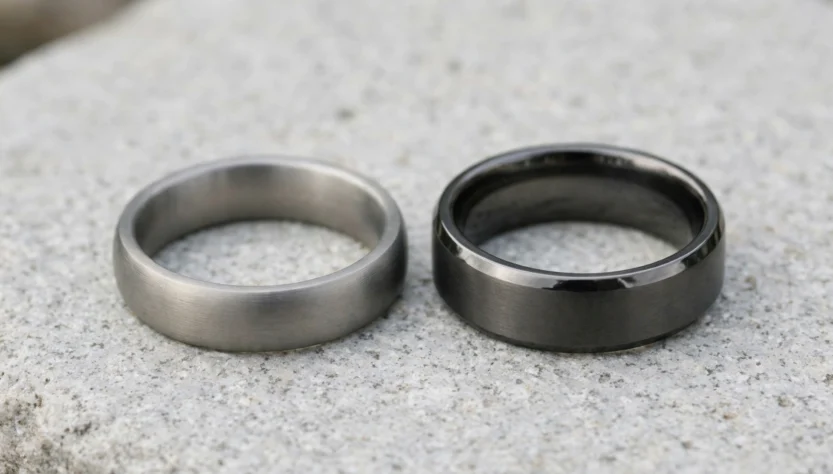
Titanium and tungsten rings look similar in a shop window, but they feel very different on the hand and they behave very differently over time. One is light and comfortable. The other is heavy, hard and almost impossible to scratch. Choosing between them comes down to how you wear a ring, what work you do with your hands, and whether resizing might ever matter.
Short answer: choose titanium if you want a light ring you forget you are wearing, especially for daily wear or active work. Choose tungsten carbide if you want maximum scratch resistance and a solid, weighty feel, and you are sure of your size. Tungsten rings cannot be resized in the normal way, while titanium rings are also very hard to resize, so sizing matters for both.
What Titanium and Tungsten Rings Actually Are
Titanium rings for jewellery are usually made from grade 5 titanium, an alloy of titanium with small amounts of aluminium and vanadium. It is a metal used in aircraft and medical implants because it is strong for its weight and resists corrosion. In a ring, that means a band that feels light, does not rust, and keeps its shape under normal wear.
Tungsten rings are almost always tungsten carbide, not pure tungsten. Tungsten carbide is a compound of tungsten and carbon, made by heating tungsten powder with carbon under pressure. It is far harder than titanium, steel or gold. Jewellers use it because it holds a polish and resists scratches better than any other common ring metal. The trade off is brittleness. Under a very hard impact, tungsten carbide can crack or shatter rather than bend.
Both metals are sometimes coated. Black titanium and black tungsten rings usually get their colour from a coating such as PVD, a thin layer applied in a vacuum chamber. The coating can wear over time, especially on the inside of the band and on edges that rub against other surfaces. Ask the seller what sits under the coating, and whether the colour is a coating or a property of the metal itself.
Titanium vs Tungsten Rings: The Main Differences
| Feature | Titanium | Tungsten carbide |
|---|---|---|
| Weight on the hand | Light, easy to forget | Heavy, solid feel similar to gold |
| Scratch resistance | Good, but it will pick up fine scratches | Excellent, very hard to scratch |
| Resizing | Very difficult, most jewellers will not resize it | Not possible in the normal way |
| Comfort fit | Available, and suits wider bands | Available, and suits wider bands |
| Colour range | Natural grey, plus coated black and blue tones | Natural dark grey, plus coated black, white and rose tones |
| Break risk | Bends under extreme force rather than cracking | Can crack under a very hard, sharp impact |
| Emergency removal | Needs a specialist ring cutter | Can be cracked off with a special tool in an emergency |
Weight and Comfort: The Difference You Feel Every Day
Weight is the first thing most wearers notice. Titanium is about a third of the weight of a similar tungsten ring. A titanium band feels light from the first day, which suits people who dislike the feeling of a ring, people who type all day, and people who wear a ring during sport or manual work.
Tungsten feels substantial. Some wearers like that weight because it feels like a traditional gold or platinum ring. Others find a wide tungsten band tiring after a long day, especially if they are not used to wearing rings. If you can, try both metals in the same width before you buy. A narrow tungsten band feels very different from a wide, flat one.
Comfort fit matters for both metals. A comfort fit band is slightly domed on the inside, so it slides over the knuckle more easily and sits more comfortably. It is worth asking for, especially for wider bands, because neither metal can be adjusted later to fix a poor fit.
Scratch Resistance and Everyday Wear
Tungsten carbide wins clearly on scratch resistance. Keys, tools, gym equipment and door handles leave far less mark on tungsten than on titanium. A tungsten ring can still lose its shine over years of hard wear, and a coated tungsten ring can show wear on its coating, but the metal underneath stays remarkably smooth.
Titanium scratches more easily. The scratches are usually fine surface marks rather than deep gouges, and many wearers accept them as part of a working ring. Brushed titanium hides scratches better than polished titanium, because the brushed finish already has a fine texture. If you want a ring that still looks new after years of daily wear, tungsten has the advantage. If you accept light wear marks and value lightness, titanium is the easier ring to live with.
Can Titanium or Tungsten Rings Be Resized?
Neither metal resizes like gold or silver. A gold ring can be cut, sized and soldered back together. Titanium and tungsten cannot be treated that way.
Most jewellers will not resize a titanium ring at all. A small number of specialist workshops can adjust titanium slightly, but the result is limited and the cost can approach the price of a new ring. Tungsten carbide cannot be resized by cutting and joining, because the material is too hard and brittle for that process.
This makes sizing the most important step in buying either metal. Get your finger sized by a jeweller, ideally later in the day when fingers are slightly larger, and in the conditions you will wear the ring in. Cold fingers measure smaller than warm fingers. If your size sits between two sizes, ask the seller about their exchange policy before you pay. Many UK sellers offer a free size exchange within a set period, which matters far more for these metals than for gold.
Stainless Steel in the Mix: Where It Sits
Stainless steel rings often appear beside titanium and tungsten rings, and they are worth understanding before you decide. Jewellery grade stainless steel is usually 316L, a grade with low carbon content and good corrosion resistance. It is heavier than titanium but lighter than tungsten, harder than silver, and far cheaper than either titanium or tungsten in most cases.
For skin comfort, the grade matters. Lower grade steel, often labelled 304, contains more nickel that can leach out with sweat and wear. Grade 316L is the grade to look for if you have sensitive skin, because its nickel is bound more tightly in the alloy. The label “surgical steel” has no single legal meaning in jewellery, so treat it as marketing unless the seller states the grade. If a listing does not state 316L, ask before you buy.
Stainless steel scratches more easily than tungsten and about as easily as titanium. It is a sensible choice if budget matters most, or if you want to test a style before committing to titanium or tungsten. It does not replace either metal on weight or on scratch resistance, but it is a useful comparison point.
Which Metal Suits Which Wearer
For a wedding ring worn every day, titanium suits people who work with their hands, play sport, or dislike heavy jewellery. Tungsten suits people who want a ring that keeps its finish with little care, and who work in an office or in light manual work where a heavy band is no problem.
For earrings and necklaces, the comparison matters less, because weight and scratch resistance are less of an issue. Titanium is a good choice for earring posts if you have sensitive skin, because it is light and well tolerated. Tungsten is rarely used for earrings or chains, because its hardness and weight suit rings far better.
For a fashion ring you change often, stainless steel or titanium makes more sense than tungsten. Tungsten is best bought as a ring you plan to keep in one size for years. For a ring with stones, check how the stones are set. Small stones set into tungsten need a skilled setter, and a cracked tungsten ring cannot be repaired like a bent gold ring.
Prices in the UK: What You Should Expect to Pay
Prices vary by width, finish and whether stones are set, but the pattern is consistent. Stainless steel rings are usually the cheapest. Titanium rings sit in the middle. Tungsten carbide rings are often priced similarly to titanium, sometimes slightly lower, because the material is common and the manufacturing is well established. Coated rings, inlay designs and stone set rings cost more in every metal.
Be wary of very cheap tungsten or titanium rings with no grade stated. A ring that does not state its material grade, or that describes itself only as “tungsten” without the word carbide, may not be what it seems. Ask for the grade, the width in millimetres, and whether the finish is coated. A clear answer is a good sign. A vague answer is a reason to buy elsewhere.
For more on how ring materials compare in general, see our guide to lab-grown diamonds vs natural diamonds in the UK, which covers certification and buying questions that apply to stone set rings in any metal. For gift buying at a set budget, see jewellery gifts under 50 pounds in the UK.
How to Care for Titanium and Tungsten Rings
Both metals need little care. Wash them in warm water with mild soap, rinse well, and dry with a soft cloth. That removes sweat, sunscreen and hand cream, which dull any ring over time. Avoid ultrasonic cleaners for stone set rings unless the seller confirms they are safe, because vibrations can loosen small stones.
Store rings separately from other jewellery, so harder metals do not scratch softer ones in the same box. Tungsten is harder than gold, silver and platinum, so a tungsten ring loose in a jewellery box can scratch softer rings. A soft pouch or a separate compartment solves the problem.
Remove any ring before heavy lifting, rock climbing, or work with machinery that could catch it. This is a safety point, not just a care point. A ring that cannot bend can cause a serious finger injury if it catches. Some workplaces require rings to be removed or replaced with a silicone band during certain tasks.
Frequently Asked Questions About Titanium and Tungsten Rings
Is tungsten heavier than titanium?
Yes, by a large margin. A tungsten carbide ring of the same size and width feels roughly three times as heavy as a titanium ring. Try both before you decide, because weight preference is personal.
Can a tungsten ring be cut off in an emergency?
Yes, but not with a normal ring cutter. Hospitals and jewellers use a special tool that cracks tungsten carbide safely. Tell medical staff that the ring is tungsten, so they use the right method.
Does titanium tarnish?
No. Titanium does not tarnish like silver. It can pick up fine scratches and lose some shine, but it does not change colour from tarnish. Coated titanium can show coating wear, which is a different issue.
Which metal is better for sensitive skin?
Both titanium and tungsten carbide are generally well tolerated, because neither relies on nickel for its structure in the way some steels do. Titanium has the longer record in medical use. If you have a known metal allergy, ask the seller for the exact grade and composition before buying.
Should I choose tungsten if I might change size?
No. If your weight, work or health makes size changes likely, choose a metal that can be resized, such as gold or silver, or buy from a seller with a clear size exchange policy. Tungsten and titanium both punish a wrong size.
Conclusion
Titanium and tungsten rings suit different wearers, and neither is better in every way. Titanium wins on lightness and everyday comfort. Tungsten wins on scratch resistance and a solid, traditional feel. Both demand careful sizing, because neither resizes in the normal way. Decide by weight first, then by how hard you are on a ring, then by price and finish. Get the size right, and either metal can serve as a comfortable everyday ring for years.