
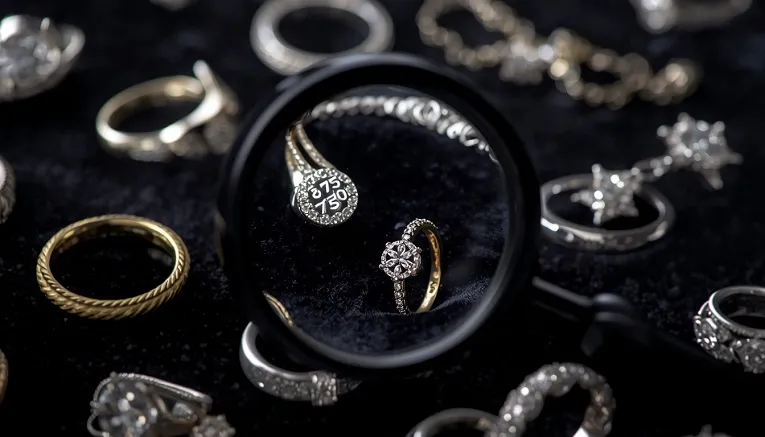
A UK jewellery hallmark is a set of tiny official stamps applied by one of the four UK Assay Offices (London, Birmingham, Sheffield or Edinburgh) that confirm a precious metal item’s purity, who submitted it for testing, and where it was tested. A full hallmark can include up to five marks: the sponsor’s mark, the fineness mark, the assay office mark, the traditional fineness symbol and the date letter. Look inside a ring band, on a bracelet clasp or on the back of a pendant, and use a loupe or your phone camera zoom if the mark is small or worn.
If you have ever turned a ring over, squinted at a cluster of tiny symbols, and had no idea what you were looking at, you are not alone. Hallmarks are one of the oldest consumer protection systems in the world, and yet most jewellery owners never learn how to read them. This guide walks through exactly what each mark means, gives you a full fineness chart for gold, silver, platinum and palladium, and shows you how to check your own jewellery at home.
What Is a Jewellery Hallmark?
A hallmark is an independent stamp applied by a UK Assay Office to confirm that a piece of gold, silver, platinum or palladium jewellery meets the legal minimum standard of purity. It is not a maker’s logo or a decorative flourish. It is a legal certification, similar in principle to a diamond certificate, except it applies to the metal itself rather than a gemstone.
Hallmarking exists because you cannot tell whether a piece of jewellery is genuine gold or silver just by looking at it or holding it. A base metal ring plated in gold can look identical to a solid gold one until it starts to wear. The hallmark is the independent proof that closes that gap between appearance and reality.
In the UK, hallmarking has been a legal requirement since the Hallmarking Act 1973, and the tradition itself stretches back even further, to 1327 when the London Goldsmiths’ Company was granted its charter. Today, only four Assay Offices are permitted to apply a UK hallmark: London, Birmingham, Sheffield and Edinburgh. Each independently tests submitted items and stamps them once they pass.
For example, two rings may look identical on the outside, but one could be solid 18ct gold while the other is simply gold plated brass. Without reading the hallmark, it is almost impossible to tell the difference by appearance alone.
Why Hallmarks Matter When Buying or Selling Jewellery
If you are buying an engagement ring, a gold chain, or a second-hand piece from an online marketplace, the hallmark is your single most reliable way to confirm what you are actually paying for. It protects you from three common problems:
- Buying an item described as solid gold that is actually gold plated or gold filled
- Overpaying for a piece because the seller misrepresented its purity
- Inheriting or acquiring a piece with no clear record of its metal content or age
For sellers and jewellers, hallmarking is a legal obligation. Selling an item described as gold, silver, platinum or palladium without a valid hallmark, where one is legally required, is an offence under UK trading law.
Hallmarks become especially important when buying jewellery from online marketplaces, auction websites, charity shops or estate sales, where the history of the item may not be fully documented. Checking the hallmark is often the quickest way to confirm whether the metal matches the seller’s description.
The Five Marks Explained
A full UK hallmark can contain up to five separate marks, though only three are compulsory. Here is what each one tells you.
1. The Sponsor’s Mark
This identifies the business or individual who submitted the item for testing, typically the maker, manufacturer, importer or retailer. It usually appears as two or three initials inside a shield, oval or other registered shape. Every jeweller registers a unique sponsor’s mark, so this is the closest thing to a maker’s signature on the piece.
2. The Fineness Mark (Millesimal Standard)
This is the number that tells you the actual metal content, expressed in parts per thousand. It is the mark most buyers look for first, because it answers the question “how much real gold or silver is actually in this?” A stamp reading 375 means the item is 37.5% pure gold, equivalent to 9 carat.
3. The Assay Office Mark
This symbol identifies which of the four UK Assay Offices tested and stamped the item. Each office has used a distinctive emblem for centuries, which also makes this mark useful for tracing a piece’s origin.
4. The Traditional Fineness Symbol (Optional)
Alongside the millesimal number, some hallmarks also carry a traditional symbol, such as a crown for gold or an orb for platinum. This mark cannot appear on its own and must always sit next to the numeric fineness mark.
5. The Date Letter (Optional)
A single letter that changes annually, allowing a piece to be dated to the year it was assayed. Date letters became optional in 1999, so many modern pieces will not carry one, but older and vintage jewellery often does.
When these marks appear together, they provide a complete identity card for the jewellery. They tell you who submitted the item, what metal it contains, where it was tested, and in some cases exactly when it was hallmarked.
Gold, Silver, Platinum and Palladium Fineness Chart
Fineness numbers are the quickest way to identify exactly what you are holding. This table covers all four precious metals hallmarked in the UK.
| Metal | Fineness Stamp | Carat / Standard | Approximate Purity |
|---|---|---|---|
| Gold | 375 | 9 carat | 37.5% pure gold |
| Gold | 585 | 14 carat | 58.5% pure gold |
| Gold | 750 | 18 carat | 75% pure gold |
| Gold | 916 | 22 carat | 91.6% pure gold |
| Gold | 999 | 24 carat | 99.9% pure gold |
| Silver | 800 | Continental standard | 80% pure silver |
| Silver | 925 | Sterling silver | 92.5% pure silver |
| Silver | 958 | Britannia silver | 95.8% pure silver |
| Silver | 999 | Fine silver | 99.9% pure silver |
| Platinum | 850 / 900 / 950 | Platinum | 85% to 95% pure platinum |
| Palladium | 500 / 950 | Palladium | 50% to 95% pure palladium |
If you are trying to work out whether a silver piece is genuinely sterling silver, our guide to <a href=”https://chicfashionjewellery.co.uk/what-is-sterling-silver-your-complete-guide/”>what sterling silver actually is</a> explains the 925 standard in more depth, including how it compares to silver plated and gold filled pieces. For gold, our breakdown of 9ct vs 18ct vs 24ct gold covers how these fineness numbers translate into price, colour and durability differences you will notice day to day.
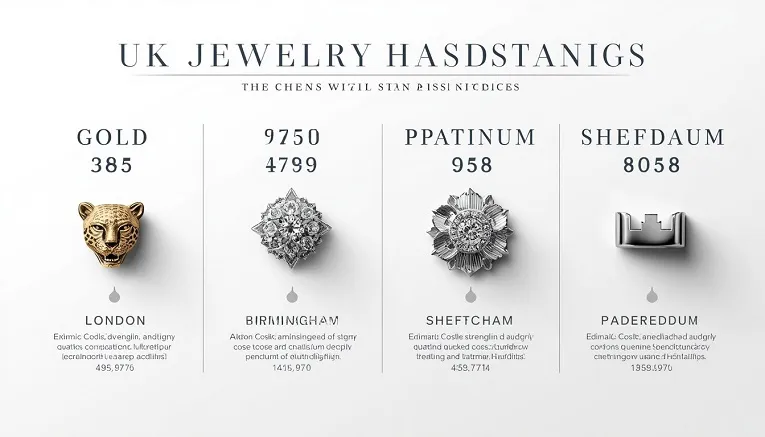
UK Assay Office Symbols
Each Assay Office has used its own heraldic symbol for centuries, and this mark is often the easiest one to spot because it tends to be the most visually distinctive stamp on the piece.
| Assay Office | City | Symbol |
|---|---|---|
| London | London | Leopard’s head |
| Birmingham | Birmingham | Anchor |
| Sheffield | Sheffield | Rose |
| Edinburgh | Edinburgh | Castle |
You may occasionally come across older or antique pieces bearing marks from Assay Offices that no longer operate, including Chester (a shield with three wheatsheaves, closed in 1962), Glasgow, or the Dublin office (a crowned harp, active until Irish independence in 1923). Finding one of these historic marks does not mean the item is fake. It simply means the piece predates the closure of that office and can help you narrow down its age.
How to Find and Check Hallmarks on Your Jewellery
Hallmarks are almost always placed somewhere discreet so they do not disrupt the design. Check inside a ring band, on the back of a pendant, near the clasp of a necklace or bracelet, or on the post of an earring.
Here is a simple checking process you can follow at home.
- Choose good lighting. Natural daylight or a bright desk lamp makes a huge difference when looking for tiny stamps.
- Check the usual spots first. Ring interiors, pendant backs, bracelet and necklace clasps, and earring posts are the most common locations.
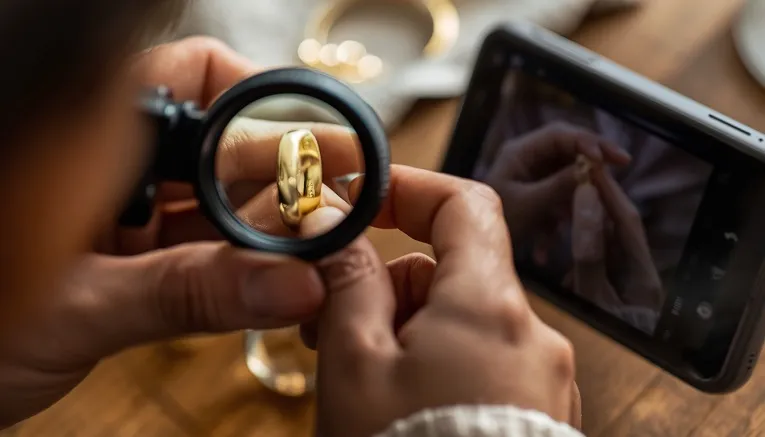
- Use magnification. A 10x jeweller’s loupe is ideal, but the zoom function on a modern phone camera works surprisingly well as a free alternative.
- Photograph the mark. Even if you cannot read it clearly with the naked eye, a close-up photo you can zoom into afterwards often reveals the detail.
- Match what you see against a chart. Compare the fineness number and assay office symbol against the tables above.
If the mark is present but too worn to read clearly, that does not automatically mean the piece is not genuine gold or silver. Decades of daily wear, repeated resizing or polishing can gradually wear a stamped hallmark down, particularly on rings. A reputable jeweller or one of the UK Assay Offices can carry out testing to confirm the metal content even when the original mark has faded.
Does All Jewellery Need to Be Hallmarked?
No. UK law sets minimum weight thresholds below which hallmarking is not legally required, even though the item is genuinely made from a precious metal.
| Metal | Exemption Weight (No Hallmark Required Below This) |
|---|---|
| Gold | Under 1 gram |
| Silver | Under 7.78 grams |
| Platinum | Under 0.5 grams |
| Palladium | Under 1 gram |
This is why very lightweight items such as delicate chains, small stud earrings or thin rings sometimes carry no hallmark at all, despite being genuine precious metal. These weight thresholds refer to the metal content only and do not include the weight of any gemstones or other materials set into the piece.
It is also worth knowing that items sold before hallmarking became compulsory, generally pieces made before the 1920s, may carry no hallmark or an incomplete one and are still considered legitimate antiques rather than fakes.
Reading Antique and Vintage Hallmarks
Vintage and antique jewellery can be trickier to read than modern pieces, largely because the hallmarking system itself has changed over time.
Before 1975, UK gold hallmarks used a different fineness system altogether: a crown symbol paired with the carat number itself, such as 9, 15, 18 or 22, rather than today’s millesimal numbers. If you find a crown next to a plain carat figure on an older piece, you are looking at the pre decimal British standard rather than a mistake or a fake.
Date letters are particularly useful for dating antique pieces, since each Assay Office cycled through a different letter of the alphabet every year, using varying typefaces and background shapes. Before the Hallmarking Act 1973 standardised the system, different offices even changed their date letter on different days of the year, which is part of why professional daters cross-reference the assay office symbol first before attempting to read the date letter.
If you are researching a piece bought in London’s historic jewellery quarter or considering where to have an older item professionally assessed, our guide to Hatton Garden covers the area’s long association with diamond and precious metal trading, testing and valuation.
Gold Vermeil, Gold Plated and the 925 Mark
One detail that catches a lot of buyers out: if you see a 925 stamp on a piece marketed as gold, that does not mean the item is fake. It means the base structure underneath the gold layer is sterling silver, not that the gold content itself has been misrepresented.
Gold vermeil is a real gold layer electroplated over a sterling silver base, and by definition it will carry the 925 silver hallmark rather than a gold fineness number, because the bulk of the item’s metal content is silver. Our guide to gold vermeil jewellery explains exactly how this differs from gold filled and gold plated alternatives, and why the base metal matters for durability and value.
Similarly, if you are comparing solid gold, gold filled and gold plated pieces, only solid gold items will carry a gold fineness stamp such as 375 or 750. Gold plated jewellery, where a thin gold layer sits over a base metal, generally will not carry a precious metal hallmark at all, because the base metal itself has no legal minimum fineness requirement to meet. This is also covered in more detail in our full gold plated jewellery guide.
Signs a Hallmark May Not Be Genuine
Genuine UK hallmarks are crisp, evenly spaced, and match an official assay office symbol exactly. Blurry, uneven, single number only, or symbol-free stamps are worth treating with caution.
A few practical warning signs to look out for when buying second-hand or online:
- A number on its own with no accompanying assay office symbol or sponsor’s mark
- Symbols that do not match any of the four current or historic UK Assay Office marks
- Stamps that look printed or painted rather than physically punched or laser etched into the metal
- Sellers who cannot or will not confirm which assay office tested the item
None of these signs alone proves an item is fake, since genuine hallmarks can wear down naturally over decades. If you have any doubt about a higher value piece, a UK Assay Office or a qualified jeweller can carry out independent testing.
Buying Second Hand and Vintage Jewellery Online
More jewellery buyers than ever are shopping second hand, whether through resale marketplaces, auction sites or vintage dealers, and hallmark literacy becomes especially useful here because you often cannot physically inspect the item before buying.
Before buying online, ask the seller for close-up, well-lit photographs of the hallmark specifically, not just the overall piece. A trustworthy seller of genuine precious metal jewellery should be able to provide this without hesitation. If you are shopping seasonal discounts or clearance sales, our guide to the best jewellery sales in the UK includes tips on spotting genuine value versus inflated “was” pricing, which applies just as usefully to precious metal purchases as it does to fashion jewellery.
If you are choosing between silver and gold plated pieces for everyday wear, our comparison of gold plated versus sterling silver jewellery and stainless steel versus sterling silver can help you decide which option suits your budget and lifestyle before you start hunting for hallmarks at all.
Frequently Asked Questions
What are the five hallmarks of gold?
A full UK hallmark can include up to five elements: the sponsor’s mark, the fineness (millesimal) mark, the assay office mark, the traditional fineness symbol, and the date letter. Only the sponsor’s mark, fineness mark and assay office mark are legally compulsory. The traditional symbol and date letter are optional additions.
How do I identify hallmarks on my jewellery?
Check inside a ring band, on the back of a pendant, or near a bracelet or necklace clasp. Use good lighting and a jeweller’s loupe or your phone camera zoom, then compare the fineness number and assay office symbol you find against a UK hallmark chart.
Does all jewellery have hallmarks?
No. Items below the UK’s legal exemption weight, such as gold under 1 gram or silver under 7.78 grams, are not legally required to carry a hallmark even if they are genuine precious metal. Antique pieces made before hallmarking became compulsory may also be unmarked.
How do you identify sterling silver hallmarks?
Look for a 925 fineness stamp, sometimes shown alongside the word “Sterling” or “Ster.” Genuine sterling silver hallmarks will also include a sponsor’s mark and, on UK-made pieces, one of the four assay office symbols.
What does 925 mean on jewellery?
925 indicates that an item contains 92.5% pure silver, meeting the legal sterling silver standard. This applies to solid sterling silver items and also appears on gold vermeil pieces, since vermeil is built on a sterling silver base.
How can I tell where my jewellery was hallmarked?
Match the small symbol in the hallmark against the four current UK assay office marks: a leopard’s head for London, an anchor for Birmingham, a rose for Sheffield, or a castle for Edinburgh. Older pieces may show symbols from historic offices such as Chester or Dublin.
How to read gold hallmarks in the UK?
Locate the fineness number first, such as 375, 585, 750 or 916, then check for the assay office symbol beside it to confirm where the item was tested. If a date letter is present, this can help confirm approximately when the piece was assayed.
Final Thoughts
Once you know how to read the sponsor’s mark, the fineness number and the assay office symbol, a jewellery hallmark stops being a mysterious cluster of tiny stamps and becomes genuinely useful information. Whether you are buying an engagement ring, sorting through an inherited jewellery box, or trying to work out exactly what that 925 stamp on your favourite gold-plated necklace actually means, the marks are there to help you, once you know what to look for.
For more on the metals behind these marks, browse our full Gold and Silver guides.
Written by the Chic Fashion Jewellery team, who research and review gold, silver and fashion jewellery across the UK market to help readers buy with confidence. For questions about metal purity, hallmarking or jewellery care, get in touch via our Contact Us page.