
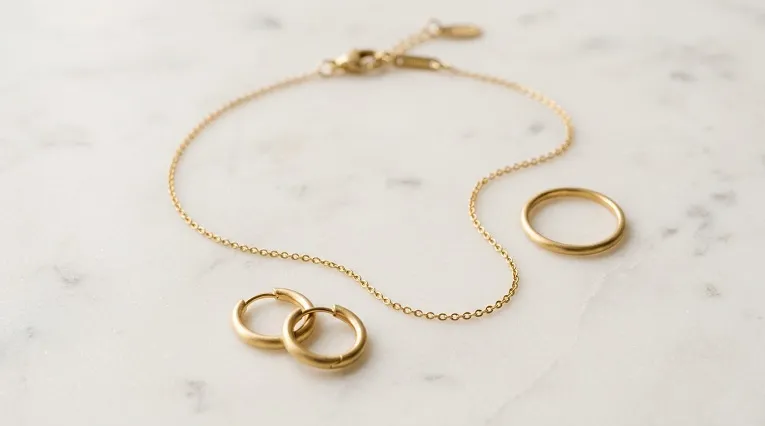
What Is Gold Vermeil Jewellery? The Complete Guide to Understanding Vermeil Gold
If you have been shopping for gold jewellery recently, you have probably seen the words “gold vermeil” on a product listing or label. Maybe you assumed it was just a fancy way of saying gold plated. Or maybe you wondered whether it was actually real gold at all.
The truth is that gold vermeil is its own specific category of jewellery, with legal standards, unique construction, and a real difference in quality compared to regular gold plated pieces.
This guide answers every question you might have, from what gold vermeil actually is and how it is made, to how it compares to solid gold, how long it lasts, and how to tell a genuine piece from a low-quality imitation.
What Is Gold Vermeil? A Clear, Simple Definition
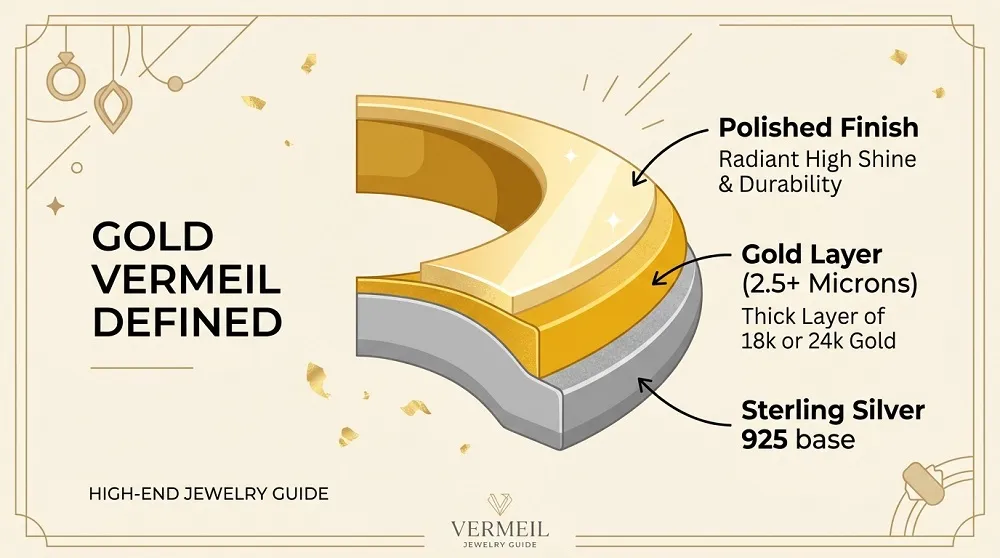
Gold vermeil (pronounced ver-MAY) is jewellery made from a sterling silver base that has been coated with a thick layer of real gold through a process called electroplating.
It is not costume jewellery. It is not solid gold either. Gold vermeil sits in a well-defined middle ground, using two genuine precious metals: sterling silver underneath and real gold on top.
In the United States, the Federal Trade Commission (FTC) sets strict legal requirements for any jewellery to be sold as “vermeil.” Three conditions must all be met:
- The base metal must be sterling silver (92.5% pure silver)
- The gold layer must be at least 2.5 microns thick
- The gold must be at least 10 karats in purity (41.7% gold content)
If a piece does not meet all three of those standards, it cannot legally be called gold vermeil in the US. This is one of the key things that separates vermeil from regular gold plated jewellery, which has no such regulations.
How Do You Pronounce Vermeil?
The word is French in origin and pronounced ver-MAY. The final “l” is silent. If you have been saying “ver-meel,” you are not alone, but now you know.
Where Does the Word Vermeil Come From?
The word “vermeil” comes from Old French and Latin, related to “vermiculus,” which referred to a bright crimson dye. Over time in France, the term evolved to describe gilded silver objects, particularly those made for the royal court. By the 18th century, French silversmiths were producing exquisite gilded silver pieces called vermeil for aristocratic households across Europe.
Today, the same term describes the modern version of that craft, though the production method has changed significantly. You might also hear vermeil referred to as “silver gilt” or “gilded silver.” These are older English terms that describe the same concept.
The Three Legal Requirements That Define Gold Vermeil
Understanding what legally qualifies as gold vermeil helps you shop smarter and avoid being misled by vague product descriptions.
The Base Must Be Sterling Silver
Sterling silver is an alloy made of 92.5% pure silver and 7.5% other metals, usually copper, for added durability. You will recognise it by the 925 stamp on genuine pieces.
Why does the base metal matter? Because jewellery wears down over time. The gold layer on any plated piece will eventually thin in areas of friction. With gold vermeil, what sits underneath is still a precious metal. With regular gold plated jewellery, the base is often brass or copper, and when the gold fades, those cheaper metals can irritate your skin or leave a green mark.
A sterling silver base also means the piece has intrinsic value beyond its gold coating, which is not true of brass-based jewellery.
The Gold Layer Must Be at Least 2.5 Microns Thick
A micron is one thousandth of a millimetre. That sounds tiny, but context makes it meaningful.
Standard gold-plated jewellery only requires a gold layer of 0.5 microns. Gold vermeil must have at least 2.5 microns, which is five times thicker. Some premium vermeil pieces reach 3 or even 5 microns.
That additional thickness is what gives vermeil its durability advantage. A thicker gold layer takes longer to wear through, which means your jewellery keeps its appearance for years rather than weeks.
The Gold Must Be 10 Karats or Higher
Karats measure the purity of gold. Pure gold is 24 karats (abbreviated 24K). The karat scale runs from 24K (99.9% gold) down to 10K (41.7% gold).
For gold vermeil, the FTC requires a minimum of 10K gold. Most quality brands use 14K or 18K gold for their vermeil, which gives a richer colour and better wear resistance.
It is worth noting the difference between karats and carats. Karats refer to gold purity. Carats refer to the weight of gemstones like diamonds. The two are completely separate measurements and easy to confuse.
Who Enforces These Standards? The FTC’s Role
The Federal Trade Commission regulates jewellery labelling in the United States. Under FTC guidelines, a seller who labels a piece as “vermeil” when it does not meet the three requirements above can face legal penalties for deceptive marketing.
The FTC also specifies that the gold must cover all significant surfaces of the piece and must be of “reasonable durability.” If a manufacturer uses a nickel barrier layer between the silver and the gold (which some do to improve plating adhesion), they are required to disclose this.
One important caveat: these are US regulations. Canada, the UK, and the EU have different standards, which we cover in a later section.
A Brief History of Gold Vermeil
Gold vermeil is not a modern marketing invention. The craft dates back centuries, and understanding its history gives you a fuller picture of why it exists and why it matters.
From Fire Gilding to Electroplating
Before the 19th century, craftsmen used a technique called fire gilding (also called mercury gilding or amalgam gilding) to coat silver objects with gold. The process involved dissolving gold in liquid mercury to create a paste, applying it to the silver surface, then heating the piece to evaporate the mercury and bond the gold permanently.
The results were beautiful and long-lasting. The problem was the mercury. Craftsmen suffered serious neurological damage from mercury vapour exposure. By the mid-1800s, the technique was largely banned in many countries for safety reasons.
Electroplating, developed in the 1840s, replaced fire gilding. It uses an electric current to deposit gold ions from a solution onto the silver surface, layer by layer. The process is precise, controllable, safe, and capable of producing a very even coat of gold. It is still the standard method used today.
The White House Vermeil Collection
One of the most famous examples of vermeil craftsmanship sits in the White House in Washington, DC. The White House Vermeil Collection is a set of gilded silver pieces, including candelabra, serving dishes, and decorative objects, that has been used for official state dinners and displayed in the White House since 1956.
The collection was gifted to the White House and represents some of the finest vermeil craftsmanship from French and American silversmiths. It is a quiet reminder that vermeil has long been considered a prestige material, worthy of the most formal settings, and not merely a budget alternative to solid gold.
How Gold Vermeil Jewellery Is Made
Most product descriptions skip the manufacturing details entirely. But knowing how vermeil is made helps you understand why quality varies between brands and why some pieces last much longer than others.
Step 1: Crafting and Preparing the Sterling Silver Base
The process starts with the silver. The silver piece is cast or formed into its final shape, then polished to a mirror finish. Surface preparation is critical at this stage. Any speck of oil, dust, or oxidation on the silver will interfere with the gold bonding. Professional jewellery manufacturers clean the silver through multiple chemical baths before plating begins.
Step 2: Electroplating (How Gold Bonds to Silver)
The cleaned silver piece is submerged in a bath of liquid solution containing dissolved gold ions. An electric current is then passed through the bath. This current causes the gold ions to migrate from the solution and bond to the silver surface, building up layer by layer.
The jeweller controls the thickness of the gold by adjusting:
- The strength of the electric current
- The concentration of gold in the solution
- The length of time the piece spends in the bath
This control is what allows manufacturers to produce vermeil at the legal 2.5-micron minimum or go thicker for premium pieces.
Step 3: Quality Finishing and Inspection
After plating, the piece undergoes multiple rinses to remove any residual plating solution. It is then dried carefully and buffed to bring out the final shine. Quality manufacturers inspect each piece for uniformity of colour, coverage, and thickness before it is packaged.
The difference between a well-made vermeil piece and a low-quality one often comes down to this final stage. Rushed finishing leads to uneven gold coverage, which causes some areas to wear down faster than others.
What Is Flash Plating, and Why Should You Avoid It?
Flash plating is the lowest quality form of gold plating. It typically involves a gold layer of under 0.5 microns, sometimes as thin as 0.1 microns, applied very quickly to a brass or copper base. These pieces look identical to quality vermeil at first glance but begin to lose their colour within days or weeks of regular wear.
If a product is described as “gold tone,” “gold colour,” or simply “plated” without specifying the thickness or base metal, it is very likely flash-plated.
Gold Vermeil vs Gold Plated vs Gold Filled vs Solid Gold
This is where most buyers get confused. The jewellery market uses several overlapping terms, and not all of them are what they appear to be.
The Full Comparison at a Glance
| Feature | Gold Vermeil | Gold Plated | Gold Filled | Solid Gold |
|---|---|---|---|---|
| Base Metal | Sterling Silver | Brass / Copper | Brass | Gold Alloy |
| Gold Thickness | Min. 2.5 microns | Min. 0.5 microns | N/A (by weight) | N/A (throughout) |
| Gold Content | Min. 10K | Any karat | Min. 5% by weight | 10K to 24K |
| Regulated (US)? | Yes (FTC) | No | Yes (FTC) | Yes (FTC) |
| Hypoallergenic? | Generally yes | Often no | Sometimes | Yes (higher K) |
| Typical Lifespan | 2 to 5+ years | Weeks to months | 10 to 30 years | Lifetime |
| Resale Value? | Minimal | None | Minimal | Yes |
| Price Range | Affordable | Cheapest | Moderate | Expensive |
Gold Vermeil vs Gold Plated: Why They Are Not the Same
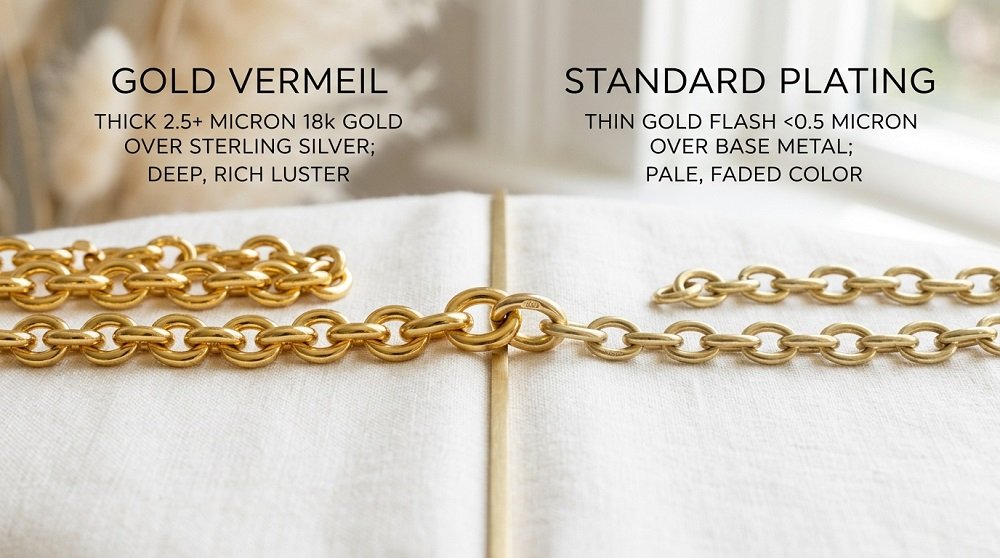
The biggest practical difference is durability. Gold-plated jewellery uses a thin gold layer over a cheap base metal. The result is a piece that can look great in photos or in a shop, but loses its colour quickly with regular wear.
Gold vermeil uses a thicker gold layer and a precious metal base. When the gold does eventually wear in high-contact areas, the sterling silver beneath does not cause skin reactions or discolouration the way copper or brass does.
Gold Vermeil vs Gold Filled: Understanding the Difference
Gold-filled jewellery is made differently from both vermeil and gold-plated jewellery. Instead of electroplating, manufacturers bond sheets of gold to a brass core using heat and pressure. By US law, the gold in a gold-filled piece must make up at least 5% of the piece’s total weight.
This means gold-filled actually contains more gold by weight than vermeil. However, the base metal is brass, not sterling silver. For buyers with brass sensitivity, this matters.
Gold-filled is generally more durable than vermeil in terms of how long the gold layer lasts, but vermeil wins on the quality of the base metal underneath.
Gold Vermeil vs Solid Gold: The Honest Answer
Solid gold jewellery is made from a gold alloy throughout, with no plating or layering. A 14K solid gold ring is 58.3% gold all the way through.
Solid gold lasts a lifetime and holds resale value. It is the right choice for heirloom pieces, engagement rings, or anything you plan to pass on. The trade-off is cost. A solid gold necklace can cost ten to twenty times the price of the same design in gold vermeil.
Gold vermeil gives you the look and weight of gold at a fraction of the cost. For everyday pieces, fashion jewellery, and gifts, it is a sensible and quality choice.
Is Gold Vermeil Real Gold?
Yes. The gold layer on a vermeil piece is genuine gold. At a minimum of 10 karats, it is legally recognised as real gold in the United States.
What gold vermeil is not is solid gold. The piece is primarily sterling silver, with a real gold coating on the outside. Think of it like quality wood veneer: the surface material is genuine, but the structure beneath is a different material.
Understanding the Karat Options in Gold Vermeil
| Karat | Gold Purity | Appearance | Durability | Best For |
|---|---|---|---|---|
| 10K | 41.7% gold | Lighter yellow | Most durable | Everyday wear |
| 14K | 58.3% gold | Warm yellow | Very durable | Everyday and special wear |
| 18K | 75% gold | Rich gold | Good durability | Special occasions |
| 24K | 99.9% gold | Deep yellow-orange | Softer | Display or occasional wear |
Most jewellery brands use 14K or 18K gold for vermeil because it strikes the right balance between rich colour and lasting wear. Pure 24K gold is very soft, which means it scratches and wears faster. Some brands like Kay Jewelers use 24K vermeil for its rich colour, which works well if the piece is worn carefully.
Which Karat Should You Choose?
Choose 14K if you plan to wear the piece daily. It holds its colour well, resists scratching, and looks great against all skin tones.
Choose 18K if you want a deeper, richer gold colour for special occasion pieces or if you prefer a more luxurious appearance and can commit to more careful wear habits.
How to Identify Genuine Gold Vermeil Jewellery
Not everything labelled as gold vermeil actually meets the legal standard, especially when buying from overseas sellers or unregulated marketplaces. Here is how to check.
Look for the 925 Hallmark
Genuine gold vermeil will always have a 925 stamp on the piece. This is the fineness mark for sterling silver, indicating that the metal is 92.5% pure silver.
You will not find a gold karat stamp like “14K” or “18K” stamped directly on a vermeil piece, because the primary metal is silver. If a piece is stamped with just a karat mark and no 925, it may be solid gold, gold filled, or simply mislabelled.
On gold plated pieces, you might see marks like GP (gold plated) or GEP (gold electroplated). These are not vermeil.
Questions to Ask Before You Buy
Before purchasing, especially from a new brand, ask:
- What is the base metal? (Answer should be sterling silver)
- How thick is the gold layer in microns? (Should be at least 2.5)
- What karat is the gold? (Should be 10K or higher)
- Is there a nickel barrier layer? (Important for allergy sufferers)
A reputable jeweller will answer these questions clearly. If a seller is vague or cannot provide specifics, that is a warning sign.
Red Flags That Suggest Low-Quality or Mislabelled Vermeil
- No 925 hallmark anywhere on the piece
- Unusually low price compared to similar styles from known brands
- Descriptions using “gold tone,” “gold colour,” or “gold finish” instead of “gold vermeil”
- No mention of micron thickness or base metal in the product listing
- The seller cannot confirm the gold karat
Is Gold Vermeil Hypoallergenic? What Sensitive Skin Buyers Need to Know
For people with sensitive skin or metal allergies, jewellery choice matters. Gold vermeil is generally considered a safe option, but there are a few things worth knowing.
Why Gold Vermeil Is Usually Safe for Sensitive Skin
Both gold and sterling silver are considered precious metals with low allergenic potential. The metals most likely to cause reactions, such as nickel, copper in high concentrations, and brass alloys, are not present in properly made gold vermeil.
This is in sharp contrast to standard gold plated jewellery, which commonly uses nickel, brass, or copper bases. When those base metals are exposed through wear, they can cause redness, itching, and the infamous green skin discolouration.
The Nickel Barrier Layer Question
Some manufacturers insert a thin layer of nickel between the sterling silver and the gold layer. This is done to improve plating adhesion and give the gold a brighter appearance. The FTC requires disclosure of this layer.
If you have a known nickel allergy, always confirm with the brand that their vermeil pieces contain no nickel. Many reputable brands specifically produce nickel-free vermeil.
A Note for UK and EU Buyers
The European Union’s Nickel Directive limits the amount of nickel that can be released from jewellery in contact with skin. Products sold in the EU must meet these standards, which gives EU buyers an additional layer of protection. UK regulations align closely with EU standards post-Brexit for jewellery safety.
If you are buying vermeil from a non-EU or non-UK seller, confirm the piece meets local safety standards before purchasing.
How Long Does Gold Vermeil Last?
This is the question most people have before buying, and the honest answer is: it depends.
The Four Factors That Determine Vermeil Lifespan
1. Gold layer thickness. The thicker the gold, the longer it lasts. A 2.5-micron layer will last longer than the absolute minimum, and a 3 or 5-micron layer will last longer still.
2. Karat quality. Higher karat gold is purer but also softer, which means it can wear faster in high-friction areas. Lower karat alloys like 14K are actually more durable for daily wear because the other metals in the alloy add hardness.
3. How often you wear it. A piece worn every single day will wear faster than one worn a few times per week.
4. How well you care for it. This is the factor you have the most control over. Exposure to water, sweat, chemicals, and rough surfaces all accelerate wear.
With regular wear and basic care, most gold vermeil pieces last between 2 and 5 years before needing attention. With meticulous care and occasional replating, a high-quality vermeil piece can stay looking good for a decade or more.
Signs Your Vermeil Is Starting to Wear
- The colour dulls even after gentle cleaning
- Small silver patches appear at edges or in high-friction areas like ring shanks
- The piece loses its warm gold tone and shifts to a slightly cooler shade
- Cleaning no longer restores the original shine
These are normal signs of wear, not defects. They simply mean the piece is ready for replating.
Can Gold Vermeil Be Replated?
Yes, and this is one of Vermeil’s genuine advantages over standard gold plated jewellery. Because the base is sterling silver, a goldsmith can strip the remaining gold layer, re-polish the silver, and apply a fresh gold coating. The result looks like a new piece.
Replating costs vary depending on the size of the piece and the thickness of gold applied, but it is significantly cheaper than replacing the jewellery entirely. Many jewellers and specialist services offer this, and it is a realistic way to extend the life of a beloved piece indefinitely.
How to Care for Gold Vermeil Jewellery
Good care habits make a real difference to how long your gold vermeil stays looking its best.
Daily Habits That Protect Your Vermeil
The most important rule is simple: remove your gold vermeil jewellery before any activity involving water, chemicals, or friction. That includes:
- Showering or bathing
- Swimming (chlorine and salt water are both harmful)
- Exercising (sweat is acidic and accelerates wear)
- Applying lotions, perfumes, sunscreen, or hairspray
- Cleaning with household products
A good habit is to put your jewellery on last when getting ready and take it off first when you get home.
How to Clean Gold Vermeil at Home
For light cleaning, a gentle wipe with a dry, soft microfibre cloth is enough to remove oils and restore shine.
For a deeper clean:
- Mix a small amount of mild dish soap with warm (not hot) water
- Dip a soft cloth in the solution
- Gently wipe the piece, avoiding hard rubbing
- Rinse with clean, cool water
- Dry thoroughly and immediately with a soft cloth
- Let it air dry completely before storing
Do not use:
- Ultrasonic cleaners (the vibrations can damage the plating)
- Abrasive cloths or sponges
- Toothpaste (too abrasive)
- Jewellery cleaning solutions not specified for vermeil
- Steam cleaners
How to Store Gold Vermeil Properly
Store each piece separately in a soft pouch or a lined jewellery box. Pieces knocking against each other cause surface scratches that dull the gold over time.
For long-term storage, an airtight container or anti-tarnish pouch reduces exposure to air and humidity, which slow down tarnishing on the silver base.
Keep vermeil jewellery away from direct sunlight and high humidity environments like bathrooms.
International Gold Vermeil Standards: What Buyers Outside the US Need to Know
The FTC standard gives US buyers clear benchmarks. But if you are buying from or living outside the US, the landscape looks different.
US vs Canada: A Significant Difference
In the United States, vermeil requires a minimum gold thickness of 2.5 microns. In Canada, the standard only requires 1.0 micron. This means Canadian-labelled vermeil can legally contain 60% less gold than US-standard vermeil.
If you are buying from a Canadian retailer, check the micron thickness explicitly. Do not assume “vermeil” means 2.5 microns unless it is stated.
Gold Vermeil Standards in the UK and EU
The UK does not have a single legal definition for “vermeil” as a standalone term. Jewellery sold in the UK must carry a 925 hallmark from an Assay Office (London, Birmingham, Edinburgh, or Dublin) to be marketed as sterling silver, but the gold layer thickness is not separately regulated under a “vermeil” standard.
The EU similarly does not have a unified “vermeil” standard, though individual member countries have precious metals regulations covering base metal composition and hallmarking.
For UK and EU buyers, this means relying more heavily on brand transparency. Look for brands that explicitly state gold thickness in microns and gold karat, not just the word “vermeil.”
A Universal Buying Checklist for Any Country
Regardless of where you are buying from, look for:
- A 925 hallmark stamped on the piece
- Stated gold thickness of at least 2.5 microns
- Stated gold karat (10K minimum, 14K or 18K preferred)
- Clear disclosure of any barrier layers (especially nickel)
- A brand with transparent product descriptions and good customer reviews
Gold Vermeil Jewellery: Pros, Cons, and Who It Is Best For
The Genuine Advantages
- Real precious metals throughout. Both gold and sterling silver are genuine materials with intrinsic value, unlike brass or copper-based alternatives.
- Hypoallergenic for most wearers. Safe for sensitive skin when nickel-free.
- Significantly more durable than standard gold-plated. Five times the gold thickness means a much longer lifespan.
- Affordable compared to solid gold. You get the look and feel of gold without the four-figure price tag.
- Wide style range. Available in yellow gold, rose gold, and white gold vermeil, and in every jewellery type from rings to necklaces to earrings.
- Replateable. Can be professionally restored when it eventually wears.
- Sustainable potential. Many brands now use recycled sterling silver as the base, which reduces environmental impact.
The Honest Limitations
- Not permanent like solid gold. The gold layer will eventually wear in high-contact areas.
- Requires more careful handling than solid gold. Cannot be exposed to water, chemicals, or rough conditions as freely.
- No meaningful resale value. Unlike solid gold, vermeil jewellery is not typically bought or valued as an investment.
- Quality varies significantly between brands. The word “vermeil” alone does not guarantee a high-quality piece.
- International standards vary, which creates confusion for cross-border shoppers.
Who Should Buy Gold Vermeil Jewellery?
Gold vermeil is a great choice if you:
- Want the appearance of fine gold jewellery without the cost of solid gold
- Have sensitive skin and need a safe base metal
- Wear jewellery regularly but want something more durable than fashion jewellery
- Are buying a thoughtful gift at a reasonable price point
- Care about wearing real precious metals, not imitation ones
- Want pieces that can be replated and refreshed over time
It is probably not the right choice if you are looking for heirloom pieces to pass down through generations, jewellery with long-term investment value, or pieces that need to withstand daily water exposure.
Frequently Asked Questions About Gold Vermeil Jewellery
What is gold vermeil jewellery?
Gold vermeil is jewellery made from a sterling silver base that has been electroplated with a layer of real gold at least 2.5 microns thick and at least 10 karats in purity. It is a legally regulated term in the United States.
Is gold vermeil the same as gold-plated?
No. Gold-plated jewellery can use any base metal and only requires a 0.5-micron gold layer. Gold vermeil requires a sterling silver base and a 2.5-micron gold layer. Vermeil is regulated; standard gold plating is not.
Does gold vermeil tarnish?
The gold layer itself does not tarnish, but it can wear over time. The sterling silver beneath can tarnish if exposed to air and moisture when the gold layer becomes thin. Proper care and storage significantly slow this process.
Can you shower with gold vermeil jewellery?
It is not recommended. Water, soap, and steam speed up the wearing of the gold layer. Removing your vermeil jewellery before showering extends its life considerably.
How long does gold vermeil jewellery last?
With regular wear and basic care, most pieces last 2 to 5 years before showing significant wear. With excellent care and occasional professional replating, a quality piece can last much longer.
Is gold vermeil hypoallergenic?
Generally, yes. Sterling silver and gold are both low-allergen precious metals. Confirm with the brand that no nickel barrier layer is present if you have a known nickel allergy.
What does the 925 stamp mean on gold vermeil jewellery?
The 925 stamp indicates sterling silver, meaning the base metal is 92.5% pure silver. Gold vermeil pieces carry a silver hallmark because silver is the primary metal in the piece, even though the visible surface is gold.
Can gold vermeil be replated?
Yes. A goldsmith can strip the existing gold layer, re-polish the silver, and apply a fresh gold coating. This restores the piece to its original appearance and is a practical option for beloved pieces that show wear.
What is the difference between 14K and 18K gold vermeil?
14K vermeil contains 58.3% gold. It is more durable and a classic warm gold colour. 18K vermeil contains 75% gold, has a richer, deeper colour, and costs more. 14K is better for everyday wear; 18K suits special occasion pieces.
Is gold vermeil a good investment?
Gold vermeil is not a financial investment in the way solid gold is. It does not hold resale value. But as a jewellery purchase, it offers excellent value: real precious metals, good durability, and a fraction of the cost of solid gold.
Conclusion
Gold vermeil sits in a well-defined and genuinely useful place in the jewellery world. It is not a marketing term, a vague category, or a shortcut. When properly made, it combines two precious metals, meets legal quality standards, and gives you years of wear at a price that makes sense.
The key is knowing what to look for. Check for the 925 stamp. Ask about micron thickness. Choose 14K or 18K gold for the best balance of colour and durability. Buy from brands that are transparent about their materials.
Take care of your pieces, remove them before water and chemical exposure, store them properly, and consider replating when needed. A well-chosen gold vermeil piece can look stunning for years, and that is exactly what good jewellery should do.