
Stainless Steel vs Sterling Silver Jewellery: The Complete, Honest Comparison
If you have been trying to decide between stainless steel and sterling silver jewellery, you are not alone. It is one of the most common questions jewellery buyers ask, and most of the answers out there either oversimplify things or push you toward whichever metal the brand happens to sell.
This guide does not do that. Both metals have genuine strengths, both have real trade-offs, and which one is right for you depends entirely on how you live and what you want from your jewellery.
By the time you finish reading, you will know exactly what each metal is made of, how it performs in real daily wear, which is safer for sensitive skin, how to care for each one, and which situations call for which metal. No vague conclusions. No wasted words.
What Are These Two Metals? Why the Difference Matters More Than You Think
Before comparing anything, it helps to understand what you are actually dealing with. These two metals are not just “silver-looking options at different price points.” They are fundamentally different materials with different compositions, properties, and histories.
What Is Sterling Silver?
Sterling silver is 92.5% pure silver combined with 7.5% other metals, almost always copper. That ratio is where the .925 hallmark comes from. If you see 925, STER, or STERLING stamped on a piece of jewellery, it confirms this standard.
Pure silver, also called fine silver at 99.9% purity, is actually too soft to use in jewellery on its own. It bends too easily, scratches too quickly, and cannot hold settings for stones reliably. Adding copper to the mix solves that. The resulting alloy is strong enough to be shaped into detailed designs while retaining the bright, lustrous appearance silver is known for.
Sterling silver is a precious metal. That classification matters because it means silver has intrinsic commodity value. It is traded on global markets, and pieces made from it retain some material worth regardless of their condition. This is part of why sterling silver typically costs more than stainless steel and why it has a resale market that stainless steel simply does not.
Visually, sterling silver has a bright, warm white tone with noticeable depth when polished. It looks rich and has a warmth to it that photographs well and suits formal and artisan jewellery particularly well.
What Is Stainless Steel?
Stainless steel is an iron-based alloy. At minimum, it contains 10.5% chromium, along with carbon and usually additional elements such as nickel, molybdenum, silicon, and manganese. The specific blend of those elements determines the grade and the properties of the finished steel.
The chromium content is the most important ingredient. When chromium comes into contact with oxygen in the air, it instantly forms an ultra-thin, transparent layer of chromium oxide on the surface of the metal. This layer is what makes stainless steel “stainless.” It prevents the underlying iron from rusting and stops most corrosive reactions from reaching the metal beneath. What makes it particularly useful is that this layer is self-repairing. If it is scratched or damaged, it reforms on contact with air.
Over 150 types of stainless steel exist across industrial applications. For jewellery, two grades dominate, and the difference between them matters far more than most brands bother to explain.
The Two Stainless Steel Grades Every Jewellery Buyer Should Know
This is information almost no brand communicates clearly, yet it is one of the most important, especially for anyone with sensitive skin.
304 stainless steel
It is the most widely used grade in jewellery. It is composed of roughly 18% chromium and 8% nickel, with iron and carbon making up the rest. 304 stainless steel offers excellent corrosion resistance under normal conditions, handles everyday moisture without issue, and maintains its appearance well over time. For most people in most situations, 304 stainless steel is a solid, reliable choice.
316L stainless steel
316L stainless steel, also called surgical steel, takes things a step further. It adds molybdenum to the 304 formula, typically around 2 to 3%. Molybdenum significantly boosts resistance to chloride-based corrosion, which means it handles saltwater and sweat far better than 304. The “L” in 316L refers to “low carbon,” which improves its weldability and further reduces corrosion risk at the structural level. This is the same grade used in surgical implants, bone screws, and body piercing jewellery. It is the gold standard for anyone prioritising skin safety and durability in wet or active conditions.
What this means for you as a buyer:
Always check product listings for the specific stainless steel grade. If a brand lists their jewellery simply as “stainless steel” without specifying 304 or 316L, ask. Brands that use 316L tend to say so because it is a selling point. If a listing is vague, that vagueness is itself useful information.
Durability: Which Metal Actually Holds Up Better?
Durability is the most common reason people search this comparison, and the honest answer is that stainless steel wins on most durability measures. But it helps to understand specifically why, and where the trade-offs lie.
Hardness, Scratch Resistance, and Daily Wear
Sterling silver sits at roughly 60 to 120 on the Vickers Hardness scale depending on the specific alloy blend and its work-hardening state. It is a relatively soft metal. 316L stainless steel sits considerably higher, typically in the range of 160 to 200 HV in its standard form, and significantly higher still after surface finishing processes.
In practical terms, a sterling silver ring worn daily without deliberate care will develop visible surface scratches within weeks. The same ring in stainless steel under identical conditions may show minimal scratching over the same period. Sterling silver, being softer, allows for more intricate jewellery designs and a classic aesthetic, but this softness also means it is more susceptible to surface damage from everyday contact with hard surfaces.
For anyone who works with their hands, wears jewellery constantly, or simply does not want to think about being careful, stainless steel’s superior hardness makes a real and noticeable difference.
Bending, Warping, and Structural Reliability
Sterling silver’s malleability, the same quality that makes it exceptional for fine design work, also makes it more prone to warping under stress. A thin sterling silver bangle can bend if sat on. A delicate sterling silver ring can warp after catching on something. This is not a flaw in the metal so much as a physical reality of its composition.
Stainless steel resists deformation considerably better. Its structural rigidity means chains, clasps, and settings hold their form reliably through impact and stress. For structural components of jewellery, stainless steel’s greater rigidity offers more reliable long-term performance.
There is, however, a meaningful trade-off here, and it comes up again in the maintenance section. Because stainless steel is harder and more rigid, it is also significantly harder to resize and repair when something does go wrong. Sterling silver’s workability is an advantage in that regard.
Active Lifestyles: Which Metal Survives Better?
Gym sessions, outdoor work, contact sports, construction, childcare, frequent handwashing. Stainless steel handles all of these more comfortably than sterling silver. It does not scratch as easily, does not tarnish from sweat exposure, and its chromium oxide layer regenerates even when the surface is abraded.
Sterling silver is better suited to a lifestyle where jewellery is worn with some conscious care, removed during certain activities, and cleaned regularly. That suits many people perfectly. For others, a metal that requires no thought at all is worth the trade-off in precious metal value and design intricacy.
Tarnish and Corrosion: Understanding How Each Metal Ages
Tarnish is the topic that generates the most frustration among jewellery buyers, and most coverage of it is either too vague to be useful or too focused on one metal. Here is the complete picture.
Why Sterling Silver Tarnishes: The Science Without the Jargon
Tarnish on sterling silver is not rust. Rust is iron oxide, which develops on iron-based metals. What happens to silver is a completely different chemical reaction.
Silver reacts with sulfur compounds in the environment, including hydrogen sulfide in the air, sulfur in certain foods, sulfur-containing compounds in rubber and some plastics, and sulfur in polluted air. When silver meets sulfur, the result is silver sulfide, a dark compound that forms a layer on the surface of the metal. That dark layer is tarnish. It is not harmful, it does not damage the metal beneath it, and it is removable with polishing. But it does look unattractive and comes back unless the underlying cause is addressed.
The 7.5% copper in sterling silver accelerates this process compared to fine silver. Copper reacts with both sulfur and oxygen more readily than silver does, contributing to faster tarnish development at the surface.
How quickly your sterling silver tarnishes depends on your individual body chemistry, the environment you live in, the products you use on your skin, and how you store the pieces. In a clean, dry environment with good storage habits, some sterling silver pieces remain bright for months without attention. In humid, polluted, or chemically active environments, tarnish can appear within days.
The Counter-Intuitive Truth About Sterling Silver and Daily Wear
This is one of the most useful and least-discussed insights about sterling silver, and it runs against what most people expect.
Sterling silver that you wear regularly actually tarnishes more slowly than sterling silver sitting in a drawer. The gentle friction of wearing the piece provides continuous, light surface polishing. Your skin’s natural oils create a subtle protective film on the surface. The result is that a sterling silver ring worn daily often maintains its shine with minimal polishing, while the same ring stored away for weeks and worn occasionally needs cleaning every single time.
The practical implication is this: if you love a sterling silver piece, wear it. The instinct to “save it for special occasions” and store it away in the meantime often creates exactly the maintenance problem you were trying to avoid. Consistent wear is a legitimate form of maintenance for sterling silver.
That said, if you do store silver, do it properly. Airtight anti-tarnish pouches or a lined jewellery box significantly slow the process. Keep rubber bands, plastic bags, and wool away from silver, as all three off-gas sulfur compounds that accelerate tarnishing.
Does Stainless Steel Tarnish or Rust?
Stainless steel does not tarnish in the way sterling silver does. The chromium oxide passive layer prevents the oxidation reactions responsible for silver tarnish from occurring on stainless steel’s surface. Similarly, the same layer prevents the iron in stainless steel from developing rust under normal conditions.
What stainless steel can do over time is develop a dullness from accumulated body oils, skincare products, and general contact with surfaces. This is not chemical degradation. It is cosmetic residue, and a wipe with a soft cloth restores the original shine quickly.
The one environment that challenges both metals is heavily sulfuric water, such as certain natural hot springs. The high sulfur content in these environments is aggressive enough to darken even stainless steel surface finishes, though sterling silver is affected more severely and more quickly.
Rhodium Plating on Sterling Silver: The Maintenance Shortcut Most Buyers Miss
Here is a practical option that almost never comes up in mainstream jewellery comparison content, despite being highly practical.
Rhodium is a precious metal in the platinum family. It is extremely hard, highly reflective, and almost completely inert, meaning it does not react with air, water, sulfur compounds, or most chemicals that cause problems for sterling silver.
Many jewellers apply a thin rhodium plate over sterling silver pieces. This creates a physical barrier between the silver surface and the environment, dramatically slowing tarnish formation. Rhodium-plated sterling silver also has improved scratch resistance compared to uncoated sterling silver. You get the precious metal value and design capability of sterling silver combined with a surface that behaves much more like stainless steel in terms of maintenance requirements.
Rhodium plating does wear off over time. Depending on the thickness of the application and how frequently the piece is worn, this typically takes between one and three years. When it does, a jeweller can re-apply it. The cost is usually modest for simple pieces.
If you love sterling silver but have always found polishing to be a nuisance, look specifically for rhodium-plated sterling silver. It is available from many reputable jewellers and is worth seeking out.
Skin Safety and Allergies: Which Metal Is Actually Safer?
Skin reactions to jewellery are more common than most people realise, and this section is particularly important for anyone who has experienced irritation, redness, itching, or rashes from wearing jewellery in the past.
Both Metals Are Generally Safe, But Not in the Same Way
Both stainless steel and sterling silver are considered hypoallergenic for most people. The most common cause of jewellery-related skin reactions is nickel, a metal found in many cheap fashion jewellery alloys and in lower-quality plated pieces. Both stainless steel (particularly 316L) and sterling silver contain little to no freely accessible nickel, which is why both are frequently recommended for people with sensitive ears or reactive skin.
For the majority of people with normal skin sensitivities, either metal should be comfortable. The nuances become important for those with more significant sensitivities.
The Sterling Silver Alloy Lottery
This concept deserves a clear, direct explanation because it is the most important thing a sensitive-skin buyer can understand about sterling silver, and it is almost never addressed clearly.
Sterling silver is legally defined as 92.5% pure silver. The remaining 7.5% can be any alloying metal or combination of metals. Copper is the traditional and most common choice. But some manufacturers use zinc, germanium, platinum, or, in lower-quality production, nickel. There is no universal regulatory requirement specifying exactly what that 7.5% must contain beyond meeting the silver purity threshold.
What this means practically: two pieces of jewellery can both be stamped .925 and have completely different alloy compositions. For most buyers, this does not matter because neither composition causes a problem. For someone with a specific allergy to nickel or another metal that might appear in that 7.5%, it can matter enormously.
With 316L stainless steel, you do not have this uncertainty. The composition is standardised, regulated, and consistent. The nickel it does contain is tightly bonded within the alloy structure rather than free to migrate to the surface. Independent testing has confirmed that quality 316L stainless steel releases negligible quantities of nickel, well within the EU REACH regulation limit of 0.5 micrograms per square centimetre per week for skin-contact jewellery. The safety is built into the material specification, not dependent on a particular manufacturer’s alloy choices.
The mitigation for sterling silver buyers: purchase from reputable, transparent brands that can confirm their alloy composition and specifically state it is nickel-free. Do not assume it is safe for sensitive skin simply because it is stamped .925.
Who Should Choose Which Metal for Skin Safety
Choose 316L stainless steel if:
- You have diagnosed nickel sensitivity or another specific metal allergy
- You have had reactions to jewellery in the past even from pieces labelled hypoallergenic
- Your skin reacts unpredictably to different pieces and you want to eliminate variables
- You have freshly healed or healing piercings where you want maximum predictability
- You cannot verify the alloy composition of a sterling silver piece you want to buy
Choose sterling silver if:
- You have no significant history of metal sensitivities
- You are purchasing from a verified, reputable brand that guarantees nickel-free composition
- Skin safety is not your primary concern and other factors drive your preference
For freshly pierced ears specifically, sterling silver from a verified quality source is a widely accepted safe option. Implant-grade titanium remains the clinical gold standard, but quality sterling silver has a long track record as a safe choice for healing piercings from reputable brands.
Does Sterling Silver Turn Your Skin Green?
Yes, it can, though the mechanism is often misunderstood.
Sterling silver itself does not cause green skin. Pure silver does not produce that reaction. The culprit is the copper in the 7.5% alloy. When copper comes into contact with sweat and skin oils, it produces copper salts. Those compounds can leave a greenish residue on skin, particularly in high-contact areas like the inside of a ring band where sweat accumulates.
This is more likely with lower-quality sterling silver where the alloy formula skews toward a higher copper ratio, or when pieces are worn in hot conditions with significant sweating. It is also more likely if the piece has been worn for a long time without cleaning, allowing copper compound buildup.
Stainless steel does not cause green skin because its alloy does not contain free copper in contact with your skin. The chromium oxide surface layer is chemically stable against the compounds in sweat and skin oils.
Green skin staining is temporary and harmless. It washes off. But if it bothers you, stainless steel is the simpler solution.
Water Resistance: What You Can and Cannot Wear in Water
This is one of the most practically important differences for modern jewellery wearers, particularly those who want to wear their pieces through workouts, travel, and daily life without thinking about removing them.
Stainless Steel and Water: The Realistic Picture
Stainless steel, particularly 316L grade, handles water exposure reliably. The chromium oxide layer protects against oxidation even in prolonged contact with water, and the metal itself does not rust under normal conditions.
Daily showers are not a problem. Gym sessions and sweating are not a problem. Rain is not a problem. Occasional swimming in fresh water is not a problem.
Where care is worthwhile: prolonged, repeated exposure to chlorinated pool water or saltwater. A single swimming session will not damage stainless steel jewellery. Swimming in the ocean or a chlorinated pool every day for months, without rinsing the piece afterward, will gradually affect the surface over a long period. The solution is simple: rinse with clean water after pool or ocean exposure and dry thoroughly. With that habit in place, stainless steel handles essentially all water-related daily activities without issue.
The one situation to avoid entirely: sulfur-rich hot springs or volcanic pools. Heavily sulfuric water is aggressive enough to affect stainless steel surface finishes. Remove jewellery before entering these environments.
Sterling Silver and Water: More Care Required
Sterling silver and prolonged water exposure do not mix as well. Water itself is not the issue. The chemicals commonly present in water are.
Chlorine, the compound used to sanitise swimming pools and hot tubs, reacts aggressively with sterling silver. It accelerates tarnishing and can cause pitting of the surface over time with repeated exposure. Saltwater is similarly problematic. The combination of salt and moisture creates a corrosive environment that speeds up both tarnishing and surface degradation of the silver-copper alloy.
Daily shower exposure with clean, non-chlorinated water is generally manageable for sterling silver if the piece is dried thoroughly after each contact. The risk is not a single shower but the cumulative effect of repeated wetting and slow drying, which creates ideal conditions for tarnish development on the surface.
Practical guidance for sterling silver wearers: remove pieces before swimming, hot tubs, and extended water-contact activities. A quick rinse under clean water and thorough drying is fine for accidental exposure. The key is avoiding the chemical environment of treated water rather than water itself.
Appearance and Design: Which Metal Looks Better?
Technical performance matters, but most jewellery purchases are driven by how a piece looks and feels. Both metals have genuine aesthetic strengths, and the better choice depends on the style you are going for.
Colour Tone: The Subtle but Real Visual Difference
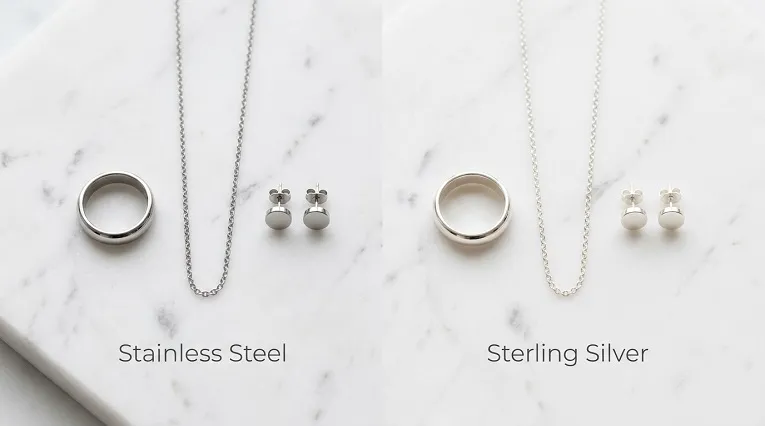
Stainless steel has a cool, grey-blue undertone. Freshly polished stainless steel has a clean, modern appearance that suits contemporary, minimalist, and industrial-inspired designs particularly well. It photographs crisply and has a precision quality to its look.
Sterling silver has a warmer, brighter white tone with more visible depth and lustre when freshly polished. The warmth comes partly from the silver itself and partly from the copper in the alloy. It has a richness that stainless steel does not quite replicate, which is part of why sterling silver has been the preferred metal for fine jewellery and artisan pieces for centuries.
In everyday wear, especially on the wrist or around the neck, the colour difference between the two metals is subtle. Most people wearing both in a stack or combination do not find the contrast jarring. But in side-by-side comparison under good light, the distinction is visible and real.
Design Intricacy: Sterling Silver’s Genuine Advantage
This is where sterling silver has a clear, practical edge that matters for certain buyers.
Sterling silver’s malleability makes it significantly easier for jewellers to work with by hand. Fine filigree work, deep engraving, delicate stone settings, sculptural forms, and complex wax-carved designs all translate more cleanly into sterling silver than into stainless steel. Artisan jewellers typically work in silver or gold rather than stainless steel because the metal responds to hand tools in a way that makes fine detail achievable.
Stainless steel’s hardness requires machine tooling, casting, or industrial manufacturing processes to shape effectively. This means the majority of stainless steel jewellery has a cleaner, more geometric, machine-made aesthetic. That suits a lot of contemporary designs perfectly. But if you are looking for a piece with exceptional hand-crafted detail, intricate surface work, or delicate construction, sterling silver gives craftspeople more creative control.
Stainless steel jewellery can be finished in a wide range of surface treatments: high-polish mirror, brushed satin, matte, hammered, and PVD-coated gold, rose gold, or black. Sterling silver offers high-polish, intentionally oxidised (antique-look), brushed, rhodium-plated, and gold-plated finishes. Both metals are versatile in terms of surface aesthetics, but the design detail achievable in sterling silver is measurably higher.
Maintenance and Care: How Much Effort Does Each Metal Really Require?
Maintenance requirements influence long-term satisfaction with jewellery more than almost any other factor. Be honest with yourself about how much upkeep you are willing to do before choosing.
How to Care for Stainless Steel Jewellery
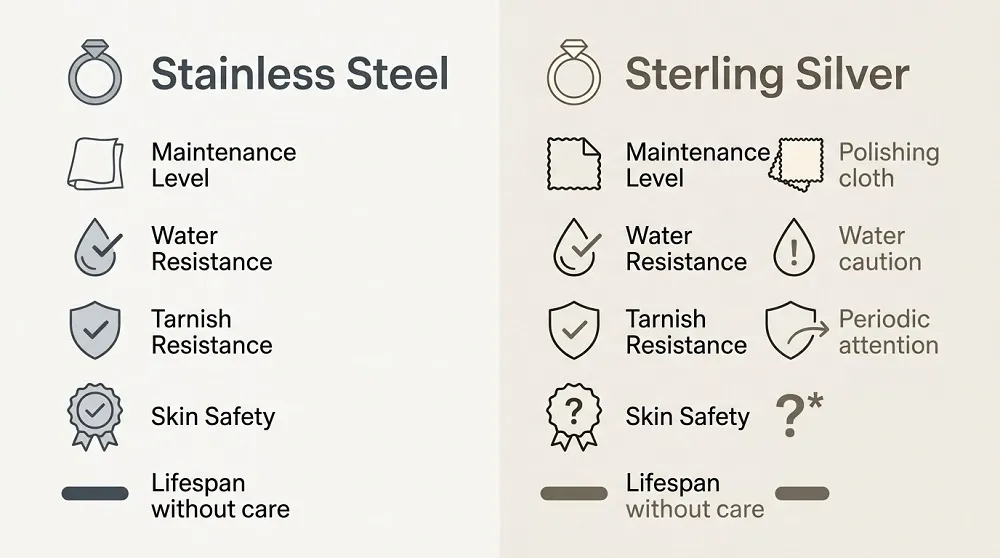
Stainless steel is low maintenance in the truest sense. Here is a practical routine:
For daily care: After wearing, wipe the piece with a soft, dry cloth to remove body oils, sweat residue, and moisture. This takes ten seconds and prevents the dull buildup that makes stainless steel look tired.
For a monthly clean:
- Fill a bowl with warm water and add a few drops of mild dish soap
- Place the piece in the water for one to two minutes
- Use a soft cloth or soft toothbrush to clean gently, following any textured surfaces
- Rinse thoroughly under clean running water
- Dry completely with a soft cloth before storing
Avoid: Abrasive scrubbing pads, bleach, chlorine-based cleaning products, and jewellery dipping solutions. None of these are necessary and all can affect the surface.
Storage: Keep pieces in a soft pouch or cloth-lined compartment to prevent surface scratching from other hard objects.
That is all stainless steel jewellery needs. No polishing compounds, no tarnish treatments, no specialist products.
How to Care for Sterling Silver Jewellery
Sterling silver rewards consistent care. Here is a complete routine:
For daily care:
After wearing, wipe with a soft, dry cloth to remove skin oils and residue. Skin oils are not the enemy of silver, but removing product buildup (sunscreen, lotion, perfume residue) prevents accelerated tarnish.
Before storing:
Dry the piece completely. Never store silver damp or in an area with humidity fluctuations.
Storage:
Use airtight anti-tarnish pouches or a lined jewellery box. Store separately from other pieces. Keep away from rubber bands, plastic bags, and wool, all of which release sulfur compounds. Small silica gel packets in your jewellery box help absorb moisture.
Regular polishing:
- Use a dedicated silver polishing cloth (the two-layer kind with a treated polishing layer and a buffing layer)
- Rub gently in back-and-forth strokes following the shape of the piece
- Do not rub in circles, which can create fine circular scratches on plain surfaces
- Buff with the clean side of the cloth to restore full shine
- How often? For daily-worn pieces, a light polish every two to three weeks keeps them looking good. For occasional-wear pieces, clean before each wear if they have been stored for more than a few weeks.
For deeper cleaning:
- Warm water and a few drops of mild soap, same as the stainless steel method
- Use a very soft toothbrush for textured areas
- Rinse and dry completely
- Avoid toothpaste and baking soda, despite popular advice. Both are abrasive enough to cause micro-scratching on polished silver surfaces over time.
- Avoid ultrasonic cleaners for pieces with porous stones or glued settings.
For stubborn tarnish: A small amount of dedicated liquid silver cleaner applied with a cloth, then rinsed off thoroughly, works better than any home remedy. Follow the product instructions and rinse completely, as residue from silver cleaning solutions can itself cause irritation in some people.
Repairability and Resizing: The Practical Factor Nobody Discusses
Almost every comparison guide ignores this, but it is a real and meaningful consideration for pieces you intend to wear long-term.
Sterling silver can be resized, repaired, and reworked by most competent jewellers. Its malleability means a jeweller can cut, solder, reshape, and refinish it with standard workshop tools. A ring that no longer fits can be sized up or down. A broken clasp can be replaced. A bent prong can be straightened. A snapped chain can be re-linked. The widespread availability of this skill and the relatively modest cost of repairs make sterling silver a practical choice for pieces you plan to own for many years.
Stainless steel is a different story. The hardness that makes it so durable also makes it very difficult to work with using standard jewellery tools. Most high-street jewellers cannot resize stainless steel rings. The specialist equipment required is not commonly available in independent jewellery workshops. Repairs are possible, but they typically require industrial metalworking facilities. Finding a workshop that can do them, and paying for the specialist labour, is considerably more complicated and expensive than equivalent sterling silver repairs.
If you are buying a ring that you expect might need resizing as your fingers change over time, or any piece that you consider a long-term investment, this difference matters. Sterling silver’s repairability is a practical advantage that its tarnished reputation sometimes overshadows.
Cost, Value, and Resale: The Financial Comparison
Both metals can be found at a wide range of price points, but the underlying economics are quite different.
What to Expect on Purchase Price
Stainless steel jewellery is generally less expensive than comparable sterling silver pieces. There are two main reasons. First, stainless steel as a raw material is far cheaper than silver, which is a traded commodity with a market price that fluctuates with global demand. Second, the dominant manufacturing approach for stainless steel jewellery uses industrial stamping and casting processes that are highly cost-efficient at scale. These savings are typically passed on to the buyer.
Sterling silver costs more because the silver itself has intrinsic value that shifts with the silver spot price, and because quality sterling silver jewellery is often produced using more labour-intensive methods. Artisan pieces with hand-finished detail are particularly expensive.
For comparable design complexity, expect to pay roughly two to four times as much for sterling silver as for stainless steel in the mass market. Artisan sterling silver commands a significantly larger premium.
Resale Value and Investment Potential: Only One of These Has It
This is a clear-cut difference worth understanding before you buy.
Stainless steel has no meaningful resale value. It is not a precious metal. If you bought a stainless steel ring for $40, you cannot resell it for anything useful. Its value to you is purely in how much you enjoy wearing it and how long it lasts.
Sterling silver has real commodity value because it contains precious metal. At a minimum, sterling silver pieces can be sold by weight at or near the silver spot price. Well-made pieces from recognised designers or from notable periods of jewellery history may hold or increase in collector value. Sterling silver can be passed down as an heirloom piece with both monetary and sentimental value that carries forward.
If the jewellery you are buying is intended to have any financial or inheritance significance, sterling silver is the clear choice. If you are buying jewellery purely as something to wear and enjoy with no expectation of financial return, stainless steel often offers better cost-per-wear value because it requires less maintenance and its lower initial cost can be justified against its practical performance.
How to Tell Stainless Steel from Sterling Silver
This is a practical guide for buyers who want to verify what they own or what they are buying, and it is something almost no jewellery content covers in a useful way.
Check for Hallmark Stamps First
Sterling silver will carry a hallmark. In most countries, sterling silver jewellery is legally required to be stamped. Common markings include:
- .925 or 925 (the most common internationally)
- STER or STERLING (common in older American pieces)
- A lion passant (the UK hallmark for sterling silver from the British Assay Office system)
Stainless steel pieces are typically stamped with:
- 316L (the grade designation for surgical stainless steel)
- 304 (the other common jewellery grade)
- S/S (abbreviation for stainless steel)
- INOX (the international designation used widely in Europe, from the French “inoxydable,” meaning rustproof)
Check the inside of ring bands, the underside of pendants, and the clasp area of bracelets and necklaces. A jeweller’s loupe (a small magnifying glass) helps read small stamps clearly.
Three Quick Tests When There Is No Visible Stamp
If you cannot find a stamp, these three simple observations can help:
Colour tone test: Hold the piece under good natural or white light. Stainless steel has a cool, slightly grey or blue-tinged silver tone. Sterling silver has a warmer, brighter, slightly creamy white tone. The difference is subtle but visible in direct comparison.
Weight test: For equivalent-sized pieces, sterling silver is noticeably denser than stainless steel. A thick sterling silver ring will feel meaningfully heavier in your hand than the same ring in stainless steel. This test works best when you have a direct comparison available.
Magnet test: Neither sterling silver nor quality austenitic stainless steel (grades 304 and 316L) is magnetic. If a piece sticks firmly to a strong magnet, it is neither quality stainless steel nor sterling silver. It is likely a cheaper iron-based alloy. This test rules out fakes but cannot confirm which of the two genuine metals you have.
If you need to confirm with certainty the metal composition of a valuable piece, a jeweller can test it with an acid test kit (destructive but definitive) or with an XRF (X-ray fluorescence) analyser, which many reputable jewellers have access to and can use without damaging the piece.
Stainless Steel vs Sterling Silver: Which Should You Choose?
You now have the full picture. Here is the clear, direct decision guide.
Choose Stainless Steel If…
- You wear jewellery every day through work, exercise, and active daily life
- You want jewellery you can shower, swim, and sweat in without giving it a second thought
- You have sensitive skin or a history of metal reactions and want predictable, reliable safety from 316L grade
- Low maintenance is a genuine priority. You do not want to think about polishing
- Budget is a primary factor and you want excellent daily-wear performance at a lower price
- You prefer modern, clean, geometric aesthetic styles
- You are buying chains, bracelets, or simple bands designed for constant wear rather than special occasions
Choose Sterling Silver If…
- You want jewellery with real precious metal value, heirloom potential, or resale worth
- You love intricate, hand-crafted designs, fine detail, deep engraving, or delicate stone settings
- You are buying for a special occasion: an engagement ring, anniversary gift, christening piece, or formal jewellery
- You are comfortable with a regular polishing routine, or you plan to buy rhodium-plated pieces that reduce this significantly
- You want the option to resize or repair the piece easily and affordably through a local jeweller in the future
- You intend the piece to last decades and potentially pass it on
What About Gold-Plated Versions of Both?
Many buyers are actually choosing between gold-plated stainless steel and gold-plated sterling silver, and this comparison is almost never addressed directly.
Gold-plated sterling silver gives you a precious metal base with a gold-coloured surface. The sterling silver base retains its intrinsic value even through the plating. The plating itself is typically applied via electroplating and will wear at edges and high-contact points over time. When it does, the silver beneath is visible. Replating is possible and can restore the piece. It suits buyers who want a gold look with the weight, feel, and resale potential of a silver piece beneath.
Gold-plated stainless steel, particularly when the gold coating is applied via PVD rather than electroplating, typically offers greater durability in the surface finish. The stainless steel base does not tarnish when the gold layer eventually wears, and the base metal holds up better physically. The trade-off is no precious metal value in the base material.
For daily-wear gold-look jewellery: gold-plated stainless steel generally provides better performance and longer-lasting finish. For occasion jewellery with real material value: gold-plated sterling silver from a reputable brand is the stronger choice.
Frequently Asked Questions About Stainless Steel vs Sterling Silver
Is Stainless Steel Better Than Sterling Silver?
Neither is objectively better. Stainless steel wins on durability, tarnish resistance, water resistance, skin safety predictability, and low maintenance. Sterling silver wins on precious metal value, resale potential, design intricacy, heirloom quality, and repairability. The better choice depends on how and why you wear jewellery.
Does Stainless Steel Tarnish?
No. Stainless steel does not tarnish. The chromium oxide layer on its surface prevents the oxidation reactions that cause tarnish. It can accumulate dullness from skin oils and products, but a wipe with a soft cloth removes this. It is not the same as tarnish.
Does Sterling Silver Turn Skin Green?
It can, though it is not the silver itself causing the reaction. The copper in the 7.5% alloy can react with sweat to produce copper salts that leave a temporary green mark on skin. This is more common in hot conditions with significant sweating, on high-contact ring surfaces, or with lower-quality alloy compositions. Stainless steel does not cause this reaction.
Can You Shower with Stainless Steel Jewellery?
Yes. Daily shower exposure is not a problem for stainless steel, especially 316L grade. Rinse and dry after showering as a general maintenance habit and the piece will maintain its appearance well over time.
Can You Shower with Sterling Silver Jewellery?
With caution. Clean, non-chlorinated water in short exposure is manageable if the piece is dried thoroughly afterward. The issue is not water itself but prolonged exposure combined with mineral content, soaps, and the repeated wetting and slow drying cycle. Chlorinated water from treated supplies should be rinsed off quickly. Pool and hot tub water should be avoided.
Is Sterling Silver Hypoallergenic?
Generally yes, for most people. Silver itself does not commonly cause allergic reactions. The copper in the alloy is usually well-tolerated. The risk comes from the small percentage of manufacturers who use other alloy components, including nickel. Buying from reputable, transparent brands minimises this risk.
Is Stainless Steel a Precious Metal?
No. Stainless steel is a base metal alloy. It is not classified as a precious metal and has no meaningful commodity or resale value as a material. Sterling silver is classified as a precious metal and holds intrinsic value based on the silver spot price.
What does .925 Mean on Jewellery?
It means the piece contains 92.5% pure silver. This is the international standard for sterling silver. The remaining 7.5% is an alloying metal, most commonly copper, added to improve the silver’s strength and durability.
Which Is Heavier, Stainless Steel or Sterling Silver?
Sterling silver is denser than stainless steel. Pure silver has a density of approximately 10.5 g/cm3, while stainless steel is around 7.9 to 8.0 g/cm3. In practical terms, a thick sterling silver piece will feel noticeably heavier in hand than the same piece in stainless steel. Whether that is a positive or negative is a personal preference.
Can Sterling Silver Be Resized?
Yes. Sterling silver can be resized by most competent jewellers using standard workshop tools and soldering techniques. This is one of sterling silver’s genuine practical advantages over stainless steel, which requires specialist equipment to resize and cannot be worked on by most high-street jewellery workshops.
How Often Should You Polish Sterling Silver?
For pieces worn daily, a light wipe with a silver polishing cloth every two to three weeks typically maintains a good appearance. For pieces worn occasionally, polish before each wear if stored for more than a few weeks. Anti-tarnish storage significantly extends the time between polishing sessions.
What Is 316L Stainless Steel?
316L is the premium jewellery grade of stainless steel. It contains iron, approximately 17 to 18% chromium, 10 to 14% nickel, and 2 to 3% molybdenum, with low carbon content. The molybdenum improves resistance to chloride-based corrosion, making it more suitable for contact with sweat and saltwater than standard 304 grade. It is the same material used in surgical implants and is the preferred grade for body piercing jewellery. For buyers prioritising skin safety and durability, 316L is the grade to look for.
Which Is Better for Sensitive Ears?
316L stainless steel offers the most predictable safety for sensitive ears because its composition is standardised and it has an established track record in medical and body jewellery applications. Quality sterling silver from a verified nickel-free brand is also a safe and widely used choice. Implant-grade titanium is the clinical gold standard if you have severe metal sensitivities. Avoid unspecified stainless steel grades and any plated fashion jewellery where the base metal is unclear.
Conclusion: Two Great Metals, Two Different Jobs
Stainless steel and sterling silver are not competitors in the way the question makes them sound. They are different tools that happen to look similar.
Stainless steel is the practical everyday workhorse. It asks nothing of you. You put it on in the morning, go about your day, and take it off at night. It handles water, sweat, impact, and neglect better than almost any other jewellery metal at its price point. If you want jewellery that fits into a busy, active life without a maintenance relationship, stainless steel is the answer.
Sterling silver is the metal with history, craft, and material worth behind it. It rewards attention and care and shows the work of the person who made it in a way that machine-made stainless steel cannot always match. It holds value, can be repaired, can be resized, and can be passed to someone who will treasure it decades from now. If those things matter to you, they are worth the polishing cloth.
Most people who love jewellery end up with both in their collection, not because they could not choose, but because different pieces serve different moments. Understanding the genuine differences between these two metals means you can make that choice deliberately rather than by chance.