
Can You Sleep with Jewellery On? What Actually Happens Overnight
You had a long day. You fall into bed and forget to take your jewellery off. Or maybe you just love your ring so much you never remove it. Either way, you wake up wondering: does it actually matter?
The honest answer is that it depends on what you are wearing, what it is made of, and how you sleep. Some pieces are low risk. Others genuinely damage both your skin and the jewellery over time. This guide covers all of it, by jewellery type, by material, and by situation, so you can make the right call for your specific pieces.
The Short Answer: Should You Sleep with Jewellery On?
For most jewellery, the recommendation is to take it off before bed. Not because something terrible will happen tonight, but because consistent overnight wear adds up. Eight hours of friction, sweat, body heat, and pressure every single night accelerates wear, tarnishing, and skin irritation faster than most people expect.
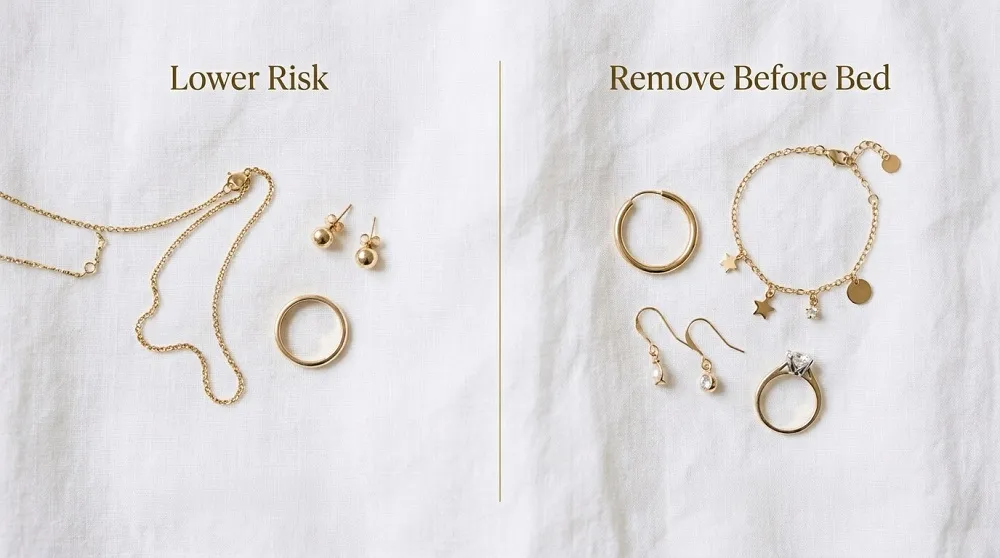
That said, some pieces are genuinely fine to sleep in. A plain solid gold band, a small flat-back stud earring in surgical steel, a simple titanium chain. These carry low enough risk that most people wear them 24/7 without problems.
The pieces that cause the most issues are necklaces (tangling and breakage), earrings with protruding backs (pressure on the scalp), rings with stone settings (prong damage and finger swelling), and anything plated (accelerated gold layer wear).
Quick Answer: In most cases, you should remove your jewellery before sleeping. Overnight wear exposes jewellery to friction, sweat, pressure, and skincare products that can speed up tarnishing, wear down gold plating, loosen gemstones, and irritate your skin. Simple pieces made from titanium, surgical stainless steel, or solid gold are generally safer to sleep in than plated jewellery, necklaces, or large earrings.
Key Takeaways
- Remove necklaces, bracelets, and gemstone rings before bed.
- Flat-back earrings are safer than butterfly backs for sleeping.
- Gold-plated jewellery wears out faster with overnight friction.
- Titanium and surgical stainless steel are the best metals for overnight wear.
- Clean jewellery regularly to reduce bacteria and skin irritation.
Quick Reference: Sleep with It On or Take It Off?
| Jewellery Type | Safe to Sleep In? | Main Risk | Verdict |
|---|---|---|---|
| Plain slim band ring | Usually | Finger swelling, moisture | Use caution |
| Ring with stone setting | No | Prong damage, snagging | Remove |
| Wedding/engagement ring | Caution | Prong loosening, swelling | Remove if set |
| Fine chain necklace | No | Tangling, breakage | Remove |
| Pendant necklace | No | Tangling, clasp stress | Remove |
| Stud earrings (flat-back) | Yes | Minimal if hypoallergenic | Generally safe |
| Butterfly-back studs | Caution | Post pressure on scalp | Use caution |
| Hoop earrings | No | Snagging, ear lobe stretch | Remove |
| Dangle earrings | No | Ear lobe elongation, tearing | Always remove |
| Chain bracelet | No | Wrist pressure, snagging | Remove |
| Rigid bangle or cuff | No | Wrist pressure, distortion | Remove |
| Anklet | Caution | Tangling, circulation | Use caution |
| New piercing jewellery | Yes (required) | Irritation if wrong metal | Keep in, right metal |
| Pearl necklace | No | String damage, luster loss | Always remove |
What Actually Happens to Your Jewellery While You Sleep
Most people picture sleep as a passive, still activity. Your body tells a different story. You shift position dozens of times each night, generate body heat, produce sweat, and press your weight unevenly against whatever you are lying on. For jewellery, this creates three distinct types of stress: friction, pressure, and chemical exposure.
Eight Hours of Friction Against Your Pillowcase
A cotton pillowcase is not smooth at a microscopic level. Its woven fibres create a surface that acts like very gentle sandpaper, and your jewellery moves against it repeatedly throughout the night. For polished metals, this gradually dulls the finish. For gold plated and gold vermeil pieces, this micro-friction removes the gold layer faster than almost anything else you could do.
A necklace that sits against a cotton pillowcase for eight hours every night is losing its finish at a measurable rate. Switch to a silk or satin pillowcase and the friction drops significantly, which is worth knowing if you sleep in jewellery by choice or necessity.
Pressure Points You Cannot Feel While Asleep
When you sleep on your side, the earring post pressed against the back of your ear is not something you consciously register. But that post is digging into skin for hours. The same applies to rings pressed between fingers, bracelets creating indentations on wrists, and pendant clasps pressed into the back of the neck.
Side sleepers have higher risk than back sleepers because they concentrate weight on one side. Stomach sleepers press necklaces and pendants directly into the chest and collarbone. None of this feels dramatic in the moment, but skin pressed against hard metal for several hours consistently leads to soreness, redness, and in some cases pressure sores.
Sweat, Skin Oils, and What They Do to Metal
Your body produces moisture during sleep even in a cool room. This moisture, combined with the natural oils your skin produces, gets trapped between jewellery and skin. The result is a warm, slightly acidic, moist environment sitting against metal for hours.
In this environment, sterling silver tarnishes noticeably faster. For gold-plated pieces, the moisture works its way into any microscopic gaps in the gold layer and begins oxidising the base metal beneath. For skin, trapped moisture combined with sweat creates the conditions for bacterial buildup, which leads to redness, itching, and in some cases mild infection.
Your Night Skincare Routine Makes It Worse
This is something no competitor guide covers, and it matters. If you apply a night cream, retinol serum, or AHA product before bed and then sleep with rings, bracelets, or a necklace on, those products get trapped against your skin under the metal.
Active ingredients like retinol and glycolic acid in prolonged skin contact under a metal band can cause localised irritation, redness, and sensitivity. Heavier night creams trap moisture under rings, which softens the skin and can cause maceration (the waterlogged, wrinkled effect you see when skin is wet too long). Perfume sprayed on the neck and then trapped under a necklace clasp overnight is a surprisingly common cause of localised contact dermatitis.
The practical fix: do your skincare routine first, let products absorb fully, and then decide whether to put jewellery back on for sleep. Better yet, remove it before your skincare routine entirely.
The Health Risks of Sleeping with Jewellery On
Occasional overnight jewellery wear rarely causes serious problems for most people. Consistent overnight wear is where the risks compound.
Skin Irritation and Contact Dermatitis
Contact dermatitis is a skin reaction caused by direct contact with an irritant or allergen. The National Library of Medicine identifies nickel as one of the most common causes of allergic contact dermatitis, and nickel is found in many jewellery alloys, including some gold and silver alloys at lower karats.
During the day, jewellery moves around on the skin, which limits sustained contact. At night, the same piece sits in exactly the same position for hours. For someone with mild nickel sensitivity who never notices a daytime reaction, overnight wear can be enough contact time to trigger redness, itching, and a rash. If you wake up with irritation under a ring or behind an earring, the overnight contact time is almost certainly the cause.
Pieces with 14K solid gold or higher, implant-grade titanium, and 316L surgical steel have the lowest risk for prolonged skin contact.
Bacteria Buildup Under Jewellery
Your jewellery accumulates dead skin cells, sweat, body oil, and environmental bacteria throughout the day. Removing it at night and wiping it with a soft cloth before storage removes most of this before it becomes a problem.
Leaving it on overnight means that accumulated bacteria sits trapped against your skin in a warm, moist environment for eight hours. The most common results are folliculitis (small red bumps or pustules under a ring or bracelet), irritation and redness around earring posts, and in people with healing piercings, a higher risk of infection.
A simple habit of wiping each piece with a dry cloth before bed, even on nights you decide to keep them on, significantly reduces this risk.
Circulation Restriction from Rings and Tight Bracelets
Fingers and wrists naturally swell during sleep. When you lie down, fluid redistributes more evenly throughout the body, and combined with body warmth, this can cause measurable swelling in the hands and wrists. A ring that fits comfortably at 6pm can be noticeably tighter by 2am.
For most people, this is a minor inconvenience. For people with a ring that already fits snugly, or who tend to retain fluid, the ring can become genuinely restrictive. Signs of overnight circulation restriction include: a deep indentation where the ring sits, numbness or tingling in the finger, slight discolouration of the finger beyond the ring, and difficulty removing the ring in the morning.
If a ring requires any effort at all to remove in the evening, remove it before sleep. The swelling will make it harder in the morning, not easier.
A Special Note for Pregnant Women and Children
During pregnancy: Fluid retention is common, particularly in the second and third trimesters, and it affects ring and bracelet fit significantly. Many pregnant women find that a ring comfortable in early pregnancy becomes dangerously tight by the third trimester, particularly overnight. Removing rings from around the third trimester, or switching to a silicone ring alternative, is a sensible precaution. The same applies postpartum, when swelling takes several weeks to fully resolve.
For children: Necklaces and bracelets worn to sleep by young children create genuine strangulation and entanglement risks. Small earring backs, clasps, and beads are choking hazards. The consistent guidance from paediatric safety organisations is that jewellery should be removed from children before sleep. There are no safe exceptions for necklaces in young children during sleep.
Did You Know?
Adults change sleeping position dozens of times each night. Those repeated movements create constant friction between jewellery, bedding, and skin, which is one of the main reasons jewellery wears faster when worn overnight.
The Physical Dangers: Tangling, Snagging, and Partner Safety
Necklaces: The Most Likely Piece to Cause a Problem Overnight
Necklaces shift with every movement during sleep. A short chain moves relatively little. A longer chain has more freedom to wrap, twist, and knot. Fine chains, particularly those thinner than approximately 0.8mm, develop micro-stress fractures at kink points from repeated overnight movement. This is why a necklace that seems sturdy eventually snaps at what looks like a random point in the chain: it has been accumulating fatigue damage at a weak spot.
If you sleep with a necklace on regularly, keep it short (14 to 18 inches), pendant-free or with a small lightweight pendant, and in a metal strong enough to resist kinking. Check the clasp condition regularly.
Earring Posts, Butterfly Backs, and Ear Lobe Damage
The post of a standard butterfly-back earring creates a hard pressure point against the scalp directly behind the ear. For side sleepers, this point bears weight for hours. The result is soreness that most people assume is just normal, but it is actually repeated low-level trauma to the skin behind the ear.
Heavier earrings, roughly above five grams, apply continuous downward pressure on the ear lobe during sleep. Over months and years, this contributes to ear lobe elongation and thinning. Dangle and drop earrings combine leverage with weight and are the highest risk for permanent ear lobe stretching. These should always come out before bed.
Prong Settings and Partner Safety
This risk is rarely discussed, and it deserves attention. Rings with raised prong settings, particularly diamond engagement rings, have sharp metal points that can scratch a sleeping partner’s skin. The same applies to charm bracelets with irregular surfaces and pendants with sharp edges.
If you share a bed and wear a prong-set ring to sleep, check with your partner whether they have noticed scratches or marks. Many people tolerate this without mentioning it. A simple smooth wedding band worn in place of a prong-set engagement ring overnight eliminates this problem entirely.
Sleeping with Rings On: What You Need to Know
Plain Bands: Lower Risk, Not No Risk
A plain smooth band in solid gold, platinum, or titanium is the lowest-risk ring to sleep in. There are no prongs to snag, no raised surfaces to catch, and durable metals do not distort from body weight. The residual risks are moisture trapped under the band and the overnight swelling issue covered above.
If you wear a plain band and have never had problems, you probably never will. The occasional habit is genuinely low risk. The concern is for consistent overnight wear over years, where even a smooth band traps sweat and prevents the skin underneath from breathing.
Engagement Rings and Stone Settings: Remove Before Bed
The prongs holding a gemstone are typically the weakest mechanical point in a ring. They are thin, they are raised, and they catch on bedding, pyjama fabric, and skin during sleep. Each catch bends a prong very slightly. Over time, this loosens the stone setting. A diamond that wobbles slightly in its setting is a diamond at risk of falling out.
The practical solution most jewellers recommend: wear a plain wedding band to bed and keep the engagement ring on the nightstand. This protects the prongs, protects your partner, and protects the stone.
When a Ring Gets Stuck Overnight
If you wake up with a ring that will not move, do not panic and do not force it.
- Elevate your hand above heart level for several minutes to help fluid drain from the finger.
- Run the hand under cold water to reduce any swelling.
- Apply a lubricant: hand soap, olive oil, or hand lotion all work.
- Rotate the ring gently while sliding it toward the fingertip. Do not pull straight.
- If the finger shows signs of restricted circulation (darkening, numbness, significant pain), seek medical help. Emergency services can remove a ring safely without damaging the finger.
Sleeping with Necklaces On
Fine Chains and the Breakage Risk
Fine chains are elegant and they are also fragile. A chain thinner than about 0.8mm is at meaningful risk of developing kinks and micro-fractures overnight. Once a chain has kinked, that point is permanently weakened. Box chains and cable chains resist tangling better than round-link or snake chains because their flatter link profiles interlock rather than twist.
If you want to sleep in a chain, choose one that is short (under 18 inches), box or cable link style, made from solid gold or surgical steel, and ideally without a pendant. A small, lightweight pendant actually helps keep the chain centred and reduces one type of tangling, but a heavy pendant creates clasp stress and can press uncomfortably into skin.
Pearl Necklaces: Always Remove
Pearls are organic material and they are sensitive. Body oils and sweat from overnight wear gradually dull the pearl surface, which cannot be reversed. The string holding a pearl necklace weakens with repeated compression against a pillow. Cotton bedding is abrasive enough to scratch pearl surfaces. Store pearl necklaces flat in a soft cloth pouch after removing them each night.
Sleeping with Earrings In: A Guide by Type
Stud Earrings: Safe with the Right Back
Small stud earrings in hypoallergenic metal are the most sleep-friendly earring option. The variables are the size (under 8mm diameter keeps pressure manageable) and the earring back.
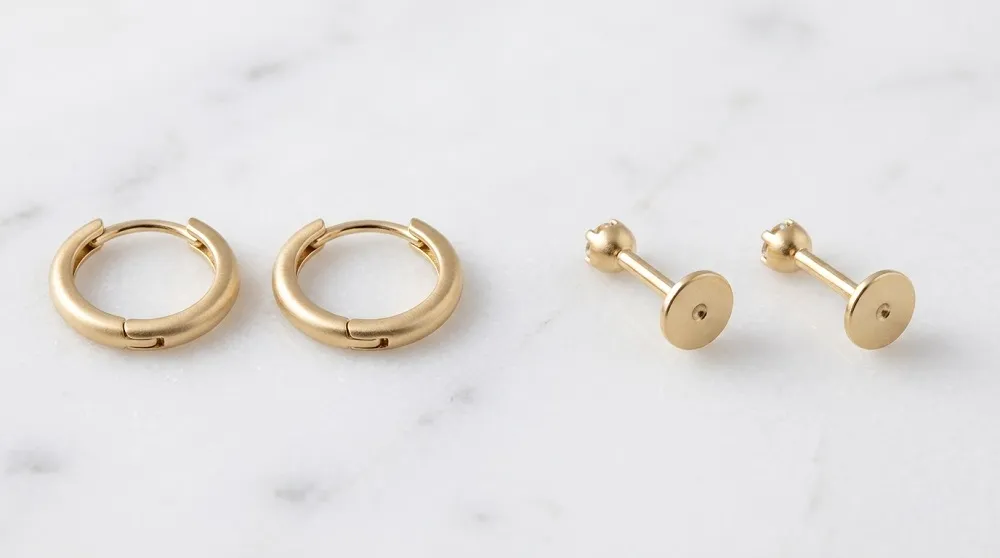
Butterfly backs (the standard push-back fitting) have a protruding mechanism that presses into the scalp for side sleepers. Flat-back labret studs, where the back is a flat disc that sits flush against the head, eliminate this pressure point entirely. If you sleep in earrings regularly, switching to flat-back labret fittings is one of the most practical improvements you can make.
Hoop Earrings: Take Them Out
Even small hoops create a catch point. When you roll onto your side, the hoop can catch on the pillowcase and pull against the piercing. This applies less to huggie hoops, which fit very close to the ear lobe and have minimal surface area to snag. But standard open-hoop earrings should come out before bed.
The ear lobe elongation that comes from wearing hoop earrings to sleep develops gradually over months. By the time it is noticeable, some of the stretching is permanent.
Dangle and Drop Earrings: Never Sleep in These
All the weight of a dangle earring is applied to the piercing hole at a single point. Lying on your side concentrates that weight with leverage for hours. The earring hook can also catch in hair or fabric, creating a sudden sharp pull that can tear the ear lobe.
No dangle or drop earring is appropriate for overnight wear, regardless of the metal. The risk is entirely mechanical, not about the material.
What Are Sleeper Earrings?
Sleeper earrings are small, smooth, continuous hoop earrings designed specifically for overnight wear and healing piercings. The defining feature is the design: a thin, unbroken hoop with a small latch or continuous wire that sits flush with the ear. There is no protruding back, no hook, and no catch point.
Originally used during the healing period of new piercings, sleeper earrings are now popular for anyone who wants to sleep with earrings in without the pressure point problem. They work best in hypoallergenic metals: implant-grade titanium, 316L surgical steel, or solid gold at 14K or higher.
Sleeper earrings versus flat-back labret studs: Both are valid for overnight wear. Flat-back studs have an advantage for side sleepers because the back is completely flush with the head. Sleeper earrings have an advantage for active sleepers because there is no back component to lose or move. Personal comfort and sleeping position should guide the choice.
Sleeping with Bracelets and Bangles On
Chain bracelets snag on bedding, build up pressure on the wrist, and can slip or tighten depending on how you move. Wrist swelling during sleep is real for the same reason finger swelling occurs: fluid redistribution and body warmth.
Rigid bangles and wide cuff bracelets carry additional risk because they cannot adjust to swelling and can press directly into the wrist bone if slept on. Wide cuffs can also bend slightly out of shape if body weight is applied to them, which is noticeable on softer metals like sterling silver.
The practical guidance for bracelets is simple: take them off. If you need to wear something on your wrist overnight for personal or cultural reasons, a smooth, properly sized bangle in a durable metal carries the least risk.
Can You Sleep with Smart Rings and Fitness Jewellery?
Smart rings and fitness trackers are designed for continuous wear and many are safe to sleep in. In fact, several sleep-tracking features require overnight use to monitor heart rate, movement, and sleep quality.
However, it’s still important to clean these devices regularly because sweat, skin oils, and bacteria can build up underneath them. If you notice redness or irritation, remove the device for a few hours each day and clean both your skin and the ring according to the manufacturer’s instructions.
Although smart rings are built differently from fashion jewellery, they can still become scratched if they rub against hard surfaces while you sleep.
Which Metals Are Safest to Sleep In?
The material of your jewellery is the most important factor in determining overnight safety for your skin.
Solid gold (14K and above): Yellow solid gold is hypoallergenic at 14K and above because the alloy content at this purity is low enough that nickel is not a significant concern in most yellow gold. It does not tarnish. It is the most practical precious metal for overnight wear. White gold is a different case: most white gold contains nickel in its alloy, which increases skin reaction risk for sensitive individuals.
Gold plated and gold vermeil: These should come off at night. The gold layer on plated and vermeil pieces is thin enough that overnight friction from pillowcases removes it measurably over time. For gold vermeil specifically, the sterling silver underneath tarnishes rather than causing a green skin reaction, but you will notice the gold colour fading sooner than it should.
Sterling silver: Tarnishes quickly with consistent overnight exposure to sweat. Removing it nightly and storing it in an anti-tarnish pouch is the single most effective way to keep sterling silver looking good longer.
Platinum: Durable, hypoallergenic, and non-tarnishing. A plain platinum band is low risk for overnight wear. Platinum pieces with stone settings carry the same prong risks as gold settings.
Titanium and 316L surgical steel: These are the best metals for overnight wear if you need to sleep in jewellery consistently. Both are biocompatible, which means they are designed to be in sustained contact with human tissue without causing a reaction. They do not tarnish, do not contain problematic nickel content, and resist the effects of sweat and body heat. Body jewellery and medical implants use these materials precisely because they tolerate 24/7 wear.
Pearls and soft gemstones: Pearls, opals, turquoise, and emeralds are sensitive to abrasion and chemical exposure. Always remove jewellery containing these materials before sleep.
Can You Sleep with Jewellery in a New Piercing?
Yes, and during the healing period you should keep jewellery in. A new piercing is an open wound, and the jewellery holds the channel open while healing occurs. Removing it during healing, including overnight, allows the piercing to begin closing within hours.
Healing times vary: earlobe piercings take a minimum of 6 to 8 weeks, cartilage piercings take 6 to 12 months, and nose piercings typically take 4 to 6 months for full healing. During this entire period, follow your piercer’s specific aftercare guidance, which overrides any general advice.
For new ear piercings, the professional standard is a flat-back labret stud in implant-grade titanium or 316L surgical steel. This combination minimises pressure on the healing tissue and eliminates allergic reactions from the metal. Sleeper earrings are also appropriate for some new piercings if your piercer recommends them.
To sleep more comfortably with a new ear piercing:
- Use a travel pillow with a hole in the centre so your ear hangs free rather than pressing against the surface
- Sleep on the opposite side from the new piercing where possible
- Change your pillowcase every 2 to 3 days during the active healing phase
- Avoid sleeping with long hair loose around a new ear or neck piercing
Does a Silk Pillowcase Actually Help?
Switching to a silk or satin pillowcase is a genuine improvement for anyone who sleeps in jewellery regularly. The difference in friction between cotton and silk at a microscopic level is significant. Cotton fibres create a rougher surface that catches against metal, accelerating surface wear. Silk and satin slide rather than catch.
For gold plated pieces in particular, this matters. The same piece that loses its finish within months on a cotton pillowcase might last noticeably longer on a silk one.
That said, a silk pillowcase does not eliminate sweat contact, pressure points, or tangling risk. It reduces friction damage. It works best as part of a broader approach: hypoallergenic metals, low-profile styles, and a silk pillowcase to reduce wear for pieces you genuinely need or want to sleep in.
The Two-Minute Bedtime Jewellery Routine
The reason most people fail to remove jewellery before bed is not laziness. It is friction: if you do not have a designated spot within arm’s reach that takes zero effort to use, you will not do it consistently.
Here is a routine that works:
- Remove jewellery as part of your skincare sequence. Before washing your face and brushing your teeth, take off your rings, earrings, necklace, and bracelet. The habit hooks onto an existing routine and becomes automatic within a week or two.
- Wipe each piece with a dry, soft cloth. Five seconds per piece. This removes the day’s oils and sweat before they can tarnish or build up. Small habit, big difference.
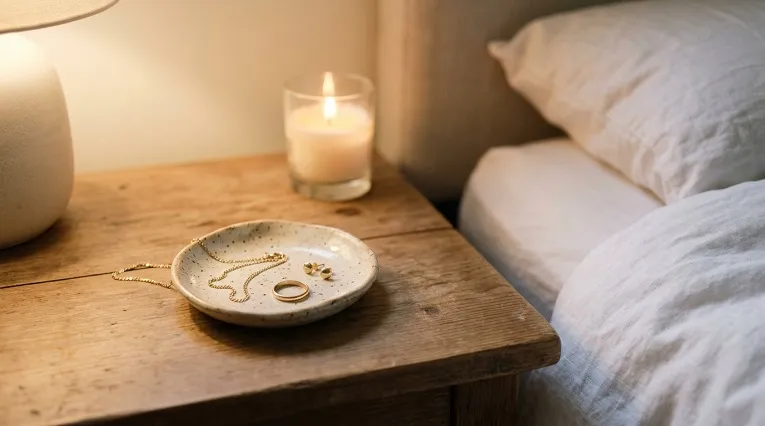
- Put everything in a designated spot immediately. A ceramic ring dish, a lined jewellery box, or an anti-tarnish pouch. The spot needs to be on the nightstand or dressing table, not in the bathroom (humidity speeds up tarnishing on silver). If it is within arm’s reach and always in the same place, the habit sticks.
- Keep jewellery away from bathroom storage. Steam from showers accelerates tarnishing on sterling silver and weakens some gemstone settings. A shelf outside the bathroom is always better than inside it.
What to avoid: leaving pieces loose on the nightstand surface where they can be knocked off, storing pieces piled together where they scratch each other, or putting a ring in a pocket where it ends up in the laundry.
Jewellery Designed for 24/7 Wear
Some people cannot or do not want to remove their jewellery overnight. For cultural, medical, or personal reasons, this is a real consideration. The good news is that the jewellery market has pieces specifically designed for continuous wear.
For a piece to genuinely handle overnight wear without damaging your skin or itself, three things need to be true simultaneously:
- Biocompatible metal: 316L surgical steel, implant-grade titanium, niobium, or solid gold at 14K or above
- Low-profile style: flat-back over protruding backs, simple chains over layered looks, slim bands over wide cuffs, no dangling elements
- Sweat and moisture resistance: the metal must not tarnish, flake, or react with the body’s chemistry
If any one of these is missing, the piece carries meaningful overnight risk.
Silicone rings deserve a specific mention. These have become a popular alternative for overnight wear, particularly for people in active professions, pregnant women dealing with finger swelling, and anyone who wants to keep something on their ring finger without the risks of metal. Silicone rings stretch and break under pressure rather than cutting the finger, contain no allergens, and are completely unaffected by moisture, sweat, or body heat. They are not for everyone aesthetically, but they solve the overnight ring problem completely.
Frequently Asked Questions About Sleeping with Jewellery On
Can you sleep with jewellery on? You can, but most types carry some level of risk to your skin or the jewellery itself. The safest overnight choices are small stud earrings in surgical steel or solid gold, plain slim metal bands, and simple short chains in durable metals. Most jewellery benefits from being removed at night.
Is it safe to sleep with a ring on? Plain, smooth bands in solid gold, platinum, or titanium carry low risk. Rings with stone settings, rings that fit snugly, or rings with raised prong details should be removed to protect the settings and avoid finger swelling becoming a problem overnight.
Should I take my necklace off before bed? Yes, in almost all cases. Necklaces are the piece most likely to tangle, knot, and break during sleep. If you must wear one, choose a short, simple cable or box chain in a durable metal with no pendant.
Can you sleep with stud earrings in? Small studs in hypoallergenic metal are generally fine. Choose flat-back labret fittings over butterfly backs to eliminate the pressure point behind the ear. Clean consistently if worn overnight regularly.
What are sleeper earrings?
Sleeper earrings are small, smooth, continuous hoop earrings with no protruding back or hook. They are designed specifically for overnight wear and healing piercings. Made in hypoallergenic metals like titanium or surgical steel, they are one of the most comfortable options for anyone who wants to sleep with earrings in.
Does sleeping with jewellery on make it tarnish faster?
Yes, particularly for sterling silver and gold plated pieces. Sweat, body heat, and skin oils trapped under jewellery during sleep accelerate tarnishing and surface degradation significantly. Removing jewellery before bed and wiping it clean is the most effective tarnish prevention habit.
Can you sleep with jewellery in a new piercing?
Yes, and you must during the healing period. New piercings will begin to close within hours if jewellery is removed. Use implant-grade titanium or 316L surgical steel in a flat-back labret style, and follow your piercer’s aftercare instructions throughout the healing period.
Can a ring get stuck on my finger overnight?
Yes. Fingers swell during sleep from body warmth and horizontal positioning. A ring that requires any effort to remove in the evening can be much harder or impossible to remove by morning. If your ring feels snug before bed, take it off.
Is it bad to sleep with pearl jewellery on?
Yes. Pearls are sensitive to body oils, sweat, and abrasion from bedding. Consistent overnight wear dulls the pearl surface and weakens the string on pearl necklaces. Always remove pearl jewellery before sleep.
Is it safe for children to sleep with jewellery on?
No. Necklaces and bracelets create strangulation and entanglement risks for children during sleep. Small components like clasps and earring backs are choking hazards. Remove all jewellery from children before they sleep.
Conclusion
Sleeping in jewellery occasionally is rarely a serious problem. Sleeping in it every night without thought is where damage accumulates, for your pieces and sometimes for your skin.
The simple habit of removing jewellery before your bedtime skincare routine, wiping each piece, and placing it in a specific spot eliminates almost all the overnight risks. Two minutes before bed protects jewellery that might be worth hundreds or even thousands of pounds, keeps your skin healthier, and means you start every morning with pieces that still look good.
If you genuinely need or want to sleep in jewellery, choose biocompatible metals, low-profile styles, and properly fitted pieces. A silk pillowcase helps reduce friction damage. A silicone ring solves the overnight ring dilemma entirely.
The goal is not a perfect routine. It is a simple, consistent one that protects what you care about.