
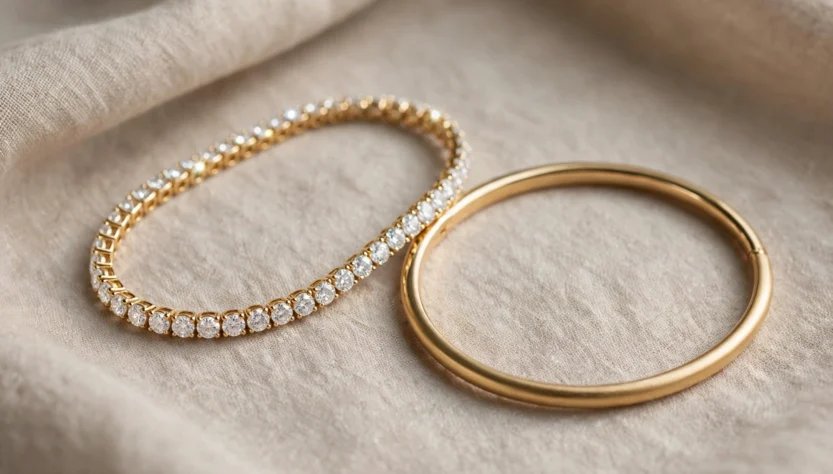
A tennis bracelet and a bangle look simple on the wrist. They behave very differently in daily life. One is a flexible line of stones on a chain. The other is a rigid circle that holds its shape. This guide compares price, comfort, security, stacking and sizing, so you can choose with confidence in the UK.
Short answer: Choose a tennis bracelet for sparkle, flexibility and a close fit that moves with your wrist. Choose a bangle for a bold shape, easy on and off wear, and a lower starting price for a similar look. If you want both, stack a slim bangle with a tennis bracelet, but size the pair together, not separately.
What a Tennis Bracelet and a Bangle Actually Are
A tennis bracelet is a single row of stones, usually round cut, set in a line on a flexible chain. The name comes from tennis, where a player famously stopped a match to look for a lost diamond bracelet. The design is light, even and symmetrical. It sits close to the wrist and moves as you move.
A bangle is a rigid bracelet. It is a solid circle, or a hinged circle that opens and closes. It does not flex. It slides over the hand, or it opens at a hinge. Bangles come in many widths, from a slim wire to a wide cuff. A cuff is a type of bangle with a gap, so it slips on from the side of the wrist.
The difference matters for comfort. A flexible bracelet follows your wrist. A rigid bangle keeps its shape and moves as one piece. That is why a bangle can knock against a desk, while a tennis bracelet tends to stay flat.
Tennis Bracelet vs Bangle: Price, Comfort, Security and Style Compared
Price depends on material and stones, not on the style alone. A tennis bracelet uses many small stones, so the stone count pushes the price up. A plain metal bangle uses no stones at all, so it often costs less than a stone set tennis bracelet in the same metal. A gem set bangle can cost as much as a tennis bracelet, or more, if the stones are large.
| Feature | Tennis bracelet | Bangle |
|---|---|---|
| Fit | Close and flexible, moves with the wrist | Rigid, needs room to slide over the hand or open at a hinge |
| Comfort at a desk | Usually flat and quiet | Can knock and slide, especially wider styles |
| Security | Depends on the clasp, check it every time | Hinged styles close firmly, solid styles cannot fall off once on |
| Stacking | Easy, adds sparkle without bulk | Adds shape and sound, best in small numbers |
| Daily wear | Good for regular wear if the clasp is strong | Good for regular wear, but wide styles show marks sooner |
For style, a tennis bracelet suits a neat, polished look. It works at work, at a wedding and at dinner, without changing the outfit. A bangle suits a bolder look. One wide bangle can carry an outfit. Several slim bangles give movement and sound.
Clasp Security: What Keeps Each One On Your Wrist
A tennis bracelet is only as safe as its clasp. Look for a box clasp with a safety catch, or a clasp with a figure of eight safety chain. Test it before you buy. Open and close it several times. It should click firmly and need a clear push to open.
A hinged bangle closes with a clasp too, but the hinge adds a second point of hold. Check that the hinge moves smoothly and that the clasp sits flush when closed. A solid bangle has no clasp at all. Once it is over your hand, it cannot slip off unless it is far too loose. That is a real advantage, but it also means the fit must be right from the start.
Whichever style you choose, check the clasp or hinge every few weeks. Clasps wear with use. A jeweller can tighten a loose clasp, and that small job can save a lost bracelet.
Daily Wear: Which One Survives Work, Travel and Weekends
For work at a keyboard, a slim tennis bracelet is often the easier choice. It lies flat and does not catch on sleeves. A slim bangle also works, but a wide bangle can press against a desk and pick up scratches.
For travel, a tennis bracelet packs well in a jewellery roll and is easy to put on after security checks. A bangle takes more room and can dent if it knocks against other items in a bag. For more on packing, see our guide to everyday jewellery capsule essentials.
For weekends, both work. A tennis bracelet adds polish to a simple outfit. A bangle adds character to a plain jumper or a summer dress. If you do a lot with your hands, such as gardening or gym work, take both off. Stones can chip, metal can dent, and clasps can catch.
Care is similar for both. Keep them away from perfume and hairspray, wipe them after wear, and store them separately so stones do not scratch metal. Our earlier guide explains lab grown versus natural diamonds in the UK, which helps if you are choosing stones for a tennis bracelet.
Stacking: How to Wear Each With Other Bracelets
Stacking works best when one piece leads and the rest support it. Let the tennis bracelet lead with sparkle, then add a slim bangle or a fine chain. Or let a wide bangle lead with shape, then add nothing else on that wrist.
Keep the total slim for work. Two or three slim pieces look polished. Four or more can look busy and can scratch each other. Mix metals only if the tones are close, such as yellow gold with warm rose gold, or keep to one metal for a clean look.
Sound is part of stacking. Bangles chime when they meet. If you work in a quiet office, choose one bangle and a tennis bracelet, not a full stack of bangles.
How to Measure Your Wrist for a Bracelet: CM Method, Step by Step
Measure your wrist before you order. A tape measure, or a strip of paper and a ruler, is all you need.
- Wrap the tape around your wrist just below the wrist bone, where a bracelet would sit.
- Keep it snug but not tight. You should be able to slip one finger under the tape.
- Note the number in centimetres. That is your wrist size.
- Add ease, as explained below, to get your bracelet size.
- Measure again in the evening. Wrists swell slightly during the day, and the evening number is the safer one.
Do not guess from a ring size or a dress size. Wrist size varies a lot, and a bracelet that fits a friend may not fit you.
Fit by Bracelet Type: Bangle vs Chain vs Cuff, and How Much Ease Each Needs
Ease is the extra room between your wrist and the bracelet. The right amount depends on the style.
- Tennis bracelet: add about 1 to 1.5 cm to your wrist size for a close fit. Add a little more if you want it to move freely.
- Chain bracelet: add about 1 to 2 cm, depending on how loose you like it.
- Solid bangle: no ease is added in the same way. The inside diameter must clear your hand, so measure around your knuckles with your hand in the position you use to put a bangle on.
- Cuff: add a small amount of ease, and choose a gap that lets you slip it on from the side without forcing it.
If a tennis bracelet is too tight, it will pull and stress the clasp. If it is too loose, it will slide over your hand and catch on things. A close fit that still moves is the aim.
Stacking Measurement: Sizing for Two or Three Bracelets Together
When you stack, size the group, not each piece alone. Put all the pieces on, then check that you can move your wrist freely and that the stack does not slide over your hand.
Start with the largest piece. A wide bangle sets the room the stack needs. Then add slimmer pieces inside that room. If the stack feels tight, size up the slimmest piece first, not the bangle.
For a tennis bracelet stacked with a bangle, choose the tennis bracelet in your normal size and the bangle in a size that clears your hand comfortably. The two will sit at slightly different points on the wrist, which is normal and looks natural.
Which One to Choose: A Decision Framework by Budget, Lifestyle and Occasion
Use these questions to decide.
- Budget first? A plain bangle gives the most look for the least spend. A stone set tennis bracelet is a bigger purchase, so buy it when you want a piece you will wear for years.
- Daily wear? A slim tennis bracelet or a slim bangle both work. Choose the one that suits your work and your sleeves.
- One special piece? A tennis bracelet is the classic gift and the classic milestone piece. It suits birthdays, anniversaries and weddings.
- Bold style? A bangle, especially a wide one, makes a statement on its own.
- Stacking? Start with a tennis bracelet, then add bangles one at a time.
For gift ideas at a set budget, our guide to titanium versus tungsten rings in the UK shows how material choice changes price and wear, a useful check before you buy any metal jewellery.
Frequently Asked Questions About Tennis Bracelets, Bangles and Bracelet Sizing
What is a tennis bracelet? A tennis bracelet is a flexible bracelet made from a single line of stones, usually round cut, set in a row. It fastens with a clasp and sits close to the wrist.
How tight should a bracelet fit? It should move a little but not slide over your hand. For a tennis bracelet, about 1 to 1.5 cm of ease over your wrist size gives a close, comfortable fit.
How do I measure my wrist for a bracelet? Wrap a tape measure just below your wrist bone, note the size in centimetres, then add ease for the style you want. For a solid bangle, measure around your knuckles instead.
Can I wear a tennis bracelet every day? Yes, if the clasp is strong and you take it off for heavy manual work, sport and swimming. Check the clasp regularly.
Can I stack a tennis bracelet with a bangle? Yes. Keep the stack slim, let one piece lead, and size the group together so it moves freely without sliding off.
Is a bangle or a tennis bracelet better for small wrists? Both can work. A slim tennis bracelet in the right size looks neat on a small wrist. A slim bangle also works, but a very wide bangle can overwhelm a small wrist.
The right choice is the one you will reach for often. Measure your wrist, check the clasp, and choose the style that fits your daily life, not just the occasion.