
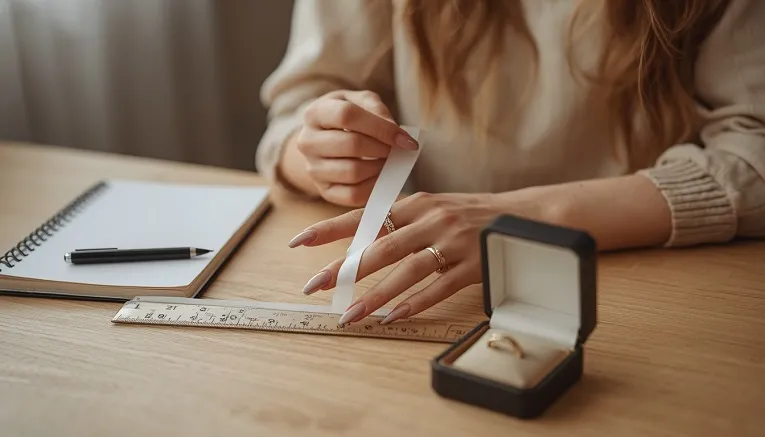
Quick answer: The fastest way to find your ring size at home is to wrap a thin strip of paper or a piece of non-stretchy string around the base of your finger, mark where the ends meet, then measure that length in millimetres against a UK ring size chart. Measure in the evening when your fingers are at their largest, and take two or three readings to be sure. If you already own a ring that fits the right finger, measuring its inner diameter works just as well and is usually the more reliable option.
Buying a ring online without knowing your size is one of the easiest ways to end up disappointed. You’ve picked the metal, chosen the style, maybe even matched it to your skin tone or wardrobe using our other guides, and then the box arrives and the ring either spins loosely on your finger or won’t pass your knuckle at all. None of that has anything to do with the ring itself. It comes down to one measurement that takes about five minutes to get right.
This guide walks through exactly how to measure your ring size at home using things you already have, how UK sizing compares with US and European systems, when to measure for the most accurate result, and what to do if you’re sizing a ring for someone else without giving the surprise away.
Why Getting Your Ring Size Right Matters
A ring that’s slightly too big will spin around your finger and catch on jumpers, gloves and door handles. A ring that’s too small is worse: it can be genuinely difficult to remove, particularly in warm weather when fingers naturally swell. Getting it right the first time saves you the cost, and the wait, of sending a ring back for resizing.
If you’ve already worked out which metal suits you using our Gold Jewellery Guide or our What Is Sterling Silver? guide, sizing is the last practical step before you buy. It’s worth five extra minutes.
UK, US and EU Ring Sizing Explained
Why the UK Uses Letters, Not Numbers
The UK ring size system runs alphabetically from A through to Z, with half sizes in between, such as K½ or N½. Each letter corresponds to a specific inner diameter of the ring in millimetres. This system is also used in Ireland, Australia and New Zealand.
The US and Canada use a numeric scale instead, generally running from around 3 to 13, again with half and quarter sizes available. Most of Europe uses a different numeric scale again, based directly on the ring’s inner circumference in millimetres, which is why European sizes tend to sit in the mid-forties to sixties.
Why You Can’t Convert Sizes With a Formula
There’s no maths shortcut between these three systems, and that trips up a lot of first-time buyers. UK letters, US numbers and EU sizes were each built independently, using different starting points and different increments. A UK size does not equal a US size of the same number, and there’s no simple multiplier or addition that gets you from one to the other.
The only reliable way to convert between them is a lookup table based on the physical measurement that all three systems actually describe: the inner diameter or inner circumference of the ring in millimetres. That measurement never changes, no matter which country’s label is stamped inside the band. If you know your size in millimetres, you know your size everywhere.
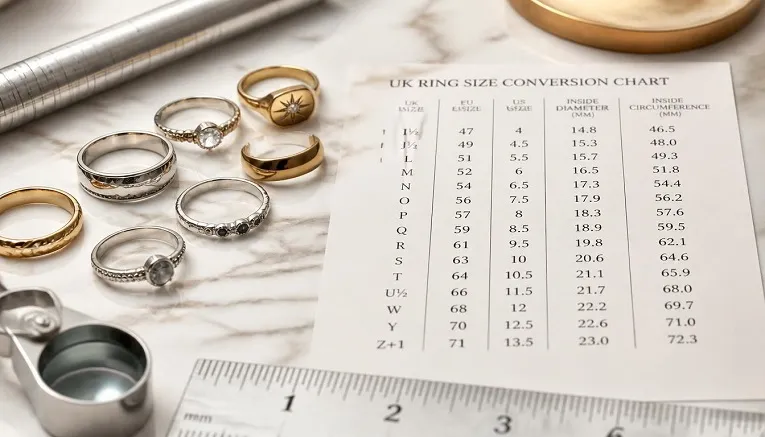
UK to US to EU Ring Size Conversion Chart
Use this table to convert between systems once you have a measurement in millimetres.
| UK Size | US Size | EU Size | Inner Diameter (mm) | Inner Circumference (mm) |
|---|---|---|---|---|
| H | 4 | 46.5 | 14.9 | 46.8 |
| J½ | 5 | 49 | 15.7 | 49.3 |
| L | 6 | 51.5 | 16.5 | 51.9 |
| N | 7 | 54 | 17.3 | 54.4 |
| P½ | 8 | 56.5 | 18.2 | 57.2 |
| R½ | 9 | 59 | 18.9 | 59.5 |
| T½ | 10 | 62 | 19.8 | 62.1 |
| V½ | 11 | 64 | 20.6 | 64.6 |
| Y | 12 | 67 | 21.4 | 67.2 |
Half sizes fall between these rows. If your measurement lands between two figures, round up rather than down, since a slightly loose ring is easier to live with than one that won’t fit over the knuckle.
How to Measure Your Ring Size at Home (4 Methods)
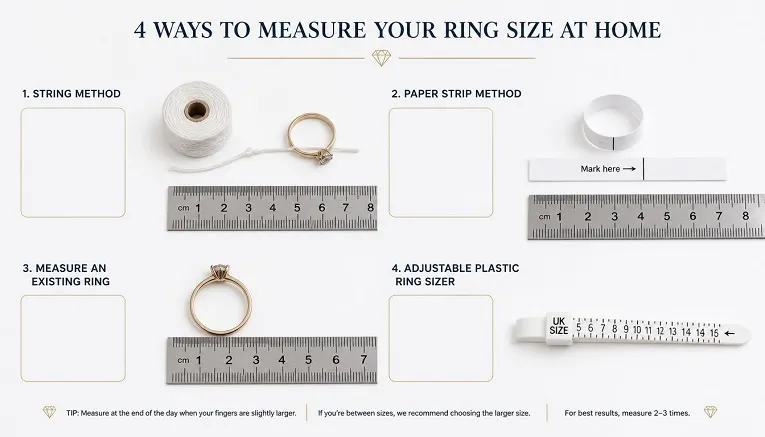
Method 1: The String or Paper Method
This is the quickest option and needs nothing more than what’s already in a kitchen drawer.
- Cut a thin, non-stretchy strip of paper or a piece of string about 15cm long.
- Wrap it snugly around the base of the finger you’d wear the ring on, at the point where the ring would normally sit.
- Mark the spot where the two ends meet with a pen.
- Lay the string or paper flat and measure the length in millimetres with a ruler.
- Match that circumference figure to the chart above.
Keep the wrap snug but not tight. You want it to sit the way a ring actually would, comfortably close but able to slide over the knuckle without a fight.
Method 2: Measuring an Existing Ring
If you already own a ring that fits the correct finger, this method tends to be more reliable than string, since there’s no risk of over-tightening.
- Place the ring on a flat surface.
- Measure the inner diameter, the distance straight across the inside of the band, not the outer edge.
- Match the diameter figure to the chart above.
Which Finger and Which Hand to Use
Always measure the specific finger the new ring is intended for, since sizes vary noticeably between fingers on the same hand. Your dominant hand is often very slightly larger than your non-dominant hand, so if the ring is for a particular hand, measure that one rather than assuming both match.
Method 3: A Printable Ring Sizer
Several UK jewellers offer free printable ring sizers online. Print the sizer at 100% scale (most browsers default to “fit to page,” which will distort the measurements, so double-check this setting), cut it out, and wrap it around your finger as directed. This method is a helpful middle ground between the string method and a proper sizer tool.
Method 4: An Adjustable Ring Sizer Tool
A physical, reusable ring sizer is the closest you’ll get to an in-store measurement without leaving home. Slide it onto your finger, tighten gradually until it feels snug but comfortable, and read off the size marked at the join. These tools are inexpensive and worth keeping if you expect to buy rings online more than once.
Which Method Is Most Accurate?
| Method | Accuracy | Tools Needed | Best For |
|---|---|---|---|
| String or paper | Good | String/paper, ruler, pen | A fast first estimate |
| Existing ring | Very good | Existing ring, ruler | Confirming a size you already trust |
| Printable sizer | Good | Printer, scissors | A guided, repeatable measurement |
| Adjustable sizer tool | Very good | Reusable sizer tool | Getting the closest thing to an in-store fitting |
For the most confidence, use two different methods and check that they agree. If they don’t, that’s usually a sign you’re between two sizes rather than a sign either method failed.
When to Measure for the Most Accurate Result
Why Finger Size Changes During the Day
Fingers are consistently smaller first thing in the morning and largest in the evening, after a day of normal activity and warmth. A morning measurement can read as much as half a size smaller than an evening one, which is exactly the kind of gap that leaves a ring feeling tight by the afternoon. Always measure in the evening, and avoid measuring immediately after exercise or a hot bath, when fingers are temporarily swollen beyond their normal size.
Temperature, Humidity and Other Factors That Affect Fit
Cold weather causes fingers to shrink slightly as blood vessels narrow, so a measurement taken outdoors in winter can undersize you. Humidity and salt intake both cause mild, temporary water retention, which can nudge finger size up for a day or two. None of these factors change your true size long term, but they’re worth avoiding on measurement day. Aim for a normal room temperature, a normal diet, and an evening reading for the most dependable result.
Average UK Ring Sizes for Women and Men
These figures are a helpful reference point if you’re stuck without any measuring tools, though they should never replace an actual measurement.
| Group | Typical UK Range | Approximate mm Circumference |
|---|---|---|
| Women | L to N | 51.5mm to 54mm |
| Men | R to V | 59mm to 64mm |
Treat this table as a starting estimate for gift shopping under time pressure, not a substitute for measuring whenever you can.
What to Do If You’re Between Two Sizes
If your measurement sits right between two sizes on the chart, size up rather than down. A ring that’s a touch loose can be worn with a small silicone ring adjuster in the meantime, while a ring that’s too tight is uncomfortable, harder to resize, and in some metals and settings, more expensive to correct.
Does Band Width Change Which Size You Need?
Yes, and this is a detail most sizing guides skip entirely. A wider band, such as a chunky signet ring or a thick wedding band, needs to be slightly larger than a slim band to fit the same finger comfortably, because more metal makes contact with the finger and the fit feels tighter for the same internal diameter. As a rough guide, go up half a size for bands wider than 6mm.
This also matters if you’re planning to wear several rings together. Our How to Stack Rings guide covers proportion and texture in detail, but from a pure sizing perspective, rings worn stacked on the same finger benefit from being measured together rather than individually, since the combined width changes how snug each one needs to be.
How to Find Someone Else’s Ring Size Without Them Knowing
Sizing a ring for a proposal or a surprise gift is its own challenge, since the obvious methods all risk giving the game away.
Borrowing an Existing Ring
If you can get hold of a ring your partner already wears on the correct finger, even for a couple of minutes, this is the most reliable secret method available. Measure the inner diameter and return it before it’s missed. Just make sure it’s worn on the right finger, since a ring worn on one finger won’t tell you much about another.
Guessing by Hand and Build
If borrowing a ring isn’t possible, a person’s finger size tends to loosely track their overall build and height, though this is a rough guide rather than a precise one. It’s enough to get you into the right general range if you’re buying an inexpensive placeholder ring for the proposal itself, with the real ring resized afterwards.
Asking Friends or Family Discreetly
A close friend or family member of your partner may already know their ring size, particularly if your partner has bought rings before or had one resized. This is often the fastest and most accurate route, and it carries far less risk of tipping them off than trying to measure them yourself.
What Happens If You Get It Wrong? Resizing Explained
How Much Does Ring Resizing Cost in the UK?
Resizing costs vary by jeweller, metal and how many sizes the ring needs to move, but a straightforward one or two size adjustment on a simple band is usually the most affordable end of the scale. More complex settings, thicker bands, or larger adjustments tend to cost more, so it’s always worth asking for a quote before committing to a purchase you’re unsure about.
Which Metals Are Easiest and Hardest to Resize?
Softer metals such as silver and gold generally resize well, since a jeweller can cut, stretch or add metal to the band without much difficulty. Our What Is Sterling Silver? guide covers how to check the quality of a piece before buying, which also affects how well it resizes later. Rings with full eternity settings, where gemstones run all the way around the band, are usually harder and more expensive to resize, since there’s less plain metal to work with.
Ring Size Guarantees: What to Look For When Buying
Some jewellers offer a free or discounted first resize within a set window after purchase, often thirty to sixty days. If you’re buying online without the chance to try the ring on first, this kind of guarantee is worth checking for before you order, since it removes most of the risk of a slightly wrong measurement.
Men’s Ring Sizing: Does Anything Change?
The method is identical for men and women. The same string, existing-ring, printable sizer and adjustable sizer approaches all work exactly the same way, and the same UK letter system applies. The only real difference is where most men land on the scale, typically between R and V, compared with L to N for most women, though plenty of individuals sit outside these ranges. Our Men’s Jewellery: The Complete UK Buying Guide covers sizing alongside material and everyday wear in more depth.
Common Ring Sizing Mistakes to Avoid
Measuring a cold finger. Cold hands read smaller than they really are. Warm up first if you’ve come in from outside.
Using the wrong hand. Dominant and non-dominant hands can differ slightly. Always measure the hand the ring is actually going on.
Ignoring band width. A wide band needs a slightly larger size than a slim one on the same finger. Factor this in before you order.
Guessing instead of measuring for a surprise. A rough guess is fine for a placeholder proposal ring, but borrow an existing ring or ask someone close to your partner whenever you can, rather than relying on eye judgement alone.
Frequently Asked Questions
How do I find my ring size at home?
Wrap a thin strip of paper or non-stretchy string around the base of your finger, mark where the ends meet, and measure the length in millimetres against a UK ring size chart. Measure in the evening for the most accurate result.
What is the UK ring size chart?
The UK ring size chart runs alphabetically from A to Z, with half sizes in between, based on the inner diameter of the ring in millimetres. It’s used across the UK, Ireland, Australia and New Zealand.
Is UK size L the same as US size 6?
Roughly yes, UK size L is approximately equivalent to US size 6, though it’s worth checking the exact millimetre measurement using the conversion chart above, since rounding can shift borderline sizes.
Does ring size change during the day or with the seasons?
Yes. Fingers are typically smaller in the morning and in cold weather, and larger in the evening and in warm conditions. Always measure in the evening at a normal room temperature for the most reliable result.
How do I find someone’s ring size without them knowing?
Borrow an existing ring they wear on the correct finger and measure its inner diameter, or ask a close friend or family member who may already know their size. Both are more reliable than guessing from build alone.
What is the average UK ring size for women and men?
Women most commonly fall between UK size L and N, while men typically fall between R and V, though individual sizes vary widely and this should only be used as a rough starting point.
Why can’t you convert ring sizes with a simple formula?
UK, US and EU sizing systems were each built independently around different scales, so there’s no mathematical shortcut between them. The only reliable conversion is through the millimetre measurement of the ring itself, which stays constant across every system.
What should I do if I’m between two sizes?
Size up rather than down. A slightly loose ring can be adjusted with a silicone ring insert, while a ring that’s too tight is uncomfortable and often more difficult and expensive to resize.
Can my knuckle be bigger than my finger?
Yes. If your knuckle is noticeably larger than the base of your finger, choose a size that comfortably passes over the knuckle without becoming excessively loose once in place. Silicone ring adjusters can help achieve a better everyday fit.
Should engagement rings fit tighter?
Engagement rings should fit snugly enough that they do not spin easily but loose enough to slide off with gentle pressure. A properly fitted ring should pass over the knuckle with slight resistance.
Final Thoughts
Finding your ring size at home doesn’t need a trip to a jeweller or any special equipment. A piece of string, a ruler and five minutes in the evening will get you a reliable result for most everyday purchases, and measuring twice with two different methods is the simplest way to catch a mistake before you order. If you’re buying for someone else, take the extra step of borrowing an existing ring or asking someone close to them rather than guessing, and you’ll avoid the most common reason rings get sent back.
Once you know your size, browse our full Rings collection to find a piece that fits from the very first wear.