
How to Choose Jewellery for Your Skin Tone: The Complete UK Guide
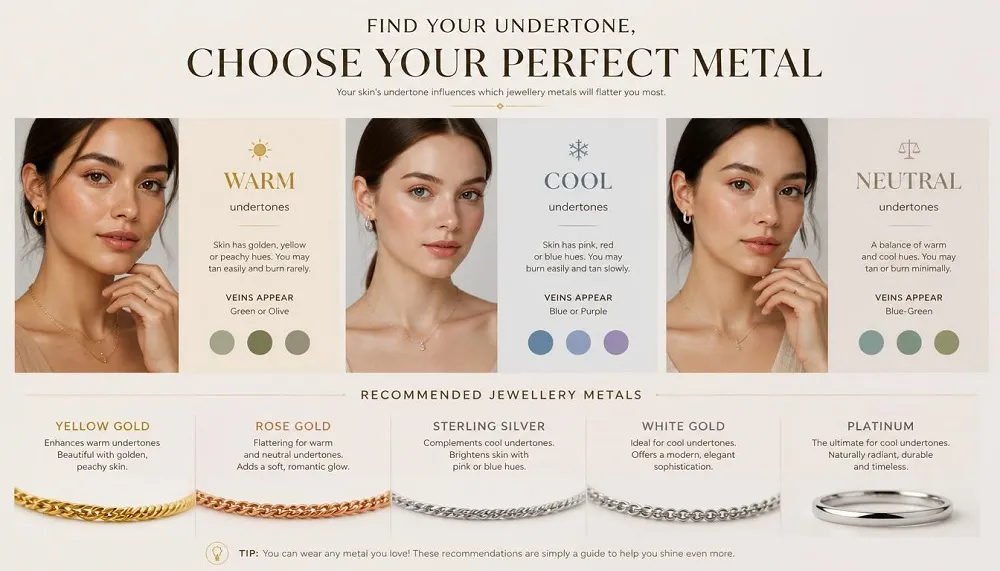
Quick answer: Warm undertones tend to suit yellow gold, rose gold and copper tones. Cool undertones tend to suit sterling silver, white gold and platinum. Neutral undertones can wear both with confidence. The fastest way to check is the wrist vein test in natural daylight: green veins point to warm, blue or purple veins point to cool, and a mix of both points to neutral. Treat this as guidance rather than a rule, since personal style and the outfit you’re wearing matter too.
Standing in front of a jewellery display, or scrolling through yet another online shop, it is easy to end up with a drawer full of pieces that never quite look right. Sometimes the problem is not the design at all. It is the colour of the metal against your skin. This guide walks through how to identify your undertone, which metals and gemstones flatter each undertone, and how to apply that knowledge whether you are shopping for yourself, for a partner, or for a gift.
What’s the Difference Between Skin Tone and Undertone?
These two terms get used interchangeably online, and that mix-up is the main reason people struggle to get a clear answer to “what jewellery suits my skin tone.”
Skin tone is the surface you see
Skin tone describes how light or deep your complexion appears. It changes with the seasons, sun exposure and even skincare, and it is usually described using words like fair, medium, olive, tan or deep.
Undertone is the hue beneath the surface
Undertone is the subtle colour running underneath your skin, and it stays fairly stable throughout your life regardless of a tan or a pale winter. Undertones fall into three broad groups: warm, cool and neutral.
Why undertone, not skin tone, decides your best metal
Two people with the same skin tone can have completely different undertones, and that is why a fair-skinned person and a deep-skinned person can both suit gold, while two people with similar depth of colour might suit opposite metals. When people ask how to choose jewellery for their skin tone, what they actually need is their undertone.
How to Find Your Skin Undertone (3 Simple Tests)
You do not need a colour consultant to work this out. Three quick checks, done together, will give you a reliable answer.
The vein test
Look at the veins on the inside of your wrist in natural daylight, away from artificial lighting that can distort colour.
- Green veins usually mean a warm undertone
- Blue or purple veins usually mean a cool undertone
- A mix of green and blue, or veins that look teal, usually mean a neutral undertone
The white fabric test
Hold something plain white, such as a t-shirt or a sheet of paper, against your face or wrist. If your skin looks flushed and healthier against the white, you are likely cool toned. If it looks a little dull or grey against stark white but comes alive against cream or ivory, you are likely warm toned.
The metal-against-skin test
Hold a gold item and a silver item against the same patch of skin in daylight. The metal that makes your skin look brighter and more even is the one that suits your undertone. The metal that makes your skin look slightly dull or ashen is the weaker match.
What to do if your tests disagree
It happens more often than you would think, especially for people close to neutral. If one test says warm and another says cool, you are probably neutral, which means you have the flexibility to wear either metal depending on the piece, the outfit, or your mood.
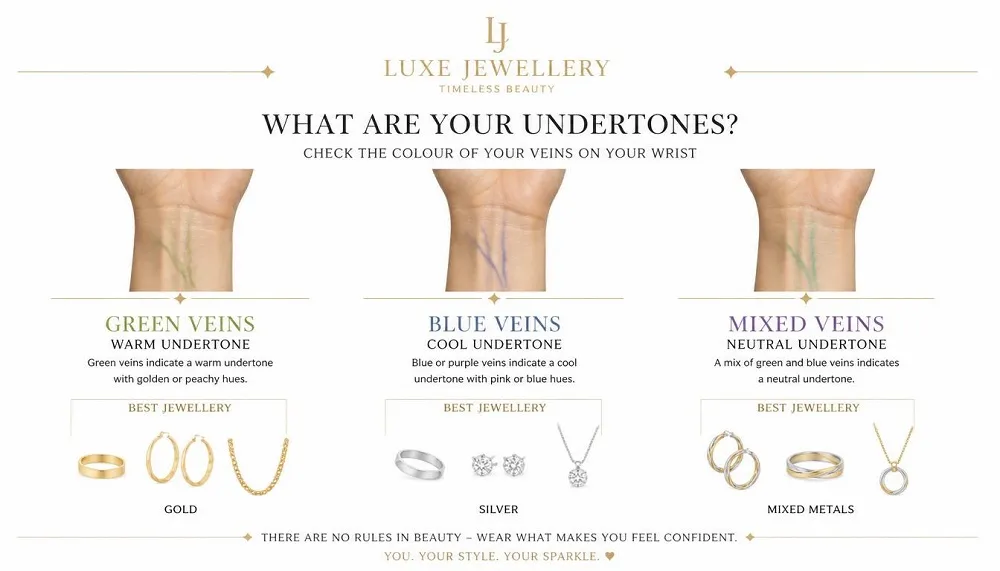
Table: Undertone Quick Reference
| Undertone | Vein colour | White fabric reaction | Best-fit metals |
|---|---|---|---|
| Warm | Green | Comes alive against cream, dull against stark white | Yellow gold, rose gold, copper |
| Cool | Blue or purple | Comes alive against stark white | Sterling silver, white gold, platinum |
| Neutral | Mix of green and blue, or teal | Looks fine against both | Either, mixed metals work well |
Best Jewellery for Warm Skin Tones
Metals that work with warm undertones
Yellow gold is the classic choice, since its rich, golden tone echoes the warmth already present in the skin. Rose gold works almost as well, adding a soft pink warmth without being as bold as pure yellow gold. Copper and brass finishes suit warm undertones for the same reason but need more careful upkeep, since both tarnish more readily.
Gemstone colours that suit warm undertones
Amber, citrine, garnet, ruby and warm-toned turquoise all sit comfortably alongside a warm complexion. These colours echo the golden or peachy undertone rather than fighting it.
Styling notes for warm undertones
A brushed or matte gold finish softens the look for daytime, while a high-polish finish suits evening wear. If you want to wear silver occasionally, pair it with warmer gemstone colours to bridge the two.
For a deeper look at metal quality and pricing, see our Gold Jewellery Guide and Gold Vermeil Jewellery Guide, which explain how a thin layer of real gold over silver can give warm-toned buyers an affordable way into solid gold’s look.
Best Jewellery for Cool Skin Tones
Metals that work with cool undertones
Sterling silver is the natural first choice, since its cool, bright finish sits comfortably against pink or blue undertones. White gold gives a similar effect with a slightly warmer edge than pure silver, and platinum offers the same cool brightness with extra durability.
Gemstone colours that suit cool undertones
Sapphire, amethyst, emerald and aquamarine all provide a flattering contrast against cool undertones, adding depth without clashing.
Styling notes for cool undertones
A high-shine silver finish is particularly flattering close to the face, such as in earrings or a short necklace. If you want to introduce warmth occasionally, a small amount of rose gold mixed into a cool-toned outfit tends to work better than full yellow gold.
Our What Is Sterling Silver? Your Complete Guide explains the 925 hallmark and quality markers to look for, and Stainless Steel vs Sterling Silver Jewellery is useful if you are choosing between the two for everyday wear.
Best Jewellery for Neutral Skin Tones
Why neutral undertones suit almost everything
If your vein test and fabric test come back mixed, you sit in the neutral category, and that gives you more freedom than any other undertone group. Both gold and silver tend to look balanced rather than clashing.
How to choose when either metal works
Since undertone will not narrow things down much for you, base your choice on the outfit, the occasion or simply what you already own. Neutral undertones are also the easiest to mix metals successfully, since neither gold nor silver is fighting your natural colouring.
Does the Jewellery Finish Matter?
The finish of your jewellery can influence how it complements your complexion just as much as the metal itself.
- Polished finishes reflect more light and create a bold, luxurious appearance.
- Matte or brushed finishes offer a softer, understated look.
- Hammered textures add depth and work well with casual outfits.
People with warm undertones often find brushed gold finishes particularly flattering, while cool undertones usually benefit from polished silver or white gold. Neutral undertones can comfortably wear either depending on the style they want to achieve.
Jewellery for Brown and Deeper Skin Tones
Why deeper skin tones can carry both warm and cool metals
Deeper skin naturally has more depth and richness, which means both gold and silver tend to read as intentional rather than mismatched. The undertone rules still apply, but the margin for error is wider than it is on very fair skin.
Gemstone colours that suit deeper complexions
Rich, saturated colours generally work well against deeper skin, including emerald, ruby, sapphire, amber and mandarin garnet. These stones hold their own visually rather than getting lost.
The myth worth ignoring
You may have come across the idea that only gold suits brown skin. It does not hold up. A bright silver or platinum piece can look striking and deliberate against deeper skin, offering a crisp contrast that gold cannot always provide. Choose based on your actual undertone using the tests above, not on assumptions about skin depth.
Does Hair Colour Affect Which Jewellery Looks Best?
While undertone should always be your starting point, hair colour can influence which jewellery appears most balanced.
- Blonde hair often pairs beautifully with sterling silver, white gold and soft rose gold.
- Brunette hair complements yellow gold, rose gold and richer gemstone colours.
- Black hair creates striking contrast with both gold and silver.
- Red hair naturally works well with rose gold, copper and warm yellow gold.
Rather than replacing undertone, hair colour should be used as a finishing styling consideration.
Jewellery Colour by Skin Tone Chart
Use this as a fast reference once you know your undertone.
| Undertone | Best metals | Best gemstones | Use with care |
|---|---|---|---|
| Warm | Yellow gold, rose gold, copper | Amber, ruby, citrine, garnet | Bright, icy silver in large amounts |
| Cool | Sterling silver, white gold, platinum | Sapphire, amethyst, emerald | Heavy yellow gold in large amounts |
| Neutral | Either, and mixed metals | Either | No real restrictions |
Jewellery Colours by Seasonal Colour Palette
If you are familiar with seasonal colour analysis, you can use it alongside your skin undertone when choosing jewellery.
- Spring usually suits yellow gold, champagne gold and warm gemstones like citrine and peridot.
- Summer often looks best in sterling silver, white gold and soft gemstones such as aquamarine and lavender amethyst.
- Autumn pairs beautifully with rich yellow gold, bronze tones, amber and garnet.
- Winter generally suits platinum, white gold and silver alongside sapphire, emerald and black gemstones.
Your undertone remains the most important factor, but combining it with your seasonal colour palette can help you create an even more balanced look.
How to Choose Jewellery for Your Skin Tone: A Guide for Men
Do the same undertone rules apply to men?
Yes. Undertone does not change based on gender, so the vein test, fabric test and metal-against-skin test work exactly the same way for men as they do for women.
Warm-toned metals for men
Brushed or matte yellow gold, rose gold and bronze-finish stainless steel all suit warm undertones without looking overly formal. A brushed finish tends to read as more casual and everyday than a high-polish one.
Cool-toned metals for men
Sterling silver, stainless steel and platinum are the strongest cool-toned options, and stainless steel in particular has become a popular everyday choice for men because of its durability.
Practical styling for men
Watches, chains and rings are usually the first pieces men buy, and they are also the easiest way to test undertone in practice. Try a watch with a warm-toned case and one with a cool-toned case side by side against your wrist to see which reads more naturally.
For more on materials, sizing and everyday wear, see our Men’s Jewellery: The Complete UK Buying Guide.
Gold or Silver? A Quick Decision Test
The thirty-second wrist test
Hold a gold piece and a silver piece against your inner wrist, outdoors or near a window, and look at which one makes your skin look more even and awake. The other will usually look slightly flat by comparison.
What to do if you genuinely cannot tell
Some people sit so close to neutral that no single test gives a clear answer. In that case, choose based on your wardrobe. If your clothes lean towards navy, black and cool greys, silver will feel more cohesive. If your wardrobe leans towards camel, olive and warm neutrals, gold will feel more integrated.
A simple self-check
- Check your veins in daylight
- Hold white fabric against your skin
- Hold gold and silver against your wrist
- If two out of three agree, that is your undertone
Match Your Jewellery to Your Clothing Colours
Jewellery looks even better when it complements both your skin undertone and your outfit.
Warm clothing colours such as camel, olive, mustard and beige naturally pair with yellow gold and rose gold.
Cool colours including navy, charcoal, black, white and icy blue usually look best alongside sterling silver, platinum and white gold.
If your wardrobe contains both warm and cool colours, neutral jewellery choices like rose gold or mixed metals provide excellent flexibility.
Rose Gold: Who Does It Actually Suit?
Why rose gold works across warm and neutral undertones
Rose gold blends the warmth of yellow gold with a soft pink hue, which is why it tends to flatter warm and neutral undertones particularly well. It photographs softly and pairs easily with both bold and everyday outfits.
Can cool undertones wear rose gold too?
Often, yes, especially in smaller doses such as a thin ring or a pair of studs. The pink element in rose gold can bridge a cool undertone in a way that pure yellow gold cannot, so it is worth trying before ruling it out.
What Is the 2:1:1 Rule for Jewellery?
You may have seen this phrase attached to skin tone content online, and it is worth being precise about what it actually means, since it gets used two different ways.
The styling version
Most commonly, the 2:1:1 rule refers to layering proportion rather than undertone. It suggests wearing two subtle pieces, one medium piece and one statement piece together, so your overall look has balance rather than everything competing for attention.
The metal-ratio version
A smaller number of sources apply 2:1:1 style thinking to metal mixing, suggesting a lead metal makes up roughly seventy per cent of what you are wearing, with the second metal filling the remaining space, adjusted according to your undertone.
Which version this guide recommends
The proportion version is the one with the wider, more consistent usage across stylists, so treat it primarily as a layering guide. If you enjoy mixing metals, let your dominant undertone metal lead the look and use the second metal in smaller amounts, such as a single ring or a pair of earrings.
For hands-on stacking guidance, our How to Stack Rings and How to Stack Bracelets guides cover proportion and texture in more depth.
Celebrity Inspiration
Many celebrities naturally wear jewellery that complements their undertones.
For example:
- Kate Middleton frequently wears white gold and sapphire jewellery that complements her cool undertone.
- Zendaya effortlessly alternates between gold and silver thanks to her balanced complexion.
- Beyoncé often wears rich yellow gold that enhances her warm undertone.
These examples show that undertone guidance is useful, but personal style always plays an important role.
Mixing Metals When You’re Between Undertones
Why matching metals is no longer a hard rule
The old advice to wear one metal only has largely fallen away. Mixed metals now appear regularly in everyday styling and are no longer seen as a mistake.
How to mix without it looking accidental
Let one metal lead, ideally the one matching your undertone, and use the second metal in a smaller, deliberate way, such as through a watch, a clasp or a single stacked ring. Keeping the ratio uneven tends to look more intentional than a strict fifty-fifty split.
Our Gold-Plated vs Sterling Silver Jewellery guide is a useful next step if you are deciding which metal to invest in first.
Does Gen Z Prefer Gold or Silver?
Current trend signals
Fashion and jewellery commentary in recent years has pointed to a swing back towards gold tones among younger shoppers, after a long stretch where silver and white metals dominated casual and streetwear-influenced styling. That said, trend cycles move quickly and preferences vary widely by individual style rather than following one universal rule.
Why trend and undertone don’t always agree
A current trend is not the same as what flatters your undertone. It is entirely reasonable to follow a trend for a statement piece while sticking with your flattering metal for everyday jewellery you wear close to your face.
Choosing Jewellery for Someone Else’s Skin Tone
How to spot their undertone without asking
Look at the jewellery they already wear most often, check the colour of their watch strap or case, or glance at their wrist veins next time you are close enough. Their existing wardrobe colours are another clue, since people tend to gravitate towards metals that already suit them.
Safest choices when you’re unsure
Sterling silver and rose gold are the two safest gifting metals, since rose gold flatters warm and neutral undertones and silver flatters cool and neutral undertones, covering most people between them. A neutral, versatile gemstone colour such as clear crystal or a soft blue also reduces the risk of a mismatch.
Our Jewellery Gifts: How to Choose the Perfect Piece guide covers this in more detail, including sizing and occasion-based advice.
Common Mistakes When Matching Jewellery to Skin Tone
Treating the rules as absolute
Undertone guidance is a helpful starting point, not a restriction. Plenty of people wear their non-matching metal happily, and it works because personal style, confidence and context all play a part.
Confusing a tan with undertone
A suntan changes your skin tone, meaning how light or deep it looks, but it does not change your underlying undertone, which stays fairly constant year-round.
Ignoring the outfit you’re actually wearing
Undertone matters most for jewellery worn close to the face, such as earrings and necklaces. For pieces like bracelets and rings, the colours in your outfit can matter just as much as your undertone.
Frequently Asked Questions
How do I know if I’m warm or cool toned?
Check the veins on your inner wrist in natural daylight. Green veins suggest a warm undertone, blue or purple veins suggest a cool undertone, and a mix of both suggests a neutral undertone.
What colour jewellery suits which skin tone?
Warm undertones generally suit yellow gold, rose gold and copper. Cool undertones generally suit sterling silver, white gold and platinum. Neutral undertones can wear either comfortably.
Can everyone wear rose gold?
Most people can. Rose gold flatters warm and neutral undertones easily, and cool undertones can often wear it too, particularly in smaller pieces such as studs or a thin ring.
Is silver or gold more flattering on pale skin?
It depends on undertone rather than paleness alone. A pale complexion with cool undertones usually suits silver, while a pale complexion with warm undertones usually suits gold.
What jewellery suits olive or neutral skin?
Olive skin often leans neutral to warm, so both gold and silver tend to work, with gold sometimes offering a slightly closer match to the underlying warmth.
Do men need to think about skin tone when choosing jewellery?
Yes. Undertone applies equally to men and women, and the same vein, fabric and metal tests work for identifying it.
What is the 2:1:1 rule for jewellery?
Most commonly it refers to a styling proportion of two subtle pieces, one medium piece and one statement piece worn together, rather than a strict rule about skin tone.
Does Gen Z prefer gold or silver jewellery?
Recent trend commentary suggests a shift back towards gold tones among younger shoppers, though personal preference still varies widely and trends move quickly.
Written by the Chic Fashion Jewellery editorial team, who research and test jewellery buying guidance for UK shoppers, covering metals, materials and styling across the site’s Gold, Silver, Rings, Necklaces and Bracelets guides.