
How to Wear a Claddagh Ring: Positions, Meaning, and Rules
Most people pick up a Claddagh ring and immediately ask the same question: which way does the heart go?
It sounds simple, but it matters more than you might think. This ring is one of the few pieces of jewelry that actually communicates something. Wear it one way, and you are telling the world your heart is free. Flip it around, and you are saying the opposite. Get the hand wrong, and you could signal that you are married when you are actually single, or engaged when you are just wearing a gift from a friend.
This guide covers everything: the four official wearing positions, what the heart direction means, how men wear it, what to do at a wedding ceremony, how to wear it for friendship, what the Fenian (crownless) version is about, and whether any of these rules change when you add a gemstone. By the end, you will know exactly how to wear your Claddagh ring with confidence.
What Is a Claddagh Ring?
The Claddagh ring, known in Irish as fáinne an Chladaigh (pronounced FAWN-ya un CLAD-uh), is a traditional Irish ring that dates back to the 17th century. It comes from the small fishing village of Claddagh on the western edge of Galway City. The name itself comes from the Irish word cladach, which means a flat stony shore.
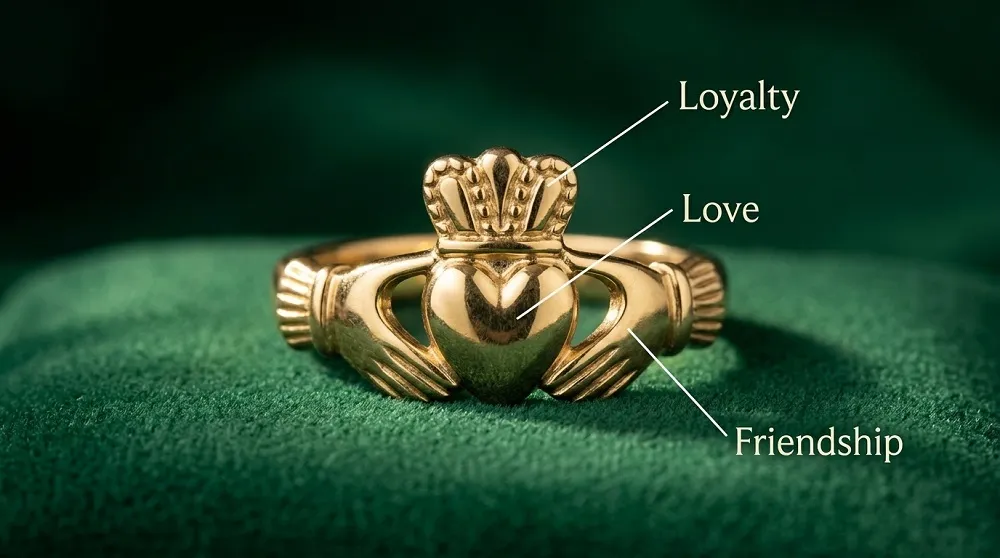
The design has three distinct elements, and each one carries its own meaning:
- Heart – represents love
- Crown – represents loyalty
- Two clasped hands represent friendship
Together, the ring expresses a single message: love, loyalty, and friendship. Those three values are why this ring has crossed oceans and generations and still means something today.
Why the Direction You Wear It Matters
Here is what makes the Claddagh ring different from almost any other ring: the way you position it on your hand sends a message. The heart can point toward your fingertips (outward) or toward your wrist (inward), and that direction, combined with which hand you wear it on,n tells the world where your heart stands.
Irish author Colin Murphy documented this four-position system, which reflects a tradition that developed organically in the village of Claddagh over centuries. Wear it wrong, a nd you send the opposite signal to anyone who knows Irish tradition. That is worth getting right.
The Four Claddagh Ring Positions
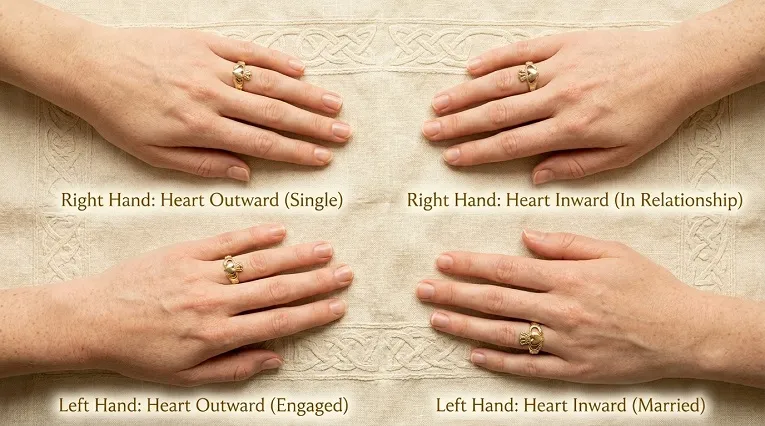
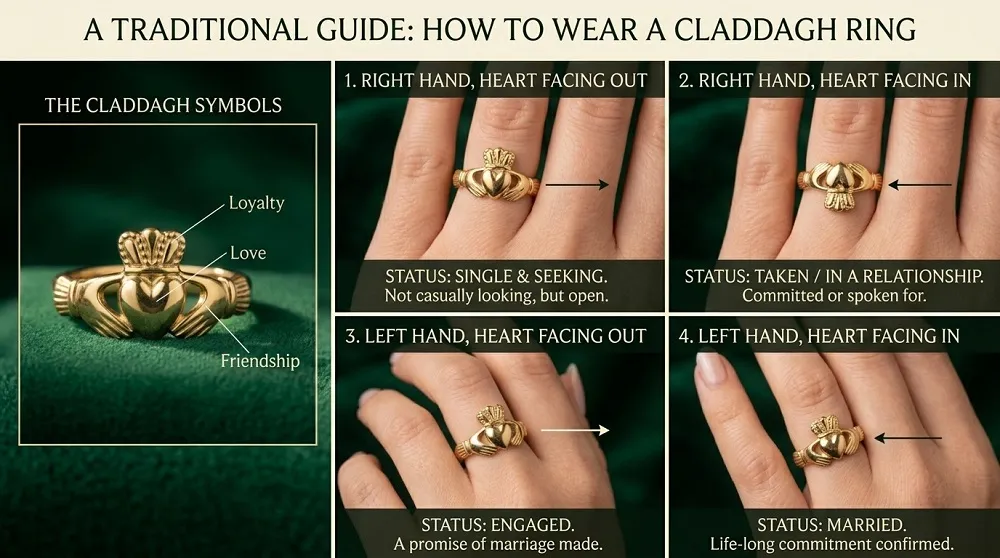
This is the core of what most people are searching for. Here is the complete system in one place.
| Position | Hand | Heart Direction | What It Means |
|---|---|---|---|
| Single | Right | Pointing toward fingertips (outward) | Your heart is free |
| In a relationship | Right | Pointing towardthe the wrist (inward) | Your heart is taken |
| Engaged | Left | Pointing toward fingertips (outward) | You are promised to someone |
| Married | Left | Pointing toward the wrist (inward) | Your heart belongs to your spouse |
Wearing a Claddagh Ring When You Are Single
Put the ring on your right hand, ring finger, with the heart pointing toward your fingertips. This means your heart is open and free. In the original Claddagh village, this position was a gentle social signal, particularly among women, letting others know they were available. Today, it still carries that same meaning for anyone who knows the tradition.
Wearing a Claddagh Ring When You Are in a Relationship
Right hand, ring finger, but now turn the heart inward so it points toward your wrist. This position says someone has captured your heart. You are committed, but not yet engaged. This is actually one of the most common ways people wear a Claddagh ring today, and it works equally well whether you have been together for six months or six years.
Wearing a Claddagh Ring When You Are Engaged
Move the ring to your left hand, ring finger, with the heart pointing outward toward your fingertips. The left hand signals a formal commitment, and the heart pointing outward shows that while you are promised to someone, that promise is still building toward marriage. Many couples use the Claddagh itself as the engagement ring, which carries a depth of tradition you simply cannot get from a standard solitaire.
Wearing a Claddagh Ring When You Are Married
Left hand, ring finger, heart pointing inward toward your wrist. This is the final position, and it represents a heart fully given. Your heart belongs to your spouse and is no longer available. Historically, in the Claddagh village, this was the primary use of the ring: as a wedding band passed from generation to generation.
What About the Crown Direction? (Something Nobody Explains)
People often get confused about the crown and think it has its own rules. It does not.
The crown simply follows the heart. When the heart points outward toward your fingertips, the crown faces your wrist. When the heart points inward toward your wrist, the crown faces your fingertips. You do not need to rotate the ring to “point the crown up.” The crown stays upright as long as you wear the ring right-side up on your finger. The only thing you control is the heart’s direction.
Think of it this way: the crown rides on top of the heart. Where the heart goes, the crown goes too.
The Claddagh Ring Wedding Ceremony Ritual
This is something almost no guide covers, and it is one of the most meaningful moments in an Irish wedding.
When a couple uses the Claddagh as both an engagement ring and a wedding ring, the ceremony itself includes a ring transfer ritual. Before the ceremony, the ring sits on the right hand in the engaged position, heart pointing outward. During or immediately after the wedding ceremony, the partner places the ring on the left hand with the heart pointing inward. The ring physically moves from one hand to the other as part of the vows.
This is not a rule that must be followed, but for couples who do it, it transforms the ring into something more than jewelry. The transfer is a gesture. It says: “You were promised to me. Now you are mine.”
Using a Claddagh Ring as a Wedding Band
A Claddagh ring worn on the left hand with the heart pointing inward works perfectly as a standalone wedding band. This is actually the most historically traditional use of the ring. The design is meaningful, the tradition runs deep, and it connects the wearer to Irish heritage in a way a plain band simply cannot.
If you plan to wear it alongside a separate engagement ring, the wedding band typically sits below the Claddagh (closer to your palm), with the Claddagh resting on top, heart pointing inward toward your wrist.
How to Wear a Claddagh Ring for Friendship
Not everyone who receives a Claddagh ring is in a romantic relationship. Many people receive one from a parent, a grandparent, or a close friend, and they want to wear it in a way that honors that friendship without sending a romantic signal.
Here is what works: wear it on your right hand, but on your middle finger or index finger instead of the ring finger. Point the heart inward toward your body to show affection and loyalty for the person who gave it to you.
If you wear it on the right ring finger with the heart inward, people familiar with Irish tradition may read that as “in a relationship.” Moving it to a different finger removes that ambiguity while keeping the same warmth in the symbolism.
The hands in the design literally represent friendship. Wearing it as a friendship ring is not a workaround or a lesser use. It is honoring one of the three core values the ring was built around.
When Friends and Family Give Claddagh Rings
The Claddagh has always moved through networks of love and loyalty beyond romance. Parents and grandparents give it to children coming of age. It appears at christenings, graduations, and milestone birthdays. Close friends give it to each other as a way of saying “this friendship matters and I want to mark it with something real.”
If someone gave you a Claddagh ring, whatever your relationship with them, that ring means something. Wear it accordingly.
Wearing a Claddagh Ring as a Promise Ring
A promise ring sits between “we are dating” and “we are engaged.” The Claddagh handles this beautifully.
Wear it on your right hand with the heart pointing inward. That position already means “my heart is taken,” which is exactly what a promise ring is communicating: I am with you, I am committed, and when the time comes, this will become something more.
The Claddagh as a promise ring is more popular than ever among younger couples, and it makes practical sense. Instead of buying a disposable fashion ring, you give something with real meaning and a real tradition behind it, and when the engagement happens, the ring simply moves to the left hand.
How Men Wear a Claddagh Ring
The rules are identical. Men wear a Claddagh ring the same way women do: right hand for single or in a relationship, left hand for engaged or married, heart outward when available, heart inward when committed. There is no gendered variation in the wearing tradition.
What differs is the design of the ring itself.
Men’s Claddagh Rings: Design Differences
Men’s Claddagh rings typically have wider bands, usually 5 to 7 millimeters, compared to 3 to 4 millimeters for most women’s styles. The design tends to be bolder and less ornate, with fewer gemstone embellishments. Common metals for men’s rings include sterling silver, yellow gold, and titanium.
Many men of Irish heritage wear a Claddagh to express pride in their ancestry and loyalty to their roots. For those men, the ring is not about relationship status at all. It is an identity statement.
The Father-to-Son Heirloom Tradition
Most guides only mention the mother-to-daughter heirloom tradition, but the male line exists too. Claddagh rings have been passed from fathers to sons in Irish families, particularly in Galway and among Irish-American families, for generations. Some of these rings trace back to the early 1700s and have been worn by four or five generations of men.
If you inherited a Claddagh ring from your father or grandfather, wear it with that history in mind. The ring is already carrying something before you put it on.
Can You Wear a Claddagh Ring If You Are Not Irish?
Yes, without hesitation.
The three values at the center of the Claddagh ring, which are love, loyalty, and friendship, belong to everyone. They are not Irish values. They are human values. The ring spread globally through the Irish diaspora because those values resonate across every culture, background, and language.
Queen Victoria wore a Claddagh ring after visiting Ireland in 1849. Walt Disney bought one for himself and his wife Lillian during an Irish visit in 1946, and his ring is visible to this day on the famous Partners Statue at Disney World. Prince Rainier and Princess Grace of Monaco received Claddagh rings on a visit to Ireland in 1961. None of them were Irish.
Wearing It with Awareness
You do not need Irish ancestry to wear a Claddagh ring. What is worth doing, regardless of your background, is understanding what the ring means and what the positions communicate. Not because there are rules you must follow, but because the ring is more meaningful when you understand it.
The ring’s own traditional motto is “Let love and friendship reign.” That belongs to anyone who wants to carry it.
The Claddagh Ring Heirloom and Gifting Tradition
The Mother-to-Daughter Tradition
One of the most enduring Irish jewelry customs is the passing of a Claddagh ring from mother to eldest daughter, sometimes from grandmother to granddaughter. The ring carries the wearer’s story with it, having moved through stages of life: single, in love, engaged, married. By the time a daughter receives it, she is receiving more than jewelry. She is receiving a record of love.
In some Irish families, the same ring has passed through three or four generations. The wear marks and the slight patina that come with age are not flaws. They are the story of the ring.
The Claddagh Ring Blessing
When a Claddagh ring is given as a gift, particularly at a wedding, christening, or milestone birthday, it is sometimes accompanied by a blessing. The most common is simply the ring’s motto:
“Let love and friendship reign.”
A longer blessing, sometimes spoken at ring-giving ceremonies, goes like this:
“With these hands, I give you my heart, and I crown it with my love.”
This phrase captures the entire design in one sentence. The hands are there. The heart is there. The crown is there. And the meaning is clear.
If you are giving a Claddagh ring as a gift, saying these words aloud while presenting it makes the moment something the recipient will remember.
Modern Wearing Styles: Stacking, Pendant, and Other Fingers
Stacking a Claddagh Ring with a Wedding Band
If you wear a Claddagh as your engagement ring and then also have a wedding band, the stacking order matters.
The wedding band typically goes below the Claddagh, sitting closer to your palm on the left ring finger. The Claddagh rests on top with the heart pointing inward. Many jewelers now offer contoured wedding bands designed specifically to curve around the Claddagh’s design for a clean, seamless fit.
Some people prefer to wear the Claddagh on the right hand and the wedding band on the left. That works too. There is no rule that both rings must be on the same finger.
Wearing a Claddagh Ring on Other Fingers
The four-position system only works on the ring finger because that is the finger with the traditional association. If you wear a Claddagh on your middle finger, index finger, or pinky, the relationship signaling does not apply. You are wearing it for personal meaning or aesthetic reasons, which is completely valid.
Wearing a Claddagh as a Pendant or Necklace
Not everyone can wear rings. Nurses, surgeons, athletes, and many trades workers often cannot. A Claddagh pendant worn on a chain carries the same symbolism as the ring.
For pendants, the convention for heart direction is simple: heart art pointing downward toward your body reflects the “inward” symbolism of being in a committed relationship. A heart pointing outward (away from your chest) reflects availability. Most people simply wear the pendant in the direction that feels natural, which tends to be heart downward.
This is a popular option for teenagers receiving a first Claddagh, for people who are not yet sure about rings, and for anyone whose daily work makes wearing rings impractical.
Gemstone Claddagh Rings: Does Adding a Stone Change the Rules?
No. The four positions apply the same way whether your ring is plain sterling silver or set with a diamond, emerald, birthstone, or sapphire.
The most common stone for a Claddagh ring is emerald, which reflects the green of Ireland. Diamond Claddagh rings are popular as engagement rings. Birthstone Claddagh rings are popular gifts because they add a personal layer to the symbolism: the wearer’s own birth month sits at the center of the heart.
Modern designers also combine Celtic knotwork with the Claddagh design, adding interlace patterns to the band or the crown. These are aesthetic additions. The wearing positions remain the same regardless.
The Fenian Claddagh: The Ring Without a Crown
This is something almost every guide skips entirely, but if you have ever seen a Claddagh ring without a crown and wondered what it means, here is the answer.
What Is a Fenian Claddagh Ring?
The Fenian Claddagh is a variant of the traditional design that removes the crown. It originated with Irish nationalists, the Fenians, who objected to monarchic imagery. For them, the crown on a ring represented British rule, and removing it was a quiet act of political identity.
The Fenian Claddagh keeps the heart and the hands: love and friendship. It removes loyalty to a crown. For wearers with a strong Irish nationalist identity, this distinction is meaningful.
How to Wear a Fenian Claddagh Ring
The positional rules are the same. Right hand outward for single, right hand inward for in a relationship, left hand outward for engaged, left hand inward for married. The absence of the crown does not change the wearing system.
The Fenian Claddagh is more niche than the standard version and tends to be worn by people who are specifically making a cultural or political statement alongside the personal symbolism of the ring. It is less common outside Ireland.
Is It Bad Luck to Buy a Claddagh Ring for Yourself?
This comes up constantly, so it deserves a direct answer.
Traditional Irish folk belief holds that a Claddagh ring should be received as a gift, not purchased for yourself. The thinking is that a ring representing love and friendship should arrive through love and friendship, not a transaction you make for yourself.
However, this belief has no documented historical root. It is oral tradition, passed down through families and local culture, not a rule from any cultural or religious authority.
The Practical Reality
The vast majority of Claddagh rings sold today are self-purchased. Millions of people buy them for themselves, either because no one else is going to give them one, because they love the design, or because they want to express self-love and connection to Irish heritage. All of those are valid reasons.
If you want a Claddagh ring, buy one. Wear it in whatever position reflects your life right now. The meaning you bring to the ring is what gives it life, not how it ended up on your finger.
A Brief History: Why This Ring Exists
Understanding where the Claddagh ring comes from makes wearing it feel different. It is not just a beautiful design. It is a story.
Richard Joyce and the First Claddagh Ring
The most widely told origin story centers on Richard Joyce, a fisherman from Galway. Around 1675, Joyce was captured by Algerian Corsairs while sailing and sold into slavery in North Africa. He was purchased by a Moorish goldsmith, who trained him in the craft over the years of his captivity.
In 1689, King William III sent an ambassador to Algeria to negotiate the release of British and Irish subjects held in slavery. Joyce was freed. His master, who had grown to value him deeply, offered Joyce his daughter’s hand in marriage and half his wealth to stay. Joyce refused and sailed home to Galway.
When he arrived, his sweetheart was waiting. He presented her with the ring he had made during his years away: two hands holding a crowned heart. The oldest surviving Claddagh rings bear the hallmark of Richard Joyce, who worked as a goldsmith in Galway from approximately 1689 to 1737.
The Older Roots: Fede Rings and Ancient Rome
The Claddagh did not emerge from nothing. It belongs to a group of European rings called fede rings, from the Italian phrase mani in fede, meaning “hands joined in faith.” The gesture of clasped hands as a symbol of pledged loyalty goes back to Ancient Rome, where it signified a solemn vow.
Fede rings were used as engagement and wedding rings across medieval and Renaissance Europe. The Galway version added a crowned heart held by those clasped hands, and the tradition that grew around it became what we now call the Claddagh ring.
Bartholomew Fallon is noted as the maker of the oldest surviving Claddagh-style examples predating Joyce. The name “Claddagh ring” itself was first used in published writing between 1841 and 1843, though the rings themselves had been worn in Galway for well over a century before that.
From a Fishing Village to the World
The Claddagh ring stayed close to Galway for its first century or so. It spread globally through the waves of Irish emigration in the 18th, 19th, and 20th centuries. Every Irish family that left for America, Australia, or Britain carried pieces of home with them. The Claddagh was one of those pieces.
Today, it worn by millions of people across six continents. It has appeared on the fingers of U.S. Presidents John F. Kennedy, Ronald Reagan, and Bill Clinton. Queen Victoria wore one. Princess Grace of Monaco wore one. So did Walt Disney, Jim Morrison, Bono, Julia Roberts, Jennifer Aniston, and Daniel Day-Lewis. In the television show Buffy the Vampire Slayer, the character Angel gives Buffy a Claddagh ring, introducing the tradition to an entire generation of American viewers. J.K. Rowling referenced it in the Harry Potter series.
From a fishing village on the west coast of Ireland to screens, stages, and jewelry boxes across the world, the Claddagh has traveled further than most symbols ever do.
Buying an Authentic Claddagh Ring: What to Look For
The Irish Hallmark
If you are buying a Claddagh ring made in Ireland, look for the Irish hallmark. Since 1637, Irish law has required all gold and silver jewelry sold in Ireland to carry a hallmark issued by the Irish Assay Office at Dublin Castle. This mark certifies the metal’s purity and confirms the ring was made in Ireland. It includes the Assay Office mark, a fineness mark (925 for sterling silver, 750 for 18-karat gold), and the maker’s mark.
A hallmarked Irish Claddagh ring is both a quality guarantee and a piece of certified Irish heritage.
Choosing the Right Metal
Claddagh rings are made in a range of metals. Sterling silver (925) is the most traditional and the most affordable. Yellow gold in 10K, 14K, or 18K is the classic choice for wedding and engagement purposes. White gold pairs well with diamonds. Rose gold has become popular in modern designs. Platinum is the most durable option and is fully hypoallergenic. For men, titanium offers exceptional strength with a lighter weight than gold.
The metal you choose does not change the wearing rules or the symbolism. Choose the one that suits your style, your budget, and your skin.
Claddagh Ring FAQ
Which hand do I wear a Claddagh ring on? Right hand if you are single or in a relationship. Left hand if you are engaged or married.
Which way should the heart face? Heart pointing toward your fingertips (outward) means your heart is open. A heart pointing toward your wrist (inward) means your heart is taken.
Can I wear a Claddagh ring on any finger? The four-position signaling system works on the ring finger. On any other finger, you are wearing it for personal or aesthetic reasons, which is completely fine.
Do men wear a Claddagh ring differently from women? No. The four-position system is identical for men and women.
Can I wear a Claddagh ring if I am not Irish? Yes. The values of love, loyalty, and friendship are universal. No Irish ancestry is required.
Is it bad luck to buy a Claddagh ring for yourself? That is an old folk tradition with no documented origin. Most people today buy their own Claddagh rings, and no cultural authority says otherwise.
What is a Fenian Claddagh ring? It is a version of the Claddagh without the crown, associated with Irish nationalist identity. The same wearing positions apply.
Can I wear a Claddagh ring on a necklace? Yes. A Claddagh pendant carries the same symbolism as the ring.
How do I stack a Claddagh with a wedding band? The wedding band goes below (closer to the paandCland the addagh sits on top with the heart pointing inward.
What is the Claddagh ring blessing? The traditional motto is “Let love and friendship reign.” The blessing spoken at gifting ceremonies is: “With these hands, I give you my heart, and I crown it with my love.”
Conclusion
The Claddagh ring is not complicated once you understand the system. Right hand for single or committed, left hand for engaged or married. Heart outward when your heart is free, heart inward when it is given. Two variables, four positions, centuries of meaning.
Whether you received your ring as a gift from someone you love, inherited it from a parent, bought it for yourself, or found it because you have always felt a connection to Irish tradition, the way you wear it reflects where you are in life right now. And that is the whole point.
The heart, the crown, and the two hands have been telling this story since a goldsmith in the 17th-century Galway carried the design home from the other side of the world. Now it is on your finger. Wear it the way that is true to you.