
What Is PVD Jewellery? How It Works, How Long It Lasts & Whether It’s Worth Buying
If you’ve been shopping for jewellery lately, you’ve probably noticed the term “PVD” appearing on product pages, in brand descriptions, and across social media. Brands describe it as tarnish-free, waterproof, and hypoallergenic. Some claim it lasts a decade. Others call it the future of affordable jewellery.
But what actually is PVD jewellery? Is it genuinely different from regular gold-plated pieces, or is it just clever marketing with a technical name attached?
This guide answers those questions honestly and completely. No filler, no hype, just everything you need to know to decide whether PVD jewellery is right for you.
What Does PVD Stand For?
PVD stands for Physical Vapour Deposition. It is a coating process used to apply a thin, hard layer of metal onto the surface of jewellery, or, for that matter, onto aerospace components, surgical tools, and medical implants.
The name sounds complicated, but the idea behind it is actually straightforward. Instead of painting or dipping a piece of jewellery into a chemical bath, PVD works by turning a solid metal into a vapour inside a vacuum chamber, then letting that vapour settle onto the jewellery surface and bond to it at a molecular level.
The result is a coating that does not just sit on top of the metal like a skin. It fuses with it. That is the key difference between PVD and traditional gold plating, and it explains why PVD jewellery tends to outlast conventionally plated pieces by a significant margin.
Quick Answer: PVD jewellery uses Physical Vapour Deposition technology to bond a durable coating to stainless steel or titanium. It is more resistant to tarnishing, water, scratches, and daily wear than traditional gold-plated jewellery and typically lasts 2 to 5 years with proper care.
Where Did PVD Technology Come From?
PVD is not a new invention. The science behind it dates back to the 19th century, and by the mid-20th century, advances in vacuum technology made it practical for industrial use.
For most of its history, PVD was used in industries where failure is not an option: aerospace engineering, electronics manufacturing, and medical devices. Surgeons use titanium nitride-coated implants. The cutting edges of high-performance tools are coated using PVD processes. Even some satellite components rely on it.
Jewellery manufacturers began adopting PVD technology more recently, recognising that the same properties that make it valuable in a hospital operating room, durability, safety, and a hard, smooth finish, also make it ideal for everyday accessories.
This industrial and medical heritage matters. It is not marketing language. It is the reason PVD jewellery can genuinely claim to be skin-safe and long-lasting in a way that traditional plated jewellery cannot.
How Does the PVD Coating Process Work?
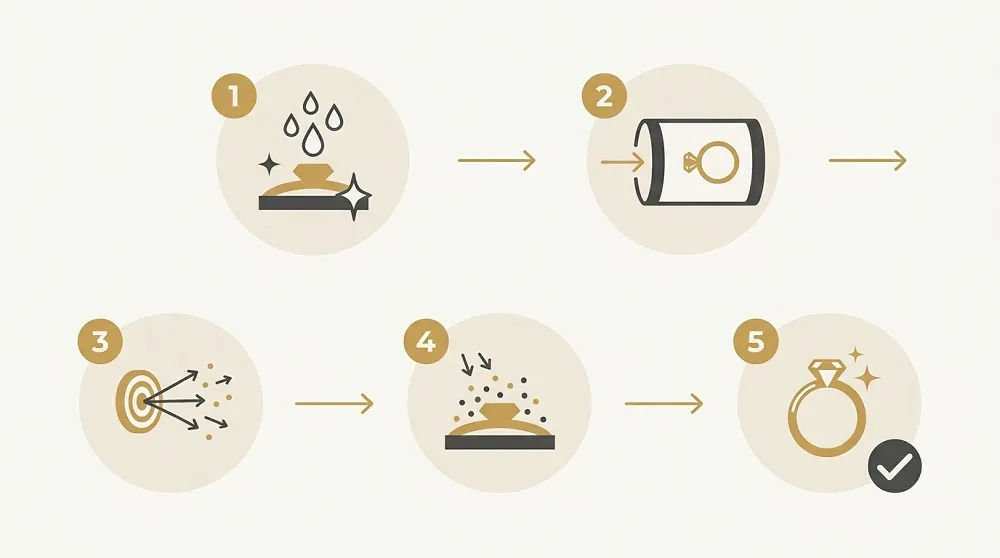
Understanding the process helps you appreciate why PVD jewellery performs so differently from cheaper alternatives. Here is how it works, step by step.
Step 1: Surface Preparation and Deep Cleaning
Before any coating happens, the jewellery piece is cleaned thoroughly. This usually involves multiple rounds of mechanical and chemical cleaning to remove every trace of oil, dirt, grease, and oxidation.
This step matters more than it might seem. Any contamination on the surface of the base metal will prevent the PVD coating from adhering correctly. Even a fingerprint left on the piece can compromise the final result. After cleaning, the jewellery is dried completely, because moisture interferes with the vacuum process.
Step 2: Placement in the Vacuum Chamber
The cleaned jewellery is arranged on a specialised stand inside a sealed vacuum chamber. The placement is deliberate; each piece needs to be positioned so that the coating covers every surface evenly.
Once the chamber is sealed airtight, the air is slowly evacuated until a high vacuum environment is achieved. This vacuum is essential. Without it, gas molecules in the air would interfere with the deposition process, resulting in an uneven or contaminated coating.
Step 3: Vaporisation of the Target Material
Inside the vacuum chamber, a “target material”, the metal that will form the coating, is bombarded with high-energy particles. This is done using techniques such as magnetron sputtering or arc evaporation.
In magnetron sputtering, magnetic fields accelerate ions toward the target material, knocking atoms loose. In arc evaporation, a high-current electric arc vaporises the material directly. Both methods achieve the same outcome: the target material is converted into a cloud of free-floating atoms.
Common target materials include titanium, zirconium, and chromium. The specific metal chosen depends on the desired colour and properties of the final coating.
Step 4: Atoms Bond to the Jewellery Surface
The jewellery pieces inside the chamber are given a negative electrical charge. This attracts the positively charged vaporised atoms, drawing them toward the jewellery surfaces where they settle in a thin, uniform layer.
Reactive gases, usually nitrogen or argon, are introduced into the chamber at this stage. These gases react with the vaporised metal atoms to form compounds. Titanium reacting with nitrogen, for example, produces titanium nitride (TiN), which creates the warm gold colour associated with most PVD gold jewellery.
The final coating is incredibly thin, typically between 0.03 and 0.3 microns. Despite this, the molecular bond created during deposition makes the coating exceptionally hard and resistant to scratching, tarnishing, and corrosion.
Step 5: Quality Check and Final Output
Once the deposition cycle is complete, the chamber is opened, and the jewellery is inspected. High-quality PVD produces a completely uniform, smooth surface with consistent colour across every piece.
The hardness of the resulting coating is measured on the Vickers Hardness Scale. PVD coatings using titanium nitride can reach up to 2,000 HV (Vickers Hardness). For reference, standard gold has a hardness of around 160 HV. Titanium nitride also rates approximately 9 out of 10 on the Mohs hardness scale, placing it close to sapphire in terms of scratch resistance.
Quick Summary: PVD coating involves cleaning the base metal, placing it in a high-vacuum chamber, vaporising a target metal using high-energy methods, and bonding the resulting atoms to the jewellery surface to form an ultra-thin, ultra-hard, molecularly bonded layer.
What Materials Are Used in PVD Jewellery?
The Base Metal (Substrate)
The base metal is the core of the jewellery piece before any coating is applied. The choice of base metal significantly affects both the durability of the PVD coating and the safety of the piece against the skin.
| Base Metal | PVD Compatibility | Hypoallergenic | Best Used For |
|---|---|---|---|
| 316L Surgical Stainless Steel | Excellent | Yes | Everyday rings, earrings, necklaces |
| Titanium | Excellent | Yes | Piercings, sensitive skin jewellery |
| Cobalt-Chrome Alloy | Good | Mostly | Watches, bracelets |
| Brass | Moderate | No | Fashion pieces, occasional wear |
316L surgical stainless steel is the most common base metal in PVD jewellery for a good reason. It is biocompatible, highly corrosion-resistant, and provides an excellent surface for PVD adhesion. It is also the same material used in surgical instruments and medical devices, which tells you something about its safety profile.
The Coating Materials (What Creates the Colour)
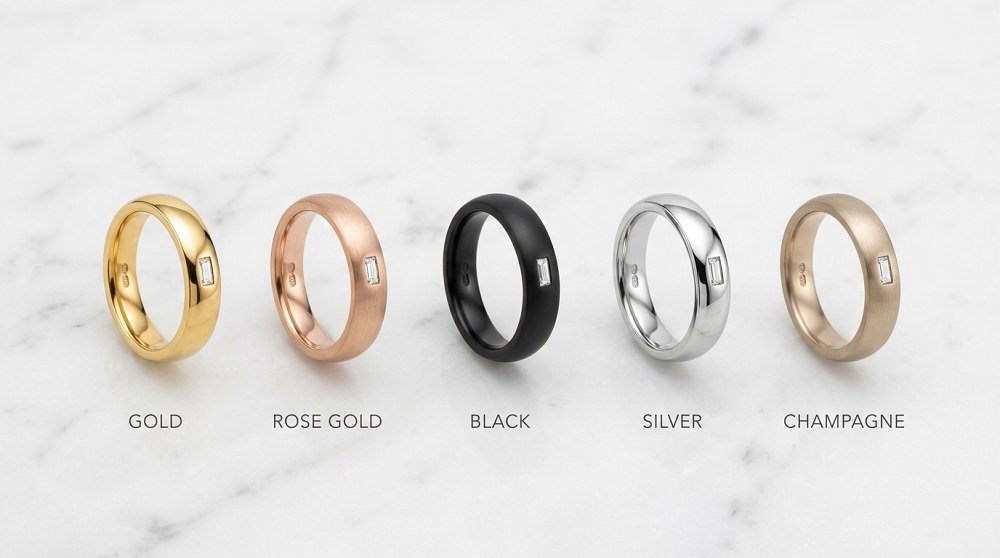
The colour of PVD jewellery comes from the chemical compounds formed when target metals react with the reactive gases introduced during the coating process.
| PVD Colour | Compound Formed | Common Use |
|---|---|---|
| Gold | Titanium Nitride (TiN) | Classic gold jewellery |
| Rose Gold | Titanium-Copper based compound | Feminine, warm-toned styles |
| Black | Titanium Carbonitride (TiCN) | Bold, modern jewellery |
| Silver/Chrome | Chromium Nitride (CrN) | Minimalist, everyday pieces |
| Bronze/Champagne | Zirconium Nitride (ZrN) | Warm luxury tones |
This is also why PVD jewellery can offer such a consistent range of colours. The colour is not a dye or a superficial layer; it is the natural result of the chemical compound formed during the deposition process.
PVD Jewellery vs Gold Plated vs Gold Filled vs Solid Gold
This is where things get genuinely useful for shoppers. The jewellery market uses a lot of terms that sound similar but describe very different products.
The Full Comparison at a Glance
| Feature | PVD Jewellery | Gold Plated | Gold Filled | Solid Gold |
|---|---|---|---|---|
| Coating Method | Vacuum deposition | Electroplating | Heat/pressure bonding | Solid metal |
| Coating Thickness | 0.03-0.3 microns | 0.5-2.5 microns | 5% by weight | N/A |
| Typical Lifespan | 2-5 years | 6-12 months | 2-10 years | Lifetime |
| Tarnish Resistance | Excellent | Poor | Moderate | Excellent |
| Hypoallergenic | Yes | Often No | Varies | Varies |
| Waterproof | Yes | No | Partial | Yes |
| Price Point | Affordable | Cheapest | Mid-range | Expensive |
| Eco-Friendly | Yes | No | Partial | No |
| Re-plateable | Yes | Yes | No | N/A |
How PVD Differs from Traditional Electroplating
Traditional gold plating, also called electroplating, works by submerging a piece of jewellery in a liquid bath containing dissolved gold particles. An electric current passes through the bath, causing gold ions to attach to the surface of the jewellery.
This process creates a thin layer of gold that rests on top of the base metal. It does not bond at a molecular level. Over time, and often within a few months of daily wear, this layer begins to wear away. When it does, it tends to peel, flake, and fade in patches. You have probably seen this on cheaper jewellery: the tell-tale spotty discolouration where the plating has worn through. Some people call this the “patchy face” effect.
PVD does not work like this. The vacuum deposition process creates a molecular bond between the coating and the base metal. The coating becomes part of the surface rather than a layer sitting on it. When PVD jewellery eventually shows wear after years of use, it fades gradually and evenly rather than peeling in patches.
What Does “18K PVD Gold” Actually Mean?
This is one of the most common points of confusion in the jewellery market, and it is worth addressing directly because almost no one does.
When a brand labels a piece “18K PVD gold,” they are not telling you the jewellery is made from 18-karat solid gold. The base metal is stainless steel. What “18K” refers to in this context is the colour tone of the PVD coating, the warm, rich yellow associated with 18-karat gold.
The coating itself is typically titanium nitride, not gold. Some brands do use real gold in the coating process, but even then, the quantity is measured in microns, not karats.
This is not necessarily deceptive; it is just a shorthand the industry has adopted to describe the shade. But if you buy an “18K PVD gold” necklace expecting it to have the same gold content as a solid 18K piece, you will be disappointed.
The honest description is: a stainless steel piece with a gold-coloured PVD coating. That is still a great product. It just is not the same thing as solid 18-karat gold.
Quick Summary: PVD jewellery outperforms gold-plated and gold-filled options in durability, skin safety, and water resistance. It does not match solid gold in terms of investment value or gold content, but for daily wear, it offers considerably better performance at a fraction of the price.
Is PVD Jewellery Real Gold?
One of the biggest misconceptions is that PVD jewellery contains large amounts of gold. In most cases, it does not.
Most gold-coloured PVD jewellery uses titanium nitride to create a gold-like appearance. Some premium manufacturers may incorporate real gold during the coating process, but the quantity is extremely small compared to solid gold jewellery.
This does not make PVD jewellery inferior. The purpose of PVD is durability rather than precious metal value. Buyers should view PVD jewellery as a long-lasting fashion and everyday-wear option rather than an investment asset.
If your goal is gold content and resale value, solid gold remains the better choice. If your goal is durability, affordability, and appearance, PVD jewellery offers excellent value.
How Long Does PVD Jewellery Really Last?
Let’s be straightforward here because this is the area where marketing tends to outpace reality.
Realistic Lifespan: What You Can Actually Expect
With regular daily wear and decent care, PVD jewellery typically lasts 2 to 5 years before showing noticeable signs of wear. Some pieces last longer. Some show wear sooner. The range depends on several factors discussed below.
A 2023 jewellery industry report found that approximately 70% of PVD jewellery users reported their pieces still looked good after 2 to 3 years of wear. A study on PVD-plated watches found that a coating 0.3 microns thick showed only around 5% shine reduction after 5 years of daily use.
Compare that to traditional gold-plated jewellery, which often starts fading within 6 to 12 months, and sometimes within weeks if worn daily in contact with sweat or water.
Factors That Affect How Long Your PVD Jewellery Lasts
Coating thickness. PVD coatings range from approximately 0.03 to 0.3 microns. A thicker coating means longer-lasting protection. Many budget fashion brands use the thinnest possible application (0.03 microns) to keep costs low. Quality brands apply closer to 0.3 microns, which makes a significant practical difference in longevity.
Base metal quality. 316L stainless steel provides much better PVD adhesion than brass or copper. A good coating on a poor base will still fail faster than the same coating on surgical stainless steel.
Frequency and type of wear. A ring worn daily on an active hand will wear faster than a necklace worn a few times a week. High-friction areas, knuckles, and wrist creases experience more wear than areas of the body that do not rub against surfaces.
Chemical exposure. Perfumes, lotions, hairsprays, chlorine in swimming pools, and cleaning products all degrade PVD coatings faster. This does not mean PVD is fragile. It means, like any surface finish, it responds to what comes into contact with it.
Body chemistry. Sweat acidity varies between people. Some individuals have more acidic sweat, which is more corrosive to metal surfaces. If you have noticed that your jewellery tends to tarnish faster than other people’s, this is likely why.
Storage habits. Tossing jewellery into a cluttered drawer where pieces scrape against each other accelerates surface wear. Storing pieces separately in soft pouches keeps the coating in better condition.
The Truth About the “10 Years” Claim
Some jewellery brands claim their PVD coating lasts 10 years. This is technically possible under near-ideal conditions: very occasional wear, no chemical contact, careful storage, and perfect body chemistry. In real-world daily use, it is not a realistic expectation for most people.
The honest answer is 2 to 5 years for daily wear. Brands that promise a decade are not necessarily lying, but they are not helping you set accurate expectations either. A brand that tells you 2 to 5 years and explains what affects that lifespan is one you can trust more.
Is PVD Jewellery Safe? Everything About Skin Safety and Allergies
Skin safety is one of the most important factors for jewellery buyers, particularly those with sensitive skin, metal allergies, or conditions like contact dermatitis.
Is PVD Jewellery Hypoallergenic?
Yes, high-quality PVD jewellery is genuinely hypoallergenic, for two reasons.
First, the coating materials used in PVD, primarily titanium nitride, are inert and biocompatible. They do not react with skin. These same compounds are used to coat medical implants, bone screws, and surgical instruments precisely because they are so well-tolerated by the human body.
Second, a well-applied PVD coating creates a complete barrier between your skin and the base metal. Even if the base metal contains traces of nickel or other potential allergens, the PVD layer prevents any contact with your skin.
The EU’s REACH regulation sets a maximum permissible nickel release of 0.5 micrograms per square centimetre per week for skin-contact jewellery. Quality PVD jewellery on a 316L stainless steel base consistently meets this standard.
That said, “hypoallergenic” does not mean “impossible to react to.” If your skin is extremely sensitive, implant-grade titanium without any coating is the safest option available. For the vast majority of people with normal metal sensitivities, PVD on 316L stainless steel is completely comfortable for daily wear.
Will PVD Jewellery Turn Your Skin Green?
No. This is a direct answer to one of the most commonly asked jewellery questions online, and it is worth being clear about it.
The green discolouration that appears on skin after wearing certain jewellery comes from copper oxidation. When copper in a base metal or plating reacts with sweat and skin oils, it produces copper salts that stain the skin green. This is common with brass-based or copper-based jewellery, especially cheap gold-plated pieces where the plating has worn through.
PVD jewellery on a stainless steel or titanium base does not contain copper in the layers that contact your skin. The PVD coating itself is a hard, inert metallic compound. There is nothing in that system that produces green staining.
Is PVD Jewellery Safe for Piercings?
For healed piercings, PVD-coated titanium jewellery is widely considered one of the better options available. The smooth, hard, inert surface of PVD titanium does not harbour bacteria, does not react with body fluids, and does not cause the irritation that cheap plated body jewellery can.
For fresh or healing piercings, uncoated implant-grade titanium is generally preferred because it eliminates any variables. Once a piercing is fully healed, PVD titanium is a solid choice that offers colour and style without compromising safety.
Quick Summary: PVD jewellery is genuinely hypoallergenic due to its biocompatible coating materials and the protective barrier it creates between the skin and the base metal. It will not turn your skin green, and it is safe for most people with sensitive skin.
Is PVD Jewellery Waterproof?
Water resistance is one of the most-searched topics around PVD jewellery, and for good reason. A lot of people want jewellery they can wear without thinking about it, through showers, gym sessions, and beach days.
What “Waterproof” Actually Means for PVD Jewellery
The PVD coating forms an impermeable metallic layer on the base metal, protecting it from oxidation and corrosion. Combined with a stainless steel base that is already highly resistant to rust, PVD jewellery holds up genuinely well against water exposure.
You can safely wear PVD jewellery during:
- Daily showers
- Workouts and heavy sweating
- Rain and general moisture exposure
- Swimming in fresh water lakes or pools (occasional exposure)
Where you want to exercise some caution:
- Chlorinated swimming pools: Prolonged or frequent exposure to chlorine can gradually degrade the PVD coating over time. Occasional swimming is fine. Training in a chlorinated pool daily for months will shorten the coating’s lifespan.
- Saltwater: The ocean is more corrosive than freshwater. Rinsing with clean water after saltwater exposure is a good habit that preserves the coating.
- Harsh chemical exposure: Cleaning products, bleach, and strong detergents are corrosive to most metal surfaces, including PVD. Remove jewellery before cleaning your home.
Some brands have had their PVD jewellery independently tested and certified as waterproof by organisations like the Birmingham Assay Office in the UK. This level of third-party verification is worth looking for when choosing a brand, as it provides independent confirmation that waterproof claims are backed by actual testing rather than marketing language.
The short answer: PVD jewellery handles everyday water exposure very well. Treat it with basic common sense around prolonged chemical exposure, and it will maintain its finish considerably longer.
Is PVD Jewellery Eco-Friendly?
Sustainability matters more and more to jewellery shoppers, particularly those who are conscious of the environmental impact of their purchases. This is an area where PVD genuinely has a strong story to tell.
How PVD Compares to Traditional Electroplating Environmentally
Traditional electroplating uses chemical baths containing heavy metals, cyanide compounds, and acids. The process generates significant quantities of contaminated wastewater that must be treated and disposed of carefully. It is not a clean process.
PVD operates in a completely different way. The vacuum chamber environment means no liquid chemical baths are required. The process generates minimal waste. No cyanide, no acid baths, no heavy metal contamination.
Specifically, PVD offers:
- No cyanide compounds are used in the process
- No acid bath waste to dispose of
- No heavy metal contamination in wastewater
- Lower energy consumption compared to electroplating operations
- Longer product lifespan, which means fewer items are replaced, and less waste is generated overall
There is also an indirect sustainability benefit worth mentioning. Because PVD jewellery lasts 2 to 5 years compared to 6 to 12 months for electroplated alternatives, consumers replace their jewellery less frequently. Less replacement means less production, less shipping, less packaging, and less waste. The environmental benefit compounds over time.
For brands committed to responsible production, PVD technology aligns well with those values. For consumers who want jewellery that is both beautiful and produced with less environmental impact, it is worth factoring into your decision.
How to Care for PVD Jewellery
PVD jewellery does not need a complicated care routine. That is genuinely one of its advantages. But a few simple habits will meaningfully extend the life of your pieces.
Daily Habits That Protect the Coating
Do these things:
- Wipe your pieces with a soft, dry cloth after wearing them, particularly if you have been sweating or the jewellery has been in contact with skincare products
- Rinse with lukewarm clean water after swimming or heavy sweating
- Put jewellery on last when getting ready, after applying perfume, hairspray, sunscreen, and moisturiser
- Store each piece separately in a soft pouch or individual compartment to prevent pieces from scratching each other
Avoid these things:
- Spraying perfume, hairspray, or dry shampoo directly onto jewellery
- Wearing jewellery during household cleaning or when using chemical products
- Storing pieces loosely in a bag or drawer where they will rub against each other and other hard surfaces
- Extended time in chlorinated pools without rinsing afterwards
How to Clean PVD Jewellery at Home
PVD jewellery does not need specialist cleaning products. Here is a simple routine that works:
- Fill a bowl with lukewarm water and add a few drops of mild soap (plain dish soap or baby shampoo works well)
- Place the jewellery in the bowl and let it soak for 1 to 2 minutes
- Use a soft cloth or very soft toothbrush to gently clean the surface
- Rinse thoroughly under clean running water
- Pat dry with a soft cloth, do not rub hard
- Allow to air dry completely before storing
Avoid: ultrasonic jewellery cleaners, alcohol-based jewellery cleaning solutions, abrasive cloths or scrubbing pads, and jewellery dipping solutions designed for solid gold or silver. These can all damage or strip PVD coatings.
Can PVD Jewellery Be Re-Plated?
Yes, and this is a topic almost no one discusses, despite being genuinely useful information.
When a PVD coating eventually wears down after several years of use, the piece can be re-coated through a professional PVD process. The original coating is stripped or worn away, the base metal is re-prepared, and a fresh PVD layer is applied.
A few things to keep in mind:
- Use a genuine PVD facility. Re-coating should be done using real PVD equipment in a vacuum chamber. Some jewellers offer “re-plating” but actually use electroplating. This is not the same thing and will not give you the same result or longevity.
- Coating thickness matters here too. Ask the facility what thickness they apply. 0.2 to 0.3 microns is a good target for lasting results.
- Cost varies widely. Re-coating a simple ring or pendant might cost $20 to $50. A more complex piece with gemstone settings or intricate design could cost considerably more, and some complex pieces may not be suitable for re-coating without risking damage to stones or details.
- Base metal condition matters. If the base metal has corroded or has deep scratches, the new PVD layer will not adhere well. The base may need polishing or light refinishing first.
Re-coating makes good economic sense for quality pieces you genuinely love. It is one of the reasons PVD jewellery can represent better long-term value than pieces where replacement is the only option when the finish wears.
Is PVD Jewellery Worth Buying? An Honest Assessment
After everything covered in this guide, the practical question is: should you buy PVD jewellery?
The Cost-Per-Wear Reality
Value is not just about the purchase price. It is about what you get per wear over the life of the piece.
Consider a simple comparison:
- A gold-plated ring at $30, lasting 6 months of daily wear = approximately $0.17 per day
- A PVD-coated ring at $60, lasting 3 years of daily wear = approximately $0.05 per day
The PVD ring costs twice as much to buy and roughly one-third as much per use. That is genuinely better value, not just a marketing claim.
Who PVD Jewellery Is Well Suited For
PVD jewellery is a strong choice if:
- You wear jewellery every day and do not want to think about removing it constantly
- You have sensitive skin or a history of reactions to cheap plated jewellery
- You lead an active lifestyle involving frequent exercise, water exposure, or sweating
- You want the look of gold jewellery without the cost of solid gold
- You care about the environmental impact of your purchases
- You are tired of jewellery fading, tarnishing, or turning your skin green within a few months
Who Might Want to Look at Other Options
PVD jewellery is not the right choice for everyone:
- If you want genuine investment value or a piece that holds gold content, solid gold is what you need. PVD is a coating, not a precious metal.
- If you only wear jewellery occasionally for special events, a standard gold-plated piece is perfectly adequate and costs less.
- If you want something to pass down as an heirloom, solid gold is the obvious choice because it genuinely lasts indefinitely.
Quick Summary: PVD jewellery offers excellent value for daily wear. It significantly outperforms traditional plated options in durability, skin safety, and water resistance. It is not a substitute for solid gold if investment value or heirloom quality is your priority, but for most everyday jewellery needs, it is one of the best-performing affordable options currently available.
Frequently Asked Questions About PVD Jewellery
What Does PVD Stand For in Jewellery?
PVD stands for PPhysical VapourDeposition. It is a coating process where a solid metal is vaporised in a vacuum chamber and bonded to the surface of a jewellery piece at a molecular level.
Is PVD Jewellery Real Gold?
No. PVD jewellery is not solid gold. The base metal is typically stainless steel or titanium. The coating, even when it is gold-coloured, is usually a compound like titanium nitride rather than actual gold. When brands label pieces as “18K PVD gold,” they are describing the colour tone of the coating, not the gold content.
How Long Does PVD Jewellery Last?
With daily wear and basic care, PVD jewellery typically lasts 2 to 5 years before showing significant wear. This is considerably longer than traditional gold-plated jewellery, which often fades within 6 to 12 months of daily use.
Does PVD Jewellery Tarnish?
PVD jewellery is highly resistant to tarnishing. Unlike traditional plated jewellery, it does not oxidise or discolour in the same way. After several years of wear, the surface may gradually show signs of wear, but it will not develop the black or greenish tarnish associated with silver or copper-based jewellery.
Can You Shower with PVD Jewellery?
Yes, daily shower exposure is generally fine for PVD jewellery. The coating is water-resistant, and the stainless steel base does not rust. Rinse and dry after showering as a general habit, and your pieces will maintain their finish longer.
Is PVD Jewellery Hypoallergenic?
Yes. PVD coatings use biocompatible materials like titanium nitride that are inert to skin. Combined with a 316L stainless steel base, quality PVD jewellery is nickel-free and safe for most people with metal sensitivities.
What is the Difference Between PVD and gold-plated jewellery?
Gold-plated jewellery uses electroplating: a chemical bath and electric current deposit a thin layer of gold onto the surface. This layer sits on top of the metal and wears away within months. PVD creates a molecular bond with the base metal in a vacuum chamber, producing a harder, more durable coating that lasts years rather than months.
Is PVD Coating Eco-Friendly?
Compared to traditional electroplating, PVD is considerably more environmentally responsible. It requires no cyanide compounds, no acid baths, and generates minimal chemical waste. The longer lifespan of PVD jewellery also reduces the frequency of replacement, which has its own positive environmental impact.
Can PVD Jewellery Be Re-Plated?
Yes. When the coating eventually wears, a professional PVD facility can strip and re-apply a fresh PVD coating. This should be done with genuine PVD equipment, not conventional electroplating, to achieve the same quality and durability as the original coating.
Does PVD Jewellery Turn Your Skin Green?
No. The green discolouration associated with some jewellery comes from copper oxidation reacting with sweat. PVD jewellery on a stainless steel or titanium base does not contain copper in contact with the skin, so green staining does not occur.
Is PVD Jewellery Better Than Gold-Plated Jewellery?
For everyday wear, PVD jewellery is generally better than traditional gold-plated jewellery because it is more durable, more water-resistant, and less likely to fade. Gold-plated jewellery may contain a thicker gold layer, but it usually wears away faster than a properly applied PVD coating.
Is PVD Jewellery Worth Buying?
When shopping for PVD jewellery, look for pieces made from 316L stainless steel or titanium. These materials provide the best combination of durability, comfort, and corrosion resistance.
Conclusion
PVD jewellery is not a gimmick, and it is not just a buzzword. It is a coating technology borrowed from industries that require genuine durability and safety, applied to everyday jewellery to give wearers something that traditional plating cannot deliver: a finish that lasts, a surface that is safe against skin, and a piece that can genuinely be worn through an active daily life.
PVD jewellery is not solid gold. It does not last forever. But for people who want real-world durability, skin safety, water resistance, and an affordable price point, PVD jewellery offers a genuinely strong combination of practical benefits.
The next time you see a brand advertising PVD coating, you now know exactly what they mean, what to expect, and what questions to ask before you buy.
Note: Jewellery lifespan figures referenced in this article are drawn from industry wear-testing data and widely reported consumer studies. Individual results will vary based on wear habits, body chemistry, and care practices.